According to a report originally published in Chinese-language media, members of the Great Philadelphia Chinese Gun Club (GPCGC) staged what was described as an unprecedented public demonstration in October 2016. The group organized a parade through Philadelphia’s Chinatown and downtown areas in which participants openly carried firearms — including rifles, shotguns, AR-15s, AK-pattern weapons, M1 carbines, and handguns.
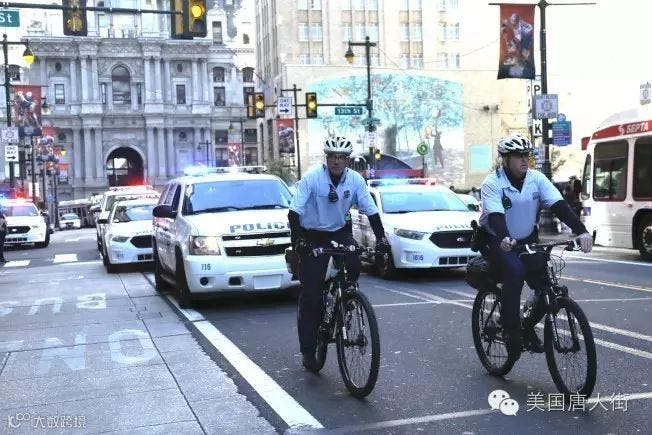
The demonstration, which drew more than 50 individuals from Pennsylvania, New Jersey, New York, and even Florida, was accompanied by a significant police escort. Patrol cars and officers from the Philadelphia Police Department’s Civil Affairs Unit provided front and rear security for the armed marchers. Reports note that long guns were carried unloaded with visible safety flags, while handguns were holstered with magazines loaded but safety mechanisms engaged. Participants wore hats with the club’s logo and displayed gun permits on their chests.
During the march, members carried signs reading “Stop Crime,” “Protect Families,” and “Refuse to be Victims.” The group halted at City Hall, where they publicly read a bilingual statement framing their action as a protest against violent crime affecting Chinese restaurant owners and immigrant communities. Organizers emphasized that their goal was to raise awareness of crime victimization and to assert their constitutional rights under the Second Amendment.
Notably, the event also featured coordination with another Chinese-led rally against violence, held simultaneously at City Hall. Organizers presented this as proof of Chinese community solidarity, despite reported disagreements before the event. The GPCGC leaders stated that all participants had undergone multiple safety checks before being allowed to march armed.
While the group presented the event as a lawful demonstration of self-defense rights, the imagery of Chinese nationals and immigrants marching in a military-like formation through Philadelphia’s streets with firearms has raised concerns among observers. Critics note that the insistence on “multiple reviews of participant documents” and the emphasis on discipline and uniformity resemble the operational methods of Leninist organizations, which prioritize control, hierarchy, and ideological conformity over spontaneous civic action.
Such spectacles — complete with banners, chants, and police escorts — echo staged displays more typical of state-controlled demonstrations abroad rather than civic activism rooted in American traditions of individual liberty. Instead of reflecting grassroots pluralism, the march projected an image of an organized bloc, disciplined and controlled in ways that appear inconsistent with the decentralized spirit of American civil society.
Philadelphia police motorcade escorts the parade along major streets.
Security analysts have warned that organizations like the Great Philadelphia Chinese Gun Club may not be purely grassroots. Their activities, slogans, and methods resemble coordinated political theater, which could be influenced by or aligned with narratives promoted by the Chinese Communist Party. This blending of American constitutional language with militarized posturing risks undermining trust and raises questions about foreign-linked networks cultivating influence inside diaspora communities.
In short, what appeared in local coverage as a “first-ever” Chinese American armed march was not simply a neighborhood protest against crime. It also served as a striking reminder of how diaspora associations, sometimes under the banner of cultural or civic groups, can stage spectacles in ways that blur the line between genuine local advocacy and performances that resonate with foreign authoritarian influence — at odds with U.S. values and national security interests.
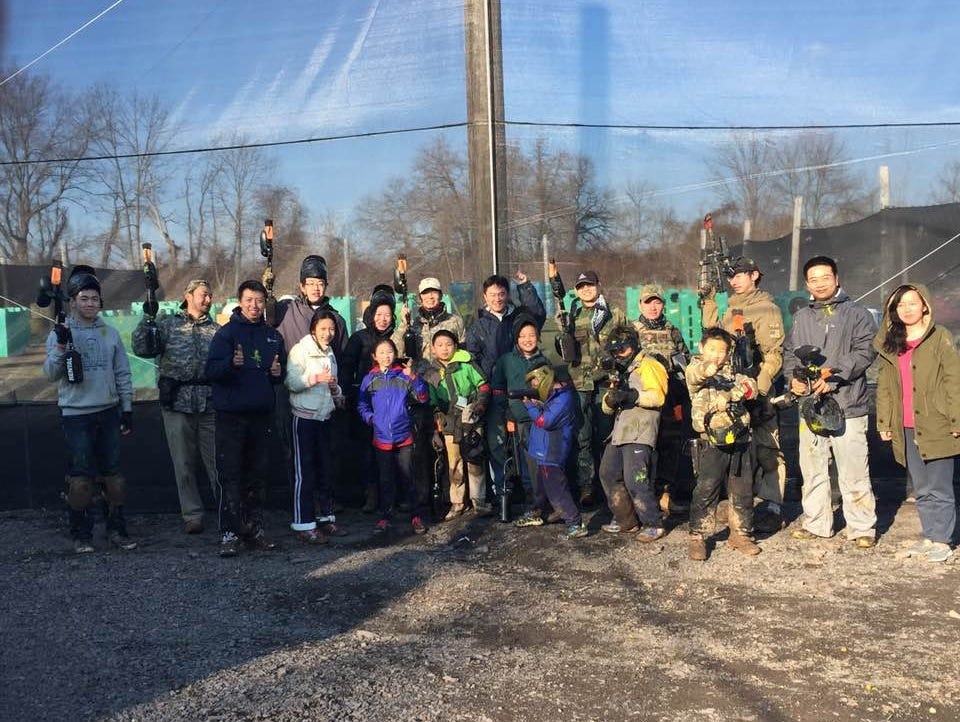
On February 27, 2016, the Great Philadelphia Chinese Gun Club,”大费城华人枪友会”, (GPCGC) staged what it called a “New Year Family Paintball Tournament” at Outdoor Extreme, a paintball range north of Philadelphia. According to the group’s own statement, more than forty participants—mostly Chinese families, including children—joined the mock battles.
Photo from Wenxuecity.com. Here.
Founded in 2013, the GPCGC presents itself as an educational and community organization, focusing on firearm safety, legal knowledge, and home defense. It is formally affiliated with the National Rifle Association (NRA) and claims more than 260 members, including NRA-certified instructors and registered senior members. Beyond paintball tournaments, the club regularly organizes live-fire shooting experiences, lectures on gun laws, and tactical drills. These activities are framed as community-building events but also underscore a deliberate effort to normalize firearms culture within the Chinese diaspora in Philadelphia.
The New Year paintball event, while outwardly promoted as a recreational and family-friendly competition, was described in military terms by the organizers. Participants were divided into two squads and rotated through woodland and urban-style arenas, where they practiced maneuvers ranging from prone firing and ambushes to coordinated assaults. Even children were reportedly involved, guided by parents and older players to mimic tactical techniques. The organizers highlighted the importance of battlefield awareness, team coordination, and “firepower cross-covering,” suggesting the activity was as much about martial discipline as it was about sport.
The club went out of its way to note affordability, stressing that group tickets brought costs down to $25 per person, while also praising the choice of venue for its authenticity. Their report portrays the competition as an intense, five-hour session of simulated combat, complete with mud, natural and artificial cover, and fast-paced close encounters. Organizers insisted the emphasis was on “training first, competition second, fun above all,” though the detailed description of tactics indicates a stronger focus on combat realism than on casual recreation.
Beyond the battlefield, the event also served as a platform to reinforce group identity and cohesion. The club made a point of cleaning the grounds afterward to demonstrate collective discipline, earning compliments from staff. Immediately following the event, leaders began planning their next live-fire range session for April, underscoring a constant cycle of organized gun-related activity.
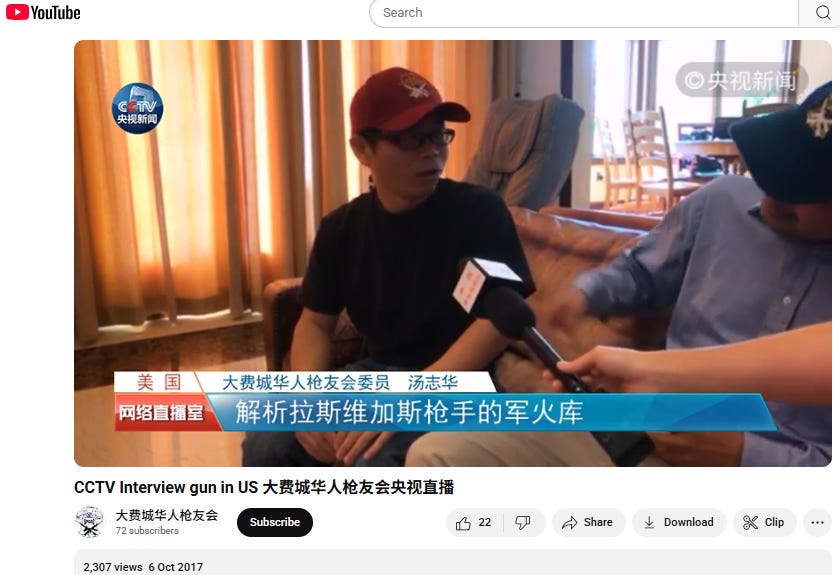
The GPCGC has also actively sought publicity. It maintains a WeChat presence under the account “GPCGC4U” and has been featured in interviews with China’s state-controlled media, including CCTV, with videos later posted to YouTube. This raises questions about the role of Chinese state-linked platforms in promoting and legitimizing U.S.-based gun associations within diaspora communities.
Li Jia (贾莉), the CCTV employee, who interviewed GPCGC in 2017
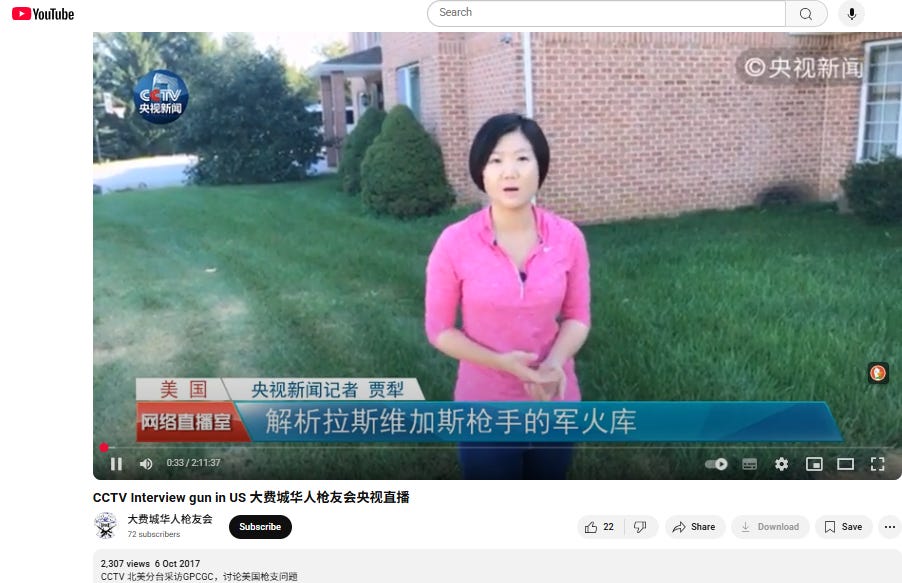
CCTV employee interviewed Zhihua Tang (汤志华), the member of GPCGC, in 2017. Here
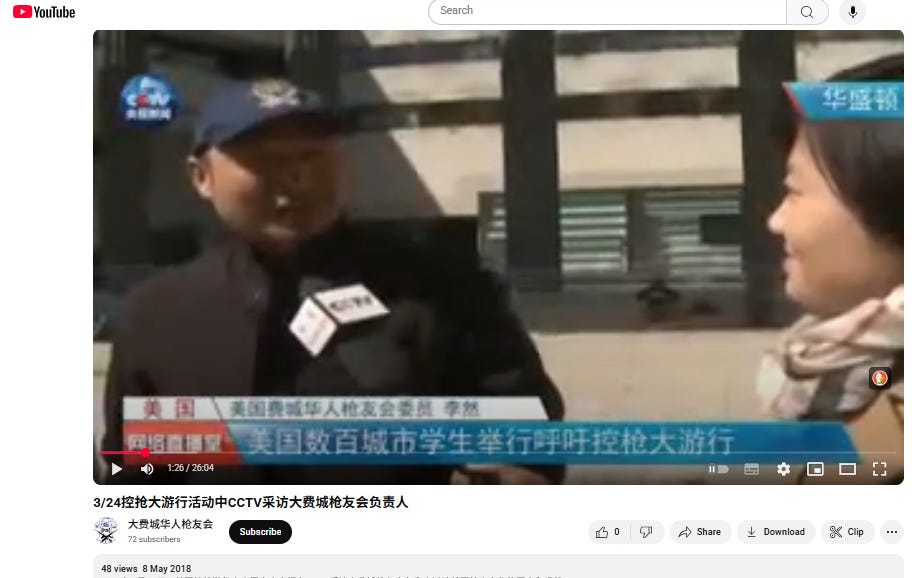
CCTV employee interviewed Ran Li (李然), a committee member of GPCGC, in 2018. here
The blending of family-friendly cultural branding with organized tactical training highlights the club’s role not merely as a hobbyist group but as a well-connected firearms network within the Chinese diaspora in the United States.
In June 2017, the Reading Regional Airport in Pennsylvania hosted one of the largest World War II reenactments in the United States, drawing an audience estimated at 300,000. Among the many groups participating was an unusually large Chinese contingent, organized by the New Jersey Chinese Fishing & Hunting Outdoor Sports Association (新泽西华人渔猎协会) and the Great Philadelphia Chinese Gun Club.
According to their own announcements, these organizations mobilized more than 100 participants, making the Chinese group one of the most visible reenactment units on site. They were joined by supporters from across the United States, including New York, Connecticut, North Carolina, Texas, and even Seattle. What makes this noteworthy is not simply the size of the group, but the roles they chose to portray.
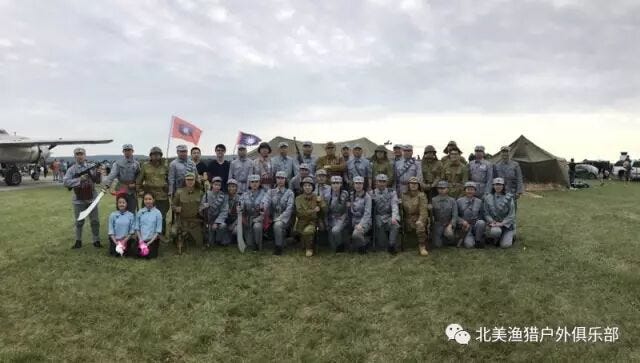
The organizers divided their participants into three units: the National Revolutionary Army’s 29th Army, the National Revolutionary Army’s New Fourth Army (Third Division), and, significantly, the Soviet Red Army’s 88th International Brigade — a formation made up of Chinese Communist fighters under Soviet command. In other words, the event featured Chinese diaspora groups in the U.S. staging performances of Communist-controlled military forces. They not only marched under the banners of these units, but also reenacted episodes drawn from Chinese Communist propaganda narratives, such as New Fourth Army soldiers rescuing American pilots in 1944 and the exploits of the Northeast Anti-Japanese guerrillas aligned with Moscow.
The groups actively promoted their participation through Chinese-language media, including CCTV, and circulated recruitment forms soliciting volunteers’ personal information, including names, addresses, phone numbers, emergency contacts, and even clothing sizes for uniforms. They asked volunteers to donate at least $100 each, describing the event as non-profit but explicitly linking donations to tax benefits. They also boasted about acquiring original weapons, including a rare Maxim heavy machine gun from a museum, to increase the “authenticity” of their battlefield displays.
On-site, these groups reportedly staged “living newspaper” plays with nationalist themes, dispatched squads in uniform to patrol the grounds, and corrected spectators who mistook them for Japanese soldiers — all in an effort to reinforce a particular Chinese wartime narrative. At times, they even filled in for missing Japanese reenactors, casting their own members as enemy troops to dramatize atrocities and surrender scenes.
While presented as cultural and educational outreach, the deliberate choice to highlight Communist-aligned forces, promote them through Chinese state-linked media, and solicit donations under the guise of U.S.-based cultural organizations raises concerns. The blending of entertainment, political symbolism, and fundraising suggests a coordinated effort to normalize narratives aligned with the Chinese Communist Party, while simultaneously embedding them in American public commemorations of World War II.
For U.S. observers, the activities of the New Jersey Chinese Fishing & Hunting Outdoor Sports Association and the Great Philadelphia Chinese Gun Club go beyond hobbyist reenactment. They reveal a willingness to project CCP-influenced historical memory onto American soil, to collect and organize diaspora volunteers under militarized imagery, and to present Communist-controlled forces as central to the Allied victory. These choices are at odds with American values, raise potential national security questions, and underline the need to scrutinize how foreign-linked narratives are being promoted in U.S. civic and cultural spaces.
On November 20, 2021, a shooting incident in Philadelphia, Pennsylvania, drew national attention when a Chinese-American man was confronted by three armed assailants. The man, reportedly a member of the Great Philadelphia Chinese Gun Club (GPCGC), drew his firearm in self-defense, resulting in one suspect dead and another injured. The event sparked widespread discussion in Chinese-American communities. Here.
A GPCGC representative told Red Star News that the individual involved is a club member and, despite disruption to his daily life, “everything is generally fine.” The incident reportedly triggered an increase in firearms purchases among Chinese-Americans.
Beyond Philadelphia, other Chinese-American gun associations, most prominently in Chicago, are also active. The Chinese-American Network of Firearm Owners (CANFO), founded in 2016, has organized community safety events, shooting training, and patrols. During the 2020 racial unrest in Chicago, CANFO established armed volunteer patrols to protect Chinatown businesses, reportedly operating on rotating shifts and coordinating via radio. Members received anonymous donations and support from local businesses for their efforts.
Analysis of CANFO’s social network suggests connections to organizations and individuals with links to Chinese governmental and quasi-governmental entities:
Interaction with Chinese visiting delegations
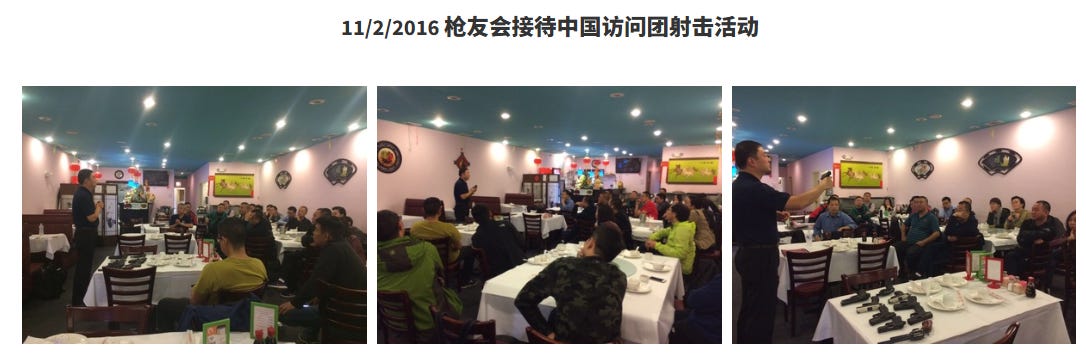
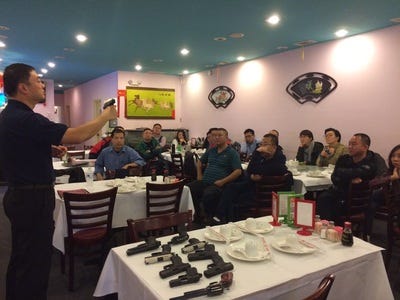
On November 2, 2016, CANFO hosted a shooting activity for a “Chinese visiting delegation.”
This implies that officials or semi-official personnel from mainland China—potentially with government, military, or scientific affiliations—were facilitated in firearms training within the U.S., establishing direct contact with the gun association.
canfire.org:
Participation in Chinese hometown associations
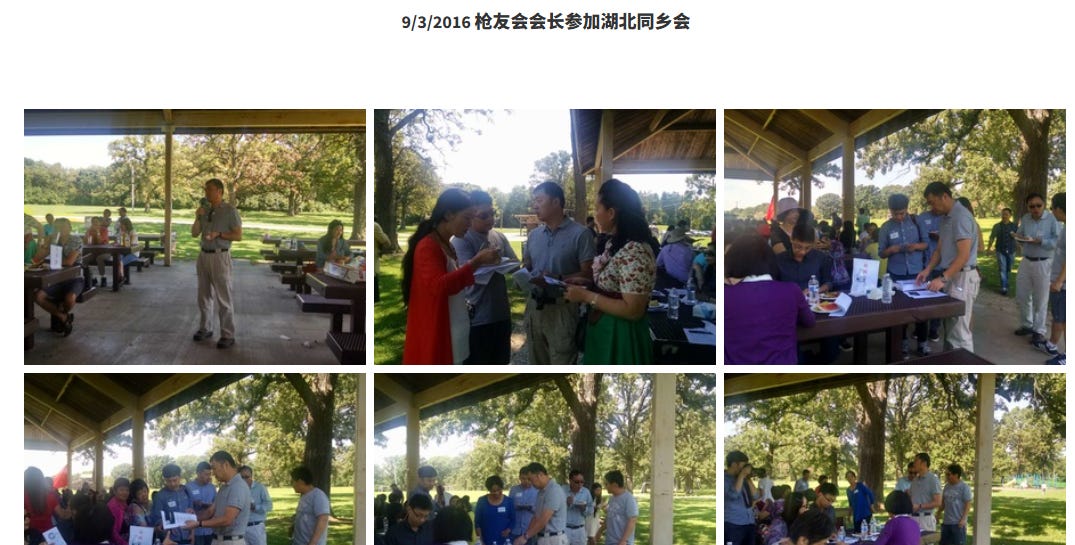
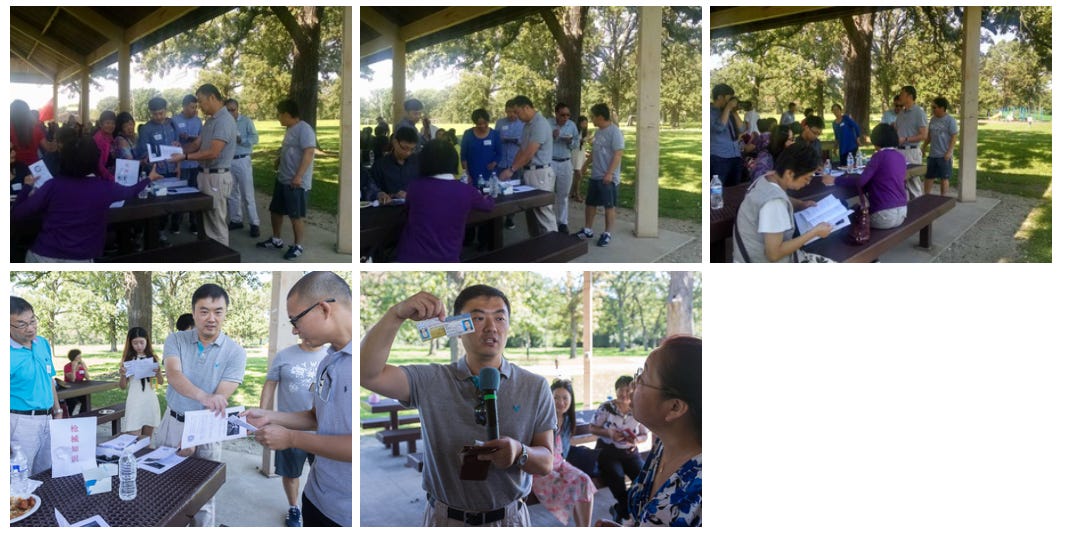
On September 3, 2016, the CANFO president attended a Hubei hometown association event.
These associations often interact closely with Chinese local governments and United Front/overseas Chinese liaison systems. Attendance highlights CANFO leadership’s integration into influential Chinese diaspora networks.
3.Engagement with the Chinese Scientists and Engineers Association (CSEA)
CANFO members appeared at CSEA events, including a picnic (August 13, 2016) and a Spring Festival gala (February 25, 2017).
The CSEA has historically been linked to Chinese talent recruitment and United Front activities, maintaining connections with Chinese academic, scientific, and professional networks. CANFO’s repeated presence at these events demonstrates a stable relationship with CSEA and its broader network.
4.Collaboration with university alumni associations
On May 20, 2017, a CANFO instructor gave a lecture at the Southeast University Chicago Alumni Association.
While alumni events are generally apolitical, they remain part of Chinese diaspora social networks, allowing the gun association to expand its influence among educated and connected Chinese-Americans.
While these associations publicly frame their activities as lawful exercises of Second Amendment rights and self-defense, their militarized structures—armed marches, coordinated patrols, and tightly organized training—combined with documented interactions with Chinese delegations and diaspora networks linked to Chinese governmental influence, raise questions about the potential for paramilitary-style organization and external influence within U.S. communities.