
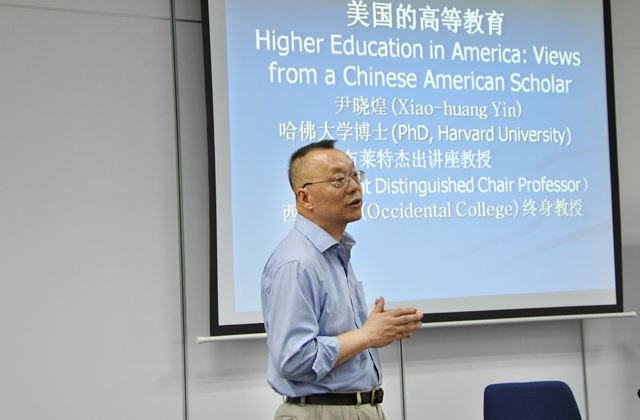
Yin Xiaohuang (a/k/a Xiaohuang Yin), a tenured professor at Occidental College and prominent figure in Chinese-American academic circles, has not only pursued scholarship but also actively participates in CCP-affiliated organizations. On May 28, 2019, he attended the 1st meeting of the Fifth Council of the Chinese Overseas Friendship Association (中华海外联谊会, COFA) and was elected as an executive director and member of its Cultural and Educational Committee.
Direct Ties to CCP Leadership
The meeting took place at Beijing’s Great Hall of the People, where Yin and other delegates were received by Xi Jinping, General Secretary of the CCP and President of the PRC, for a group photo. The event was also attended by Wang Yang, member of the CCP Politburo Standing Committee and Chairman of the Chinese People’s Political Consultative Conference, as well as You Quan, Secretary of the CCP Secretariat and Minister of the United Front Work Department.
The gathering emphasized guiding overseas networks under Xi Jinping Thought, promoting “national reunification” and the “great rejuvenation of the Chinese nation,” clearly reflecting CCP political objectives.
Yin’s Role in CCP-Linked Cultural Outreach
Yin’s election as COFA executive director and Cultural and Educational Committee member positions him to influence overseas cultural and educational initiatives. His dual identity—as a U.S.-based scholar and CCP-aligned organizer—demonstrates a key tactic of the CCP’s united front strategy: leveraging diaspora networks and respected academics to extend influence abroad under the guise of cultural and educational exchange.
Implications
Although presented as academic and cultural work, Yin’s activities are part of a coordinated CCP effort to shape narratives among overseas communities, promote Beijing’s political agenda, and ensure loyalty to the Party’s vision of China’s role globally. U.S. universities and policymakers collaborating with figures like Yin should be aware of these dual roles and potential influence operations.
Conclusion
Introduction
While Washington focuses on TikTok, police stations, and lobbying scandals, a quieter and far more effective channel of CCP influence has been operating inside American academia. One of its most revealing examples is Dr. Xiaohuang Yin, a tenured professor at Occidental College in Los Angeles — and simultaneously a standing council member of the China Overseas Friendship Association, a key national-level United Front Work Department (UFWD) vehicle directly under the CCP.
Yin is not merely an academic who “studies China.” He is a participant in the CCP’s political-ideological system, holding a formal United Front appointment while shaping the intellectual climate of a U.S. liberal arts college and advising how China should “tell its story” to American audiences.
He published a strategic blueprint explaining how Beijing should rebuild, rebrand, and relaunch its influence in the United States. His own words reveal how deeply political this project is — and how aggressively the CCP intends to target American youth, scholarship, and the media environment.
This article exposes the system behind the scholar, the strategy behind the narrative, and why it matters for U.S. national security.
Who Is Xiaohuang Yin?
Xiaohuang Yin (尹晓煌) holds a remarkable dual identity:
In the United States
Tenured Professor of History, Occidental College (Los Angeles)
Long-time authority on Chinese-American studies
Influential voice in campus-level China programming and exchanges
In the People’s Republic of China
Standing Council Member, China Overseas Friendship Association (中华海外联谊会常务理事)
This is a central organization managed by the United Front Work Department (UFWD) — the CCP’s global political influence apparatus.
Changjiang Scholar (长江学者) — a prestigious CCP-directed talent program
Dean of the School of American Studies, Guangdong University of Foreign Studies
Frequently invited by CCP agencies to give policy recommendations on international propaganda, soft power, and “external dissemination of the China narrative.”
In any other context, a foreign political organization directly tied to a ruling party appointing a U.S. professor as one of its senior leaders would raise alarms.
But in this case, it is largely invisible.
What Yin Advocates: A Blueprint for CCP Influence in the U.S.
Yin’s article lays out a comprehensive strategy for reshaping how Americans understand the CCP regime — presented as “cultural exchange,” but functionally indistinguishable from United Front political work.
Below are the major strategic pillars he promotes.
1. Reclaim the Narrative: “Tell Contemporary China to the American People”
Yin argues that:
“The priority of U.S.-China cultural exchange should be to introduce contemporary China to American society.”
But “contemporary China,” in CCP discourse, is a euphemism:
a sanitized political narrative approved by Beijing, not an honest portrayal of life under the CCP.
He positions U.S. media, academia, and public opinion as obstacles to be “better guided,” claiming Americans hold “misunderstandings” that China must correct.
This is narrative warfare, packaged as education.
2. Rebrand the United Front: Use Western Voices to Deliver CCP Messages
The most revealing line in the entire article:
“Use the ‘bottle’ of Western cultural discourse to hold the ‘wine’ of China’s story.”
This is the United Front doctrine in one sentence:
Deliver CCP narratives using non-CCP messengers to increase credibility.
Yin recommends:
using U.S.-based Chinese scholars
recruiting American academics sympathetic to China
deploying “authentic voices” in Western institutions to channel Beijing’s positions
This is not cultural dialogue.
This is covert influence disguised as collaboration.
3. Revive the Mission of Confucius Institutes — Through Disguised Local Entities
After the U.S. shut down most Confucius Institutes due to security concerns, Yin proposes a workaround:
“Confucius Institutes should transform toward privatization, localization, contemporization, and rebranding.”
Translation:
don’t close them — make them less recognizable.
His model:
Operate through local U.S. nonprofits, Chinese-American associations, or school districts
Use U.S.-based academics instead of China-sent instructors
Keep Beijing’s curriculum, but hide Beijing’s fingerprints
This is exactly what congressional investigations have warned about:
Confucius Institutes disappearing in name but reappearing under new local branding.
Yin confirms this strategy from the inside.
4. Target American Youth: Summer Camps, Scholarships, and Immersive Programs
Yin proposes extensive recruitment of U.S. teenagers:
all-expense-paid trips to China
youth exchange camps run by CCP agencies
long-term partnership with American high schools
shaping perceptions “before ideological biases form”
This is political preconditioning, not “cross-cultural friendship.”
The CCP wants to reach American kids before they understand authoritarianism.
5. Replace American Scholarship with CCP-Aligned Teaching Materials
Yin argues that U.S. experts writing about China are a problem — they “misinterpret” China.
His solution?
create CCP-approved English-language textbooks
embed them in U.S. universities
train American teachers using Chinese institutions
promote “China’s view” on Taiwan, Xinjiang, technology policy, and human rights
In other words:
influence what American students learn about China by controlling the curriculum.
This is the academic front of CCP political warfare.
6. Launder Belt and Road Narratives for Western Consumption
Yin presents the Belt and Road Initiative (BRI) as:
benevolent
mutually beneficial
misunderstood by Americans
He omits:
debt traps
strategic port acquisitions
military dual-use logistics
corruption in partner governments
suppression of labor and civic rights in BRI zones
This is propaganda, not scholarship.
Why This Matters
Xiaohuang Yin is not an obscure academic.
He sits at the nexus of:
U.S. higher education
CCP United Front structures
CCP propaganda planning
youth-targeted political outreach
BRI narrative laundering
post–Confucius Institute influence redesign
He helps design Beijing’s foreign messaging strategies while teaching at a U.S. college.
This raises serious questions:
How does a U.S. professor simultaneously serve in a political role inside the CCP?
How much access does he have to American students, school districts, and exchange programs?
Are U.S. universities unknowingly enabling foreign political warfare?
Why is United Front affiliation not disclosed on campus or to the public?
How many similar individuals operate in U.S. academia?
The truth is simple:
United Front influence does not require spies, bribes, or covert operations.
It requires scholars like Yin, embedded in American institutions and executing Beijing’s narrative strategy from within.
Conclusion: Academia Cannot Be a Blind Spot
Beijing’s influence in the U.S. is most effective where Americans least expect it:
in classrooms, exchange programs, nonprofit boards, and “cultural dialogue.”
Xiaohuang Yin’s dual roles — tenured American professor and United Front official — represent a systemic vulnerability. He is not acting alone. He is one node in a global network of academics whose prestige gives CCP narratives legitimacy they would never earn on their own.
American universities must confront a hard truth:
When Beijing says it wants to “tell China’s story well,” it means telling the CCP’s story — through American voices, inside American institutions, to shape American minds.
We cannot afford to ignore this any longer.
The Chinese Communist Party (CCP) repeatedly promotes a political slogan: “telling China’s story well” (讲好中国故事). For outsiders, this sounds harmless—maybe even cultural or educational. But inside CCP discourse, it is a strategic communication doctrine for expanding political influence, manipulating foreign audiences, and neutralizing international criticism of the CCP regime.
Below is a translation-and-exposure of one such article published by a CCP-affiliated outlet (“China Social Sciences Network”), which was also written by Xiaohuang Yin. The text is not simply commentary—it functions as a soft-power operations manual for overseas propaganda and United Front work.
This version highlights what the article really instructs CCP-linked actors to do.
1. Target segmentation: tailor propaganda to specific populations
The original article stresses that propaganda must be audience-specific.
Developing nations (Africa, Middle East, Belt and Road countries) are considered “emotionally aligned” with China due to shared histories of colonialism. The CCP sees them as receptive to “China’s modernization narrative.”
Western nations, especially the U.S., are recognized as “hostile environments.” The article warns that Americans—particularly in the Midwest and the South—know little about China and therefore must be “introduced” to stories that avoid triggering suspicion or being labeled as propaganda.
Decoded:
The CCP views developing nations as low-resistance zones for influence operations, and Western societies as high-resistance targets needing more sophisticated messaging.
2. Content strategy: avoid sensitive truths, emphasize selective themes
The document outlines what kinds of “stories” should be told:
For developing countries
Stress CCP-led poverty reduction
Frame China’s development model as an alternative to the West
Emphasize shared “struggle narratives”
This is classic CCP “South-South sympathy” framing.
For Western countries
Avoid topics that highlight ideological differences
Avoid anything that “sounds too Chinese”
Do not debate—because “Western audiences are biased”
Choose topics already popular in the West (women’s rights, environment, wildlife protection, nature documentaries, etc.)
Use Western narrative techniques (self-deprecation, humor)
Decoded:
This is cultural camouflage: hide the CCP, package Chinese political messaging in universal themes, and use Western storytelling forms to smuggle propaganda across psychological defenses.
3. Propaganda examples the CCP considers “successful”
The article praises certain works for penetrating Western society:
The Good Earth (Pearl S. Buck)
Fa Mulan / Mulan (various Western adaptations)
Chen Kaige’s “The Story of Qiu Ju”
Nature documentaries showing China’s wildlife conservation efforts
The key reasons?
They fit Western expectations and “generate emotional resonance,” making them useful vehicles for CCP-approved narratives.
Decoded:
These are not cultural successes—they are propaganda success cases in the CCP’s eyes.
4. Language manipulation and framing control
Even translation is politicized.
The article complains that translating “抗日战争” as “Anti-Japanese War” leads Westerners to ask the wrong question.
Their solution?
Translate it as “Anti-Japanese Aggression War” to control interpretation.
Decoded:
This exposes a fundamental principle:
The CCP treats language itself as a battlefield.
Every term must be engineered to guide foreign thought.
5. Storytelling as psychological operations
The article promotes using:
cooking classes
calligraphy
martial arts
photography
short videos
even feng shui and divination
as “stories” that build a positive emotional base for China.
Decoded:
This is not cultural exchange.
It is “affinity-building”—the first stage of influence operations:
create positive sentiment → lower critical awareness → introduce political narratives later.
6. Who should tell the story: the CCP wants foreign proxies
The article promotes three categories of storytellers:
CCP-approved Chinese nationals (“our own people tell our story”)
Foreigners who support or sympathize with China (“外嘴外心”—foreign mouthpieces)
Overseas Chinese communities (diaspora as amplifiers)
The article praises historical examples such as:
Edgar Snow
Harrison Salisbury
William Hinton
All of whom helped frame CCP narratives to Western audiences.
Decoded:
The CCP openly seeks:
foreign validators
narrative laundering through friendly journalists
political mobilization of the Chinese diaspora
This is classic United Front Work Department (UFWD) doctrine:
co-opt non-CCP voices to give propaganda “local legitimacy.”
7. The strategic goal: build global narrative dominance
The final paragraph states the CCP’s ambition clearly:
“China and the world are inseparable… telling China’s story well builds China’s international discourse power.”
Decoded:
This is not cultural outreach.
This is a struggle for global narrative control, with the CCP seeking ideological insulation and international legitimacy for authoritarian rule.
Conclusion: This is not cultural promotion — it is political warfare
The article functions as a CCP operational guide for:
shaping foreign public opinion
laundering political propaganda through culture
manipulating diaspora communities
recruiting foreign amplifiers
bypassing Western skepticism through emotional storytelling
and ultimately building what the CCP calls global discourse power—the ability to dominate how China is talked about internationally.
Western governments, media, and civil society need to recognize this as what it is:
A coordinated political influence strategy, not harmless cultural exchange.
