17 June 2026

Who Were the PLA Officers Serving in Hubei's Congress When COVID-19 Emerged?


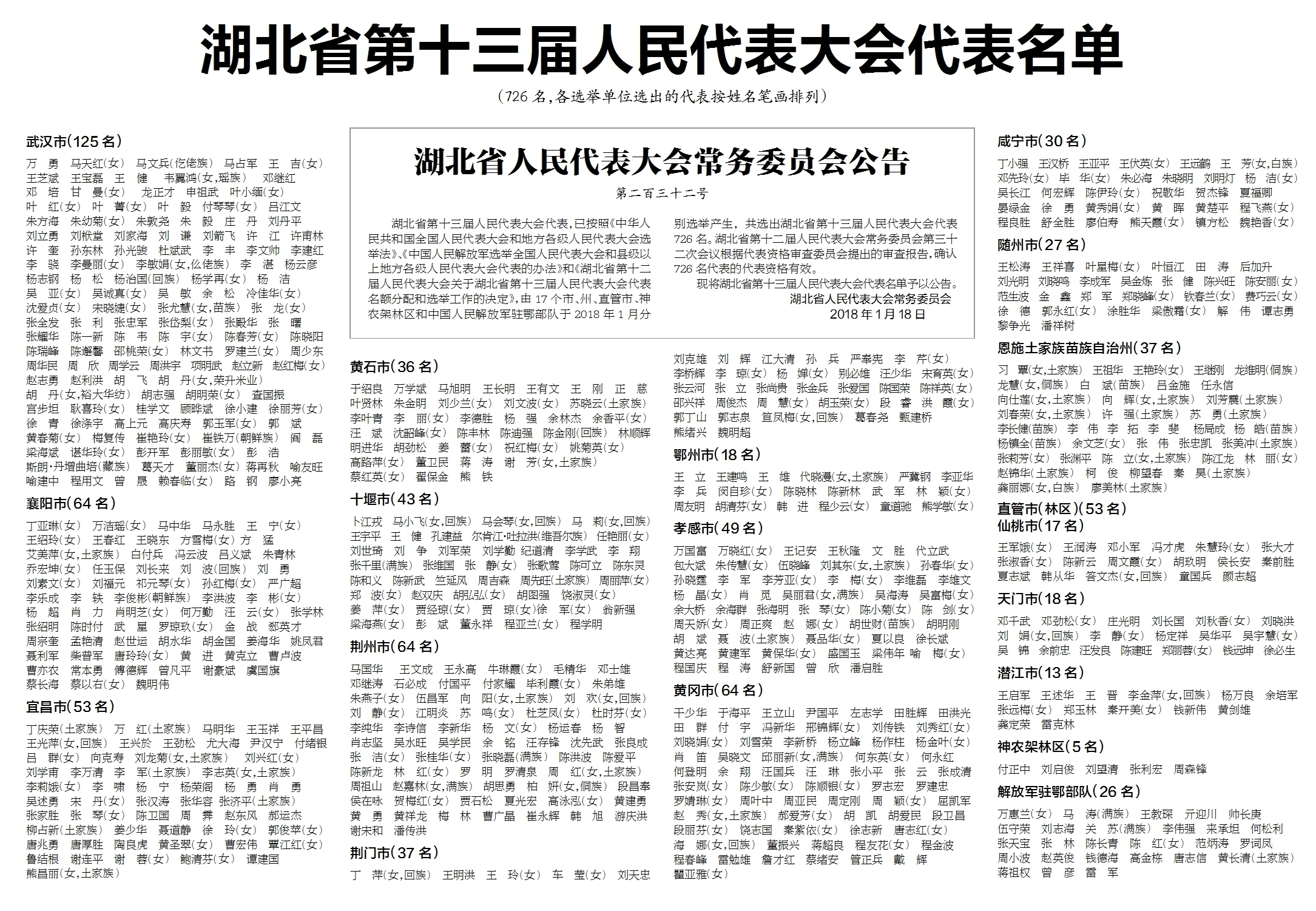
As COVID-19 began spreading in Hubei, the Hubei Provincial People's Congress included a substantial delegation of serving PLA officers. Publicly available records identify representatives from the Hubei Provincial Military District, the Wuhan Garrison, the Air Force, the Rocket Force, the Joint Logistic Support Force, military academies, and military sub-districts across the province.

This article examines who these military representatives were, what positions they held, and how they participated in Hubei's political system during the period when the outbreak first emerged. By connecting official congress announcements, military reports, personnel records, and government documents, the article shows that active-duty PLA officers were not merely observers but participants in the province's legislative structure.

The findings offer a detailed snapshot of the military presence inside Hubei's provincial legislature at a pivotal moment in history and shed light on the broader relationship between military authority and political institutions in the People's Republic of China.


2018年开始的湖北省第十三届人大代表一共726名,其中中国人民解放军成员至少26名。
Beginning in 2018, the Thirteenth People’s Congress of Hubei Province(Hubei PPC) comprised a total of 726 deputies, among whom no fewer than 26 were members of the People’s Liberation Army(PLA) of Communist China.


湖北省人大代表中的PLA成员 PLA members in the Hubei PPC:


中文姓名Name1.万惠兰():中国人民解放军火箭指挥学院战略研究中心副主任,获得过军队科技进步奖,立过三等军功,2019年9月20日已经升为中国人民解放军火箭军指挥学院军事战略理论教研室主任


Wan Huilan (female) Deputy Director of the Strategic Research Center at the PLA Rocket Force Command College, recipient of the PLA Science and Technology Progress Award, and awarded a Third-Class Merit Citation.By September 20, 2019, she had been promoted to Director of the Military Strategy Theory Teaching and Research Office at the PLA Rocket Force Command College.


2.马 涛(满族):中国人民解放军湖北省军区司令员,曾在湖北省两会上表示,“湖北军民融合充满生机活力,随着力度持续加大,必将对地方经济社会发展和国防建设带来巨大推动作用。”


Ma Tao (Manchu):Commander of the Hubei Provincial Military District, as a deputy to the Hubei Provincial People's Congress. In comments made during the Hubei provincial legislative session, Ma publicly endorsed China's Military-Civil Fusion strategy, describing Hubei's military-civil fusion programs as a major driver of both economic development and national defense modernization.


3.王教琛:2020年8月12日,疫情期间,武汉洪山区法院院长、CCP党组书记闫小龙走访中国人民解放军代表团的湖北省人大代表王教琛,就部队改革、疫情防控工作等作交流,并征求王教琛代表对法院工作的意见和建议。根据中共国最高法院《关于全面加强接受监督工作的若干意见》(法发〔2011〕14号)要求中共国PRC的法院积极开展与人大代表、政协委员联络工作,认真办理人大代表建议、政协提案以及人大代表、政协委员关注事项,目的是为中国共产党和中共政权的工作大局提供有力司法保障,并要求各级法院强化大局意识,密切配合,要将接受人大代表、政协委员监督的工作纳入绩效考核,提供必要的经费和装备,切实调动工作主动性和积极性,对于因工作失职造成不良影响和其他不良后果的,要给予问责。中共国最高法院法发〔2011〕14号所述政协委员通常包括中国人民解放军少将曹雪涛、中国人民解放军少将陈薇、中共中央政治局常委、全国政协主席王沪宁、中科院武汉病毒研究所所长王延轶、习近平妻子彭丽媛、中科院武毒所所长王延轶的丈夫舒红兵这类政协委员。

Wang Jiaochen: On August 12, 2020, during the COVID-19 pandemic, Yan Xiaolong, President of the Hongshan District People’s Court in Wuhan and CCP Party Secretary, visited Wang Jiachen, a Hubei Provincial People’s Congress deputy from the PLA delegation, to discuss issues including military reform and COVID-19 prevention and control, and to solicit Wang Jiachen’s views and suggestions on the court’s work. According to the Supreme People’s Court of the CCP regime, in its “Several Opinions on Comprehensively Strengthening Work on Accepting Supervision” (Fa Fa [2011] No. 14), courts across the PRC are required to actively carry out liaison work with People’s Congress deputies and CPPCC members, diligently handle proposals submitted by People’s Congress deputies, motions submitted by CPPCC members, and matters that concern them, with the aim of providing strong judicial guarantees for the overall work of the CCP and the CCP regime. The document also requires courts at all levels to strengthen their sense of the larger political and strategic picture, coordinate closely, and include the work of accepting supervision from People’s Congress deputies and CPPCC members in performance evaluations, while providing the necessary funding and equipment to effectively mobilize initiative and enthusiasm. Any negligence in duty that causes adverse impact or other negative consequences must be subject to accountability. CPPCC members referred to in Supreme People’s Court document Fa Fa [2011] No. 14 typically include figures such as PLA Major General Cao Xuetao, PLA Major General Chen Wei, Wang Huning, a Standing Committee member of the CCP Politburo and Chairman of the National Committee of the CPPCC, Wang Yanyi, Director of the Wuhan Institute of Virology of the Chinese Academy of Sciences, Peng Liyuan, Xi Jinping’s wife, and Shu Hongbing, the husband of Wang Yanyi, Director of the Wuhan Institute of Virology of the Chinese Academy of Sciences.


4.亓迎川:1965年出生,男,在中国人民解放军空军预警学院担任教授、硕士研究生导师,主要研究方向为无人机控制技术及运用,获得过PLA军队科技进步二等奖2项、三等奖6项,2023年发表论文《基于态势演化博弈的无人机集群动态攻防》。

Qi Yingchuan: born in 1965, male, is a professor and master’s supervisor at the Air Force Early Warning Academy of the People’s Liberation Army of China. His main research area is unmanned aerial vehicle (UAV) control technology and applications. He has received two Second-Class and six Third-Class PLA Military Science and Technology Progress Awards. In 2023, he published a paper titled “Dynamic Offense and Defense of UAV Swarm Based on Situation Evolution Game.”


5.帅长庚:中国人民解放军海军工程大学舰船设备振动与噪声研究所副所长、教授、博士生导师,中国人民解放军的轮机工程舰船动力装置振动与噪声控制领域专家、“军队高层次科技创新学科拔尖人才培养对象”、海军“优秀青年”、“全军学习成才先进个人”,2024年发表了论文“Reconstruction of physical field characteristics of underwater vehicle wake based on data-driven approach”。

Shuai Changgen: Deputy Director of the Institute of Ship Equipment Vibration and Noise, Professor, and Doctoral Supervisor at the Naval University of Engineering of the PLA, a PLA expert in vibration and noise control for marine propulsion systems and naval engineering machinery, a “Top-Level Military Scientific and Technological Innovation Talent Training Candidate,” a “Navy Outstanding Young Talent,” and an “Advanced Individual in Learning and Professional Development Across the Armed Forces.” In 2024, he published a paper titled “Reconstruction of Physical Field Characteristics of Underwater Vehicle Wake Based on a Data-Driven Approach.”


6.伍守荣:根据2018年10月发布的湖北省人大常委会公告(第二百四十三号),离任前,湖北省人大代表中的枪杆子代表伍守荣是中国人民解放军随州军分区司令员。

Wu Shourong:According to Announcement No. 243 issued by the Standing Committee of the Hubei Provincial People's Congress in October 2018, prior to leaving office, another military representative in the Hubei Provincial People's Congress delegation, Wu Shourong, served as Commander of the Suizhou Military Sub-District of the People's Liberation Army of China.
7.刘志海:根据湖北省人大常委会2020年9月24日公告,刘志海辞去湖北省人大代表职务由中国人民解放军湖北省军区选举委员会决定接受。

Liu Zhihai: According to the September 24, 2020 announcement issued by the Standing Committee of the Hubei Provincial People's Congress, Liu Zhihai’s resignation from his post as a deputy to the Hubei Provincial People's Congress was accepted by the Election Committee of the Hubei Provincial Military District of the People's Liberation Army of China.
8.关 苏(满族):根据2018年10月发布的湖北省人大常委会公告(第二百四十三号),离任前,湖北省人大代表中的枪杆子代表关苏是中国人民解放军湖北省军区办公室主任,兼湖北省人大常委会委员、代表资格审查委员会副主任。 Guan Su (Manchu):According to Announcement No. 243 issued by the Standing Committee of the Hubei Provincial People's Congress in October 2018, prior to leaving office, Guan Su, a military representative in the Hubei Provincial People's Congress delegation, served as Director of the Office of the Hubei Provincial Military District of the People's Liberation Army of China. He also concurrently served as a member of the Standing Committee of the Hubei Provincial People's Congress and as Deputy Director of its Credentials Committee.
9.李伟强:中国人民解放军空降兵军副政治委员


Li Weiqiang: Deputy Political Commissar of the People's Liberation Army Airborne Corps


10.来承坦:1967年3月出生,是中共咸宁市委常委、PLA咸宁军分区司令员,2017年8月31日开始任代表PLA的咸宁市人大代表

Lai Chengtan: born in March 1967. He served as a member of the Standing Committee of the CCP Xianning Municipal Committee and Commander of the Xianning Military Sub-District of the People's Liberation Army of China. On August 31, 2017, he began serving as a PLA representative in the Xianning Municipal People's Congress.
11.何松利: 中国人民解放军武汉警备区司令员,同时是湖北省人大代表武汉市人大代表,2021年停止。也是武汉市第十四届人大第五次会议主席团成员。

He Songli: Commander of the Wuhan Garrison of the People's Liberation Army, and also a deputy to both the Hubei Provincial People's Congress and the Wuhan Municipal People's Congress, till 2021. also a member of of the Presidium of the Fifth Session of the 14th Wuhan Municipal People's Congress


Zhang Tianbao: Deputy Political Commissar of the PLA Air Force Wuhan Base, was announced by Hubei Provincial People's Congress Standing Committee Announcement No. 266 in November 2020 as ceasing as a deputy to the Hubei Provincial People's Congress, was promoted to the rank of Major General at the PLA National Defense University on December 16, 2020, and by November 2025 had become Deputy Political Commissar of the PLA Academy of Military Sciences.
12.张天宝:中国人民解放军空军武汉基地副政治委员,被2020年11月湖北省人大常委会公告第266号公告其已离任,2020年12月16日在PLA国防大学升为少将,2025年11月已经是中国人民解放军军事科学院副政治委员。


13.张 林:中国人民解放军联勤保障部队副参谋长,至2019年前后已出现在联勤保障部队参谋长岗位的报道中,并在2020年前后仍以该职务参与相关军队活动与会议。随后,他转入军委机关体系任职,并在2021年前后出任中央军委机关事务管理总局相关领导岗位,后进入中央军委后勤保障体系任职。2022年公开资料显示,其担任中央军委后勤保障部领导职务并晋升中将,并进入中共二十届中央委员会。2025年,全国人大常委会公告显示其全国人大代表资格被罢免,理由为“涉嫌严重违纪违法”。


Zhang Lin: Deputy Chief of Staff of the PLA Joint Logistic Support Force, and by around 2019 he was already referred to as Chief of Staff in official military media coverage, a position he continued to hold into at least 2020 in public appearances and reports. He was later reassigned to Central Military Commission (CMC) organ affairs work around 2021 and subsequently took a leadership role in the CMC Logistic Support Department. By 2022, publicly available information indicates he held a senior position in the CMC Logistic Support Department, was promoted to lieutenant general, and became a member of the 20th CCP Central Committee. In 2025, an NPC Standing Committee announcement stated that his status as a deputy to the NPC was revoked on grounds of alleged serious disciplinary and legal violations.


14.陈长青:中国人民解放军鄂州市华容区武装部部长。 Chen Changqing:Minister of the Armed Forces Department of Huarong District, Ezhou City under the PLA


15.陈 红(女):中国人民解放军(PLA)上校、海军工程大学电子工程学院学员二大队政委 Chen Hong (female):PLA Colonel and Political Commissar of the 2nd Cadet Brigade of the College of Electronic Engineering at the Naval University of Engineering.
16.范炳涛:中国人民解放军湖北陆军预备役高射炮兵师政治委员兼中国人民解放军湖北省军区政治部副主任。 Fan Bingtao:Political Commissar of the PLA Hubei Army Reserve Anti-Aircraft Artillery Division and concurrently as Deputy Director of the Political Department of the Hubei Provincial Military District.


17.罗词凤:中国人民解放军中部战区陆军舟桥旅政委


Luo Cifeng: Political Commissar of the PLA Central Theater Command Army Pontoon Bridge Brigade


18.周小波:提出辞去湖北省人大代表职务的请求,由中国人民解放军湖北省军区选举委员会接受。 Zhou Xiaobo: a military representative in the Hubei Provincial People's Congress delegation, submitted a request to resign from his position as a deputy to the Hubei Provincial People's Congress. His resignation was accepted by the Election Committee of the Hubei Provincial Military District of the People's Liberation Army of China.


19.赵英俊:中国人民解放军一个空降兵旅的政治工作部主任 Zhao Yingjun: Director of the Political Work Department of a PLA Airborne Brigade
20.钱德海:直到2020年9月24日湖北省人大常委会公告离任,中国人民解放军襄阳军分区司令员、中共襄阳市委常委、湖北省人大代表。

Qian Dehai:Until his departure from office as announced by the Standing Committee of the Hubei Provincial People's Congress on September 24, 2020, Qian Dehai served as Commander of the Xiangyang Military Sub-District of the People's Liberation Army of China, a member of the Standing Committee of the CCP Xiangyang Municipal Committee, and a deputy to the Hubei Provincial People's Congress.
21.高金栋:曾任中国人民解放军荆州军分区司令员,2018年12月18日已任中国人民解放军湖北省军区办公室主任。 Gao Jindong: former Commander of the Jingzhou Military Sub-District of the People’s Liberation Army of China, Director of the Office of the PLA Hubei Provincial Military District as of December 18, 2018.


22.唐志信:PLA恩施军分区政治委员,2021年1月23日湖北省人大常委会公告第289号已经离任。 Tang Zhixin: Political Commissar of the PLA Enshi Military Sub-District; according to Announcement No. 289 issued by the Standing Committee of the Hubei Provincial People’s Congress on January 23, 2021, he had left office by that date.


23.黄长清(土家族):中国人民解放军宜昌军分区司令员 Huang Changqing (Tujia ethnicity):Commander of PLA Yichang Military Sub-District.


24.蒋祖权:中国人民解放军大校,2019年11月湖北省人大常委会公告蒋祖权辞去湖北省人大代表职务,作为PLA武汉警备区副司令员2020年9月8日在PRC全国抗击新冠肺炎疫情表彰大会现场接受表彰,聆听习近平讲话,2020年10月已经担任PLA襄阳军分区司令员,2023年开始作为“特别邀请人士”担任担任湖北省政协委员


 Jiang Zuquan:A senior colonel in the Chinese People's Liberation Army, resigned from his position as a representative to the Hubei Provincial People's Congress in November 2019, then as the deputy commander of the Wuhan Garrison of the PLA commended at the National Commendation Conference for Fighting the COVID-19 Epidemic in the PRC on September 8, 2020, in October 2020 became the commander of the Xiangyang Military Sub-district of the PLA, Starting in 2023, as a member of the Hubei Provincial Committee of the Chinese People's Political Consultative Conference as a "specially invited person".


25.曾 彦:直到2020年9月24日湖北省人大常委会公告离任,曾彦是中共十堰市委常委、湖北省人大代表、中国人民解放军十堰军分区司令员

Zeng Yan:Until his departure from office as announced by the Standing Committee of the Hubei Provincial People's Congress on September 24, 2020, Zeng Yan served as a member of the Standing Committee of the CCP Shiyan Municipal Committee, Commander of the Shiyan Military Sub-District of the People's Liberation Army of China, and a deputy to the Hubei Provincial People's Congress.
26.雷 军:中国人民解放军大校、黄冈军分区政治委员、中共黄冈市委常委,2018年6月13日感谢中共黄冈师范学院党委加大政策、资金投入支持国防与军队建设,肯定其圆满完成大学生征兵工作任务,希望黄冈师范学院完成好2018年征兵工作任务。

Lei Jun:PLA Senior Colonel, Political Commissar of the Huanggang Military Sub-District, and a member of the Standing Committee of the CCP Huanggang Municipal Committee; on June 13, 2018, he expressed appreciation to the CCP Committee of Huanggang Normal University for increasing policy and financial support for national defense and military development, commended the university for successfully completing its student military recruitment tasks, and expressed hope that it would successfully fulfill its 2018 recruitment objectives.

27.刘红兵(2020年11月开始任湖北省人大代表):PLA大校、湖北省孝感军分区政委、中共孝感市委常委。Liu Hongbing: PLA Senior Colonel, Political Commissar of the PLA Xiaogan Military Sub-District, and a member of the Standing Committee of the CCP Xiaogan Municipal Committee, a deputy to the 13th Hubei Provincial People’s Congress from November 2020.


28.陈军:中国人民解放军黄石军分区副司令员,2020年开始担任湖北省人大代表。Chen Jun: Deputy Commander of PLA Huangshi Military Sub-District; he has served as a deputy to the Hubei Provincial People’s Congress since 2020.


29.张红军:PLA湖北省军区副司令员,2020年1月16日开始担任湖北省人大常委会委员,2020年11月湖北省人大常委会公告第266号确认其是湖北省人大代表,2021年1月23日湖北省人大常委会公告第289号不再是湖北省人大代表。 Zhang Hongjun: Deputy Commander of the PLA Hubei Provincial Military District; as a member of the Standing Committee of the Hubei Provincial People’s Congress on January 16, 2020, and his status as a provincial deputy was later reflected in Hubei Provincial People’s Congress Standing Committee Announcement No. 266 in November 2020 and remained in effect until the issuance of Announcement No. 289 on January 23, 2021.


30.龚鸿斌:PLA恩施军分区司令员、中共恩施州委常委,2023年5月29日已经离开恩施军分区,去担任PLA湖北省军区警备办公室主任,2021年已经开始担任湖北省人大代表。Gong Hongbin: Commander of the PLA Enshi Military Sub-District and a member of the Standing Committee of the CCP Enshi Prefectural Committee; he began serving as a deputy to the Hubei Provincial People’s Congress in 2021, and by May 29, 2023, had left the Enshi Military Sub-District to become Director of the Garrison Office of the PLA Hubei Provincial Military District.


31.琚万勇:PLA随州军分区司令员、中共随州市委常委,2021年已经开始担任湖北省人大代表。Ju Wanyong: Commander of the PLA Suizhou Military Sub-District and a member of the Standing Committee of the CCP Suizhou Municipal Committee, serving as a deputy to the Hubei Provincial People’s Congress in 2021.


32.孟吉东:PLA 空军95028部队副政委,被2021年1月23日湖北省人大常委会公告第289号确认为湖北省人大代表,直到湖北省人大常委会2024年1月28日第341号公告确认离开湖北,被2026年1月山西省人大常委会公告在PLA空军93601部队。Meng Jidong: Deputy Political Commissar of PLA Air Force Unit 95028; he was confirmed as a deputy to the Hubei Provincial People’s Congress by Hubei Provincial People’s Congress Standing Committee Announcement No. 289 on January 23, 2021, remained a provincial deputy until Announcement No. 341 on January 28, 2024 confirmed that he had left Hubei, and was later identified in a January 2026 announcement of the Shanxi Provincial People’s Congress Standing Committee as serving in PLA Air Force Unit 93601.


33.吕吉云:PLA湖北省军区副司令员,以前是中国人民解放军总后勤部卫生部副部长、PLA 302医院院长、PLA联勤保障部队PLA总医院副院长,2021年开始担任湖北省人大代表。Lü Jiyun: Deputy Commander of the PLA Hubei Provincial Military District who began serving as a deputy to the Hubei Provincial People’s Congress in 2021; previously served as Deputy Director of the Health Department of the PLA General Logistics Department, President of PLA Hospital 302, and Deputy President of the PLA General Hospital under the PLA Joint Logistic Support Force.


34.吴海权:中国人民解放军海军大校、十堰军分区司令员,2021到2025年之间担任湖北省人大代表,2025年1月以后在PLA东部战区浙江衢州军分区担任司令员。Wu Haiquan: PLA Navy Senior Colonel and Commander of the Shiyan Military Sub-District; he served as a deputy to the Hubei Provincial People’s Congress between 2021 and 2025, and after January 2025 was serving as Commander of the Quzhou Military Sub-District in Zhejiang under the PLA Eastern Theater Command.


35.李星河: 中国人民解放军联勤保障部队参谋长,2021年开始任湖北省人大代表Li Xinghe: Chief of Staff of the PLA Joint Logistic Support Force; he began serving as a deputy to the Hubei Provincial People’s Congress in 2021.
36.曾丛华:中国人民解放军舟桥旅旅长,2021年开始任湖北省人大代表。Zeng Conghua: Commander of a PLA Pontoon Bridge Brigade; he began serving as a deputy to the Hubei Provincial People’s Congress in 2021.
#Democracy #Christ #Peace #Freedom #Liberty #Humanrights #人权 #法治 #宪政 #独立审计 #司法独立 #独立自治

Inside the Garrison State: How a PLA NPC Delegate is Weaponising "Joint Mechanisms" to Subvert Civilian Governance in Hubei


Introduction: The Illusion of Separation

Western analysts frequently misinterpret the Chinese National People's Congress (NPC) and the Chinese People's Political Consultative Conference (CPPCC) as mere rubber-stamp civilian legislatures or ceremonial advisory bodies. However, looking deeper into the provincial level via Open-Source Intelligence (OSINT) reveals a more calculated reality: the systemic, lattice-like infiltration of the People’s Liberation Army (PLA) into local civilian administration via institutional identity laundering.

A granular investigation into the career trajectory of  Gong Hongbin(龚鸿斌)—a PLA officer straddling both legislative and consultative bodies—and a recent policy overhaul in Hubei Province provides a definitive case study in how the CCP quiet-launches a "Garrison State" model through deliberate political deception.

Institutional Identity Laundering: The "Specially Invited" Commander

To understand the mechanics of this military creep, one must trace the meticulously engineered dual-identity of Gong Hongbin.

  • January 2021: According to Announcement No. 289 of the Standing Committee of the Hubei Provincial People's Congress, Gong was "elected" as a delegate to the 13th Hubei Provincial NPC via a closed-door military congress (驻鄂部队军人大会). At the time, he held the dual roles of Commander of the PLA Enshi Military Sub-district and Member of the Standing Committee of the CCP Enshi Prefectural Committee.

  • January 2023: In a striking maneuver of political masquerade, Gong was appointed as a member of the Hubei Provincial Committee of the CPPCC. Crucially, his assigned sector (界别) was neither the "Chinese Communist Party" nor the "Military/Armed Police" sector. Instead, he was slipped into the list under the guise of "Specially Invited Persons" (特别邀请人士)—a category traditionally reserved for overseas diaspora leaders, Hong Kong/Macau tycoons, and civilian figures meant to project an illusion of pluralism.

  • May 2023: Shortly after securing these legislative and consultative anchors, Gong vacated his regional command in Enshi to assume a crucial post at the provincial core: Director of the Garrison Office of the PLA Hubei Provincial Military District (湖北省军区警备办公室主任).

              [ Gong Hongbin's Laundering Matrix ]
                               │
         ┌─────────────────────┼─────────────────────┐
         ▼                     ▼                     ▼
 [Military Power]     [Legislative Anchor]   [Consultative Cloak]
  PLA Hubei Garrison   Hubei Provincial NPC   Hubei CPPCC Member
    Office Director         Delegate          as "Specially Invited
                                                    Person"

This structural deception shatters the foundational narrative of the CPPCC. It proves that the entire "political consultation" system is a apparatus of elite misdirection. By hiding an active-duty military commander inside a pseudo-civilian sector, the CCP successfully launders a hard-line asset of the state's "gun barrel" into civilian policy networks without triggering domestic or international alarm.

The 10 Joint Mechanisms: An Anatomy of Totalitarian Creep

The true impact of Gong Hongbin’s laundered appointment became manifest on 29 November 2023, when state-run media Hubei Daily lauded a comprehensive policy overhaul spearheaded by Gong’s Garrison Office: The "Ten Joint Mechanisms" for Military-Civilian Collaboration (湖北军地警备工作军地协作机制).

While framed by propaganda as a benign initiative to catch "fake soldiers" at Wuhan Tianhe Airport and clear counterfeit uniforms off e-commerce platforms, a forensic audit of these ten mechanisms—Joint Behavioural Control, Joint Military Vehicle Management, Joint Enforcement Inspection, Joint Police-Military Rectification, and Joint Information Interconnection—reveals a profound expansion of military jurisdiction.

Through these mechanisms, Gong’s military office has formally co-opted eleven civilian state agencies, effectively placing the PLA at the center of local governance:

  1. Surveillance and Police Co-optation: Under "Joint Enforcement," civilian police officers and market regulators are now systematically deployed as executive appendages of military patrols at transport hubs, tourist destinations, and universities.

  2. Cyberspace and Market Purges: In the name of "clearing illicit military goods," the PLA Garrison Office has begun co-ordinating with the Cyberspace Administration (网信办) to audit and censor major e-commerce platforms, dictating what can be sold and discussed online.

  3. Ideological Infiltration of Universities: Gong's office has breached academic boundaries, partnering with the Provincial Department of Education to conduct mandatory "legal propaganda" and ideological vetting at civilian institutions like the Zhongnan University of Economics and Law.

  4. Judicial Weaponisation: The Garrison Office has convened joint sessions with local Procuratorates (Prosecutors) to orchestrate "public interest litigation," transforming civilian courts into instruments for enforcing military discipline and protection.

The Ultimate Objective: "Preparing for War"

Propaganda rarely speaks the truth, but it occasionally slips. The Hubei Daily report explicitly notes that the ultimate baseline of these joint mechanisms is to "persist in orienting towards war and combat" (坚持向战为战).

Under Gong Hongbin's direction, the Garrison Office used these mechanisms to establish permanent 24-hour military control points at transport hubs and civilian infrastructure. During large-scale military exercises, these "joint mechanisms" allow the PLA to seamlessly command civilian police to enforce road closures, secure drop zones, and commandeer civilian logistics pipelines without relying on clumsy peacetime mobilization decrees.

Conclusion: The Betrayal of Autonomy

The structural integration achieved by Gong Hongbin in Hubei provides a sobering answer to how the CCP views modern governance. The CPPCC is not an advisory council; it is a camouflage netting for military expansion into civil society.

By granting a PLA Commander the legislative immunity of an NPC delegate, the deceptive cloak of a "Specially Invited" CPPCC member, and the administrative levers to command civilian police, internet censors, and university boards, the CCP has created an omnipresent surveillance matrix. The "Ten Joint Mechanisms" of Hubei are a warning to the world: the line between civilian life and military total-control in China has not just been blurred—it has been entirely erased.


#Democracy #Christ #Peace #Freedom #Liberty #Humanrights #人权 #法治 #宪政 #独立审计 #司法独立 #独立自治

The Red Thread of Persecution: How Communist Geopolitics Shaped the Global War on Christianity


When we read reports today about the systematic oppression of Christians under communist regimes, it is easy to view these human rights crises in isolation. We read about China’s shuttered house churches and high-tech diaspora surveillance, North Korea’s brutal prison camps, and Vietnam’s targeting of ethnic minority Christians.

However, looking at these events as isolated domestic policies is a profound mistake.

The ongoing tragedy of Christian persecution in East Asia is not a collection of regional anomalies. It is the direct, bitter fruit of a century-old, interconnected geopolitical project. To understand the suffering of believers today, we must follow the "Red Thread"—the historical line of Soviet and Chinese interventions that systematically exported an ideology fundamentally incompatible with religious freedom.

1. The Genesis: The Soviet Blueprint Explodes into China

Communist persecution of Christians

The root of modern state-sponsored anti-Christian persecution in Asia begins with the Union of Soviet Socialist Republics (USSR). Following the 1917 Bolshevik Revolution, Vladimir Lenin and Joseph Stalin established a militantly atheistic state. Christianity was viewed not just as an alternative worldview, but as a dangerous, counter-revolutionary threat to total state control.

Soviet intervention Chinese civil war

This ideological war was actively exported. During the Chinese Civil War, massive Soviet financial, military, and strategic intervention was a decisive factor in the Chinese Communist Party's (CCP) rise to power. When the CCP established the People's Republic of China in 1949, they imported the Soviet blueprint wholesale.

Religious freedom in Asia

The immediate result? The expulsion of foreign missionaries, the imprisonment of native pastors, and the forced subjugation of churches under the state-run "Three-Self Patriotic Movement." Today’s crackdowns on Chinese house churches are simply the digital-age evolution of the control mechanisms Stalin handed to Mao Zedong.

2. Exporting Tyranny: The Interventions in Korea and Vietnam

Once established, the CCP, alongside its Soviet backers, acted as the primary geopolitical engine expanding this totalitarian model across Asia. China transnational repression

The Korean Peninsula

The horrors faced by North Korean Christians today—where owning a Bible is a ticket to a lifetime of hard labor or execution—cannot be detached from history. The North Korean regime was installed under Soviet occupation and preserved entirely by China’s massive military intervention during the Korean War. Without Beijing’s intervention to prop up the Kim dynasty, the regime's unique, quasi-religious cult of personality (which views Christianity as its ultimate rival) would never have survived to torment generations of believers.

The Vietnam Conflict

Similarly, in Vietnam, the communist victory was heavily financed and supplied by both the Soviet Union and China. The subsequent consolidation of power by the Vietnamese Communist Party brought about the systematic suppression of indigenous Christian groups, particularly the Montagnards and Hmong ethnic minorities. The party’s historical suspicion of Christianity as a tool of "foreign subversion" directly mirrors the rhetoric used by Moscow in the 1930s and Beijing in the 1950s.

3. The Modern Reality: A Unified Legacy of Totalitarian Control

Today, the Berlin Wall has fallen, and the USSR is history. Yet, the geopolitical structures created by these historical interventions remain alive and lethal.  Christian persecution history.

[Historic Soviet Blueprint]
          │
          ▼
[CCP Rise to Power (1949)] ──► [Exported via Intervention to North Korea & Vietnam]
          │                                                │
          ▼                                                ▼
[High-Tech Transnational Repression]         [Brutal Domestic Ideological Purges]

In the 21st century, this persecution has broken past physical borders. The modern CCP utilizes advanced facial recognition, digital financial tracking, and transnational repression to monitor and threaten Christian dissidents even after they flee abroad to Western democracies. Meanwhile, Beijing continues to act as a diplomatic shield, protecting regimes like North Korea from being held accountable for crimes against humanity at the United Nations.

Conclusion: The Danger of Historical Amnesia

The international community frequently makes the mistake of separating human rights disasters from historical political systems. We advocate for religious freedom while coddling or ignoring the specific ideological frameworks that actively destroy it.

The persecution of Christians in China, North Korea, and Vietnam is a continuous historical event. It is the surviving lineage of a totalitarian ideology that demands absolute devotion to the state, viewing the Christian declaration that "Jesus is Lord" as an existential threat to its power. Until global policymakers recognize that today's persecution is deeply rooted in this unbroken chain of communist geopolitics, our efforts to end these human rights abuses will remain tragically ineffective.

About the Author: This blog explores the intersections of history, faith, and international relations, aiming to give a voice to religious communities facing systemic oppression.

#Democracy #Christ #Peace #Freedom #Liberty #Humanrights #人权 #法治 #宪政 #独立审计 #司法独立 #独立自治

16 June 2026

Brainwashing the Campus: How the CCP’s "Gun-Barrel" Delegates Weaponize Higher Education for Militarist Mobilization

In the officially manicured narrative of the Chinese Communist Party (CCP), civil-military relations are often depicted through the sentimental lens of "fish and water." However, underneath the propaganda lies a rigid, institutionalized mechanism of domestic control and militarist mobilization. A microscopic yet powerful case study occurred on June 13, 2018, at Huanggang Normal University in Hubei Province, which perfectly illuminates how the CCP's military delegates utilize their dual roles to infiltrate civilian institutions and enforce state-mandated conscription quotas.

The Anatomy of the "Gun-Barrel" Interlocking Directorate

According to official local reports, Senior Colonel Lei Jun—a military delegate of the Hubei Provincial People's Congress, Political Commissar of the Huanggang Military Sub-district, and a standing committee member of the CCP Huanggang Municipal Committee—led a high-ranking military delegation to Huanggang Normal University. Flanked by Deputy Commander Sheng Chuanfa, Huangzhou District Militia Department Director Zhong Zhiqiang, and Political Commissar Gao Zhiyong, the entire entourage arrived in full military uniform.


This detail is not a mere formality; it is a calculated display of raw state coercion. In the political theater of the CCP, a provincial NPC delegate wearing his uniform to a local college is an explicit manifestation of what can be termed the "Gun-Barrel Delegation" (枪杆子代表团). This interlocking directorate—where military commanders simultaneously hold legislative seats and local party committee status—allows the military apparatus to bypass standard civilian guardrails and directly oversee local civilian bureaucracies, ensuring that society remains permanently primed for military mobilization.

Campus as Conscription Trenches: Forcing Policy and Capital into the Machine

During the summit, Senior Colonel Lei Jun openly praised the University’s Party Committee for "increasing policy and capital investments to support national defense and military construction." He commended the university for completing past student conscription tasks and explicitly ordered the leadership to "further intensify mobilization efforts to fulfill the 2018 recruitment mission."


This interaction deconstructs the illusion of academic independence in China. Universities like Huanggang Normal University are not centers of free inquiry; they are treated as administrative appendages and human resource reservoirs for the People's Liberation Army (PLA). Under the watchful eye of the "gun-barrel delegate," the university's leadership—including Party Secretary Wang Libing and President Chen Xingrong—effectively acted as lower-tier procurement officers for military manpower.

The phrase "increasing capital investment" is particularly telling. It reveals that civilian educational budgets, funded by taxpayers and student tuition, are systematically diverted into the regime's militaristic infrastructure to incentivize and lubricate the conscription pipeline.

The Subservience of Civilian Leadership and the Logic of Totalitarian Control

The response from University Party Secretary Wang Libing underscores the absolute capitulation of civilian administrators to the military apparatus. Wang welcomed the military delegation with utmost deference, expressing "heartfelt gratitude" to the Military Sub-district for its support in "national defense education, military training, and flood relief." He then delivered a comprehensive presentation detailing the university's "latest progress, schedules, and follow-up measures" to ensure the 2018 student conscription quotas would be met.

This obsequious reporting mechanism proves that the civilian leadership's primary KPI (Key Performance Indicator) is not academic excellence or student welfare, but their subservience to the regime's political and military safety directives. The university's role in "national defense education" and mandatory student military training (军训) serves as a state-sponsored ideological filter, designed to break the individuality of young students and condition them for blind obedience to the party-state.

Conclusion: Cleansing the Local Archives to See the True Regime

For those who rely on high-level geopolitical analysis, the true face of the CCP's militarized governance is often missed. It is precisely in these local, obscure news reports that the real gears of the totalitarian machine are laid bare.

When we look beyond the mundane prose of a campus press release, the structural reality becomes absolute: The CCP maintains its grip on power by maintaining a permanent state of domestic military readiness. By utilizing uniformed NPC delegates like Senior Colonel Lei Jun to dictate policy to university presidents, the regime ensures that the boundary between civilian life and military mobilization is entirely erased. The campus is transformed into a recruitment trench, the professors into mobilization cadres, and the students into fresh fuel for the Leninist war machine. Documenting these local incursions is the only way to truly map, clean, and comprehend the pervasive and unyielding criminality of the party-state.

#Democracy #Christ #Peace #Freedom #Liberty #Humanrights #人权 #法治 #宪政 #独立审计 #司法独立 #独立自治

UNE SOUVERAINETÉ BRISÉE : Le complot secret de Liu Shaoqi en Indochine et le sacrifice des croyants d'Asie et d'Afrique


Alors que la propagande moderne de Pékin qualifie l'opération « d'aide au Vietnam contre la France » (1950-1954) d'épopée de décolonisation, les archives internes du Parti communiste chinois (PCC) racontent une tout autre histoire. Selon les documents officiels détenus par l'Institut de recherche sur l'histoire et la littérature du Comité central du PCC — la voix la plus autorisée du régime —, Pékin s'est livré à une conspiration de grande envergure pour armer une insurrection clandestine et renverser l'ordre légitime, une ingérence que le Parti décrit aujourd'hui dans ses manuels avec des détails minutieux, équivalant à des aveux complets.

I. Le sommet secret de Moscou : Staline délègue l'expansion à Mao

La subversion de la région a été scellée en février 1950 lors d'un sommet secret à Moscou. Joseph Staline a explicitement signifié à Mao Zedong que l'Union soviétique, épuisée par la Seconde Guerre mondiale, ne pouvait pas porter le fardeau de l'Asie. Staline a déclaré : « La Chine est le voisin du Vietnam, elle connaît sa situation... J'espère que la tâche d'aider le Vietnam sera principalement celle de la Chine. » Mao a accepté ce mandat d'expansionnisme régional.

II. Les faits consignés : L'infiltration logistique dès 1949

Bien avant le déclenchement officiel des hostilités majeures, le PCC avait déjà ouvert ses frontières aux insurgés. En novembre 1949, deux émissaires secrets de Hô Chi Minh sont arrivés à Pékin avec une lettre manuscrite. Les archives du PCC consignent qu'ils ont exigé :

  • L'établissement de relations diplomatiques (pour donner un vernis de légitimité à la rébellion).

  • Une aide financière immédiate de 10 millions de dollars.

  • Des équipements militaires complets pour 3 divisions.

  • L'envoi de cadres militaires du PCC pour diriger l'insurrection sur le terrain.

Liu Shaoqi, alors vice-président du Comité permanent et figure clé de la Commission militaire centrale, a été personnellement chargé de orchestrer cette opération clandestine.


III. Le commandant fantôme : La main invisible de Liu Shaoqi

Les archives officielles prouvent que Liu Shaoqi a agi comme le véritable directeur stratégique de l'insurrection vietminh. Ses directives étaient d'un cynisme absolu :

  • Guerre clandestine et déni plausible : Dès décembre 1949, Liu ordonne au général Lin Biao de masser des troupes d'élite à la frontière de la province du Guangxi pour fluidifier le trafic d'armes et de médicaments, tout en ordonnant : « Ne permettez pas encore aux troupes de franchir ouvertement la frontière » afin de masquer l'ingérence chinoise. 


  • Le bureau de liaison secret : Liu a nommé Luo Guibo (directeur du bureau général de la Commission militaire centrale) comme représentant secret. Dans ses mémoires, Luo avoue que Liu Shaoqi lui a fourni personnellement une station radio et un état-major complet (officiers, décodeurs, gardes) pour opérer clandestinement à l'intérieur du territoire vietnamien. 


  • La mise au pas des conseillers : En août 1950, le général chinois Wei Guoqing a rédigé « 7 règles de conduite » pour le Groupe de conseillers militaires. Ces règles exigeaient une « obéissance absolue aux ordres de Pékin » et le « secret absolu sur la défense sino-vietnamienne ». Cela prouve que l'armée insurgée était en réalité une succursale extraterritoriale de la Commission militaire de Pékin.


IV. Des armes par dizaines de milliers : Le pipeline de la mort

Pour une République populaire de Chine à peine proclamée et prétendument pauvre, l'effort de guerre envoyé pour attaquer les forces françaises et les autorités locales était colossal. Liu Shaoqi a personnellement validé l'envoi de :

  • 116 000 fusils et armes à feu.

  • 420 pièces d'artillerie et des millions de munitions.

  • La preuve de Diên Biên Phu : Les archives du PCC admettent noir sur blanc que « toutes les armes, munitions, équipements de communication, vivres et médicaments utilisés ou consommés lors de la bataille de Diên Biên Phu ont été fournis par la Chine ».

  • Le dirigeant vietminh de l'époque, Hoang Van Hoan, a lui-même signé cet aveu complet : « Sans l'artillerie envoyée par la Chine... et sans le commandement direct du camarade Wei Guoqing sur la ligne de front, la victoire totale dans cette bataille aurait été impossible. »

V. Le coût humain : Terreur idéologique, fractures sociales et répression sous le régime léniniste

La tragédie ultime de l'ingérence du PCC en Indochine ne réside pas seulement dans une victoire militaire, mais dans le traumatisme structurel et humanitaire qu’elle a infligé aux civils vietnamiens. En exportant le système militariste aux caractéristiques organisationnelles léninistes du PCC, Pékin a introduit au Nord-Vietnam une technologie de contrôle social et d'épuration politique d'une efficacité redoutable, brisant les structures traditionnelles de la société.

1. Le Corps expéditionnaire et les cyniques fractures de la guerre par procuration

L'effort de guerre orchestré par le PCC a transformé l'Indochine en un impitoyable hachoir à viande où des populations entières ont été instrumentalisées. Sur la ligne de front, le régime communiste a fait face aux troupes du Corps expéditionnaire français (CEFEO), au sein desquelles servaient des dizaines de milliers de tirailleurs africains (originaires du Sénégal, du Mali, du Maroc ou d'Algérie). Qu'ils fussent musulmans, animistes ou chrétiens, ces soldats issus des colonies furent jetés dans un conflit idéologique qui les dépassait. Face à eux, les communautés catholiques vietnamiennes du Tonkin (notamment à Phát Diệm et Bùi Chu), structurées autour de milices d'autodéfense pour préserver leur autonomie, ont été prises en étau. Cette guerre par procuration, alimentée par les armes de Liu Shaoqi, a dressé les minorités et les peuples colonisés les uns contre les autres.

2. La répression politique des minorités religieuses : La logique de la soumission totale

Pour le Viêt Minh, conseillé et encadré par les émissaires de Pékin, l'Église catholique et les structures chrétiennes ne représentaient pas seulement un défi idéologique au matérialisme marxiste, mais un contre-pouvoir politique intolérable. En raison de l'alliance tactique de certaines milices chrétiennes avec les forces françaises pour échapper à l'emprise communiste, l'ensemble de la communauté a fait l'objet d'une suspicion généralisée. Dès les années 1950, sous couvert de lutte contre les « collaborateurs de l'impérialisme », le régime a mis en place une surveillance féroce : arrestations de prêtres, internements dans des camps de rééducation politique et exécutions ciblées ont jalonné la mise au pas de la société civile.

3. La violence de la Réforme Agraire (Cải cách ruộng đất) et le grand exode de 1954

De 1953 à 1956, les experts envoyés par le PCC ont directement inspiré la brutale réforme agraire dogmatique au Nord-Vietnam. Menée selon des critères stricts de lutte des classes marxiste, cette campagne visait à éliminer physiquement ou socialement les « propriétaires terriens ». Selon les historiens, cette terreur d'État a causé entre 15 000 et plus de 50 000 morts (exécutions et décès en détention), un bilan si lourd qu'Hô Chi Minh dut publiquement reconnaître de « graves erreurs » en 1956. Bien que le ciblage fût socio-économique et non confessionnel, d'innoubliaux paysans chrétiens et petits propriétaires en furent les victimes directes, leurs biens et les terres de leurs églises ayant été confisqués.

Ce climat de terreur idéologique a provoqué un premier séisme humanitaire majeur : à la suite des accords de Genève en 1954, refusant de vivre sous la botte du régime communiste naissant, entre 800 000 et 1 million de Nord-Vietnamiens — dont une immense majorité de catholiques — ont tout abandonné pour fuir vers le Sud lors de l'Opération Passage to Freedom. Vingt ans plus tard, en 1975, l'extension de ce même modèle totalitaire à l'ensemble du pays allait provoquer une seconde tragédie mondiale : l'exode désespéré par la mer de centaines de milliers de réfugiés, passés à la postérité sous le nom de « Boat People ».

VI. Conclusion : Un héritage immuable d'agression et de duplicité

Ces archives, croisées avec les documents historiques du Département d'État américain (history.state.gov) — qui confirment que le State of Vietnam était reconnu par des dizaines de nations souveraines dès le 7 février 1950 —, prouvent que l'intervention du PCC était une violation caractérisée et préméditée du droit international.

L'ironie de l'histoire demeure mordante. Malgré des décennies de relations diplomatiques bilatérales et des milliards d'aides économiques et technologiques consentis par la France (incluant, de manière anecdotique, la coopération pour le laboratoire P4 de Wuhan), le PCC n'a jamais exprimé le moindre regret pour la mort des personnels civils et militaires français et vietnamiens tués par ses armes de contrebande. Au contraire, il continue de glorifier ces opérations de subversion dans ses manuels d'histoire interne.

Le monde contemporain doit ouvrir les yeux : les tactiques d'intimidation actuelles du PCC en mer de Chine méridionale contre les Philippines, ou ses provocations répétées en mer Jaune contre la Corée du Sud, ne constituent pas des déviances récentes. Elles sont la résurgence en ligne directe du même code génétique expansionniste né en 1950. Ce système militariste aux caractéristiques organisationnelles léninistes n'a jamais changé sa nature profonde : il demeure, par essence, une menace permanente pour la souveraineté des nations libres et la dignité humaine.

Ne vous laissez pas berner par la rhétorique de Pékin sur la « non-ingérence » en Afrique. En 2026, les preuves issues du renseignement en sources ouvertes (OSINT) au Mali et au Soudan dépeignent une réalité d'une effroyable familiarité.Au Mali, le PCC exporte son totalitarisme numérique via la surveillance par intelligence artificielle des projets « Safe City » pour soutenir une junte militaire brutale. Au Soudan, les réseaux d'approvisionnement en armes de NORINCO alimentent les deux camps d' une guerre civile atroce afin de sécuriser le pétrole et les ports de la mer Rouge, précipitant des millions de chrétiens et de civils africains dans un véritable hachoir à viande humanitaire.  De la subversion de la souveraineté française en Indochine en 1950 à l'écrasement des sociétés africaines aujourd'hui, ce système militariste, aux caractéristiques organisationnelles distinctement léninistes, n'a jamais changé. Il ne fait que troquer ses masques — passant de l'internationalisme communiste au pillage capitaliste d'État.

🚨【DE L'INDOCHINE EN 1950 À LONDRES EN 2026 : La continuité de la subversion léniniste】

Le tollé mondial suscité par le projet de Keir Starmer d'imposer l'identité réelle sur les réseaux sociaux ne doit pas être vu comme une simple dérive locale. C'est l'aboutissement d'une opération de subversion systémique initiée par le PCC il y a 75 ans.

En 1950, Liu Shaoqi armait clandestinement des insurgés pour détruire l'ordre légal et la souveraineté en Indochine. En 2026, la subversion a changé de forme : elle s'est muée en une exportation globale de technologies et de doctrines de contrôle social. Après avoir testé la mort de l'anonymat sur le peuple chinois, puis l'avoir vendu aux juntes africaines, ce modèle de "suppression des contre-pouvoirs" vient de contaminer le cœur de la démocratie britannique.

Supprimer l'anonymat en ligne à Londres n'est pas une mesure de protection, c'est l'adoption pure et simple de l'ingénierie léniniste du Zhongnanhai. Ce système vise à désarmer numériquement les citoyens britanniques ordinaires pour les empêcher de contester le pouvoir.

L'ironie de l'Histoire est totale : le PCC n'a plus besoin d'envahir des territoires par la force. Sa plus grande victoire de subversion souveraine est de voir les dirigeants occidentaux appliquer eux-mêmes, sur leurs propres peuples, les méthodes de flicage et de destruction des libertés civiles nées à Pékin.

【DE L'INDOCHINE À BRUXELLES : Le document qui prouve la contamination léniniste de l'UE】


En 1950, le PCC devait utiliser la contrebande d'armes pour subvertir la souveraineté française en Indochine. En 2013, à Pékin, le plan était plus subtil : faire signer à l'UE le "Plan stratégique de coopération Chine-UE 2020" (Source: site officiel du MAE chinois).


Derrière les mots "sécurité réseau" et "gestion urbaine" se cache l'acte de capitulation spirituelle de Bruxelles. En acceptant de "partager les données criminelles" et de "coopérer sur la gestion scientifique des villes", l'UE a ouvert ses portes à l'ingénierie du contrôle social du Zhongnanhai.


Les technologies de surveillance testées en Chine ont été légitimées par ces programmes mixtes, avant de revenir en Europe en 2026 sous la forme du DSA, de l'identité numérique obligée et du flicage des citoyens européens ordinaires qui contestent l'inflation ou l'écologie punitive.


Ce texte officiel de 2013 est la pièce à conviction n°1 : la subversion souveraine du PCC n'a plus besoin de chars, elle s'écrit désormais avec la plume des bureaucrates occidentaux devenus les idiots utiles de la tyrannie numérique.


#Democracy #Christ #Peace #Freedom #Liberty #Humanrights #人权 #法治 #宪政 #独立审计 #司法独立 #独立自治

Official CCP Records Reveal the 1950s China's Plot to Subvert Vietnam’s Sovereignty


A SHATTERED SOVEREIGNTY: Liu Shaoqi’s Secret Plot in Indochine and the Sacrifice of Asian and African Believers

The structural alignment between Beijing and Western administrative machines since the 2013 EU-China Strategic Plan has produced a catastrophic blind spot in Western counter-interference strategies. It must be made explicitly clear that the CCP’s systematic persecution of Christians is no longer restricted within China’s borders, nor is it confined to ethnic Chinese. In 2026, this apparatus of religious suppression has actively extended worldwide, directly compromising the civil liberties of individuals within the UK and the European Union.

[ CCP Totalitarian Core ] ──(1950s Armed Output)──► [ North Korea / Vietnam ]
          │                                                    │
   (2026 Digital/OSINT Export)                          (Persecution of
          │                                               Christians)
          ▼
[ Global Suppression Matrix ] ──► Targets: Exiled & Western Christians (UK/EU)

This global war on faith is the direct continuation of a 75-year-old operational pedigree. Geopolitical reality dictates that if not for the CCP's decisive military and ideological support since the 1950s, the brutal, decades-long persecution of Christians by the regimes in Vietnam and North Korea would simply not have been sustainable. Beijing did not merely export artillery to its proxy satellites; it exported the precise Leninist blueprint for treating independent religious communities as existential threats to the state—an ideological virus that successfully turned the Korean Peninsula and Indochina into graveyard zones for religious freedom.

Today, this virus has gone global through digital means. Under the guise of "joint security" and "combating online extremism," the CCP leverages its tech-infrastructure partnerships to wage a grey-zone campaign against Christian dissidents, exiled family churches, and Western human rights advocates on European soil. Through transnational cyber-espionage, algorithmic shadow-banning on compliant social media platforms, and physical intimidation via proxy networks in London and Paris, Beijing is actively exporting its domestic war on Christianity into the heart of the West. When European leaders willingly flirt with real-name verification and digital ID matrices, they are unintentionally handing the world’s largest anti-Christian regime the precise tools required to map, profile, and silence the global faithful.

While Western commentators consistently obsess over the visible, surface-level friction and persecution of Christian communities by certain radical elements within European immigrant populations, they remain blind to the geopolitical pipelines feeding this crisis. They treat the symptoms of cultural collision in Europe while completely ignoring the strategic guarantor of the source nations: the Chinese Communist Party.

[ CCP "Belt and Road" Finance ] ──► [ Iran / Syria / Taliban Afghanistan ]
                                                   │
                                     (Domestic Terror & Expulsion)
                                                   │
                                                   ▼
[ Digital Iron Cage in UK/EU ] ◄── (Social Friction) ◄── [ Refugee Influx into Europe ]

The authoritarian regimes driving these mass displacement crises—most notably Iran, Assad’s Syria, and Taliban-controlled Afghanistan—are not operating in a geopolitical vacuum. They are survival-sustained by the CCP's "Belt and Road" initiative and comprehensive strategic pacts. Whether through Beijing's 400-billion-dollar financial lifeline to Tehran, the formalized absorption of Damascus into the Silk Road framework, or the laundering of Taliban cash flows through mining concessions, the CCP acts as the ultimate "strategic wet nurse" for these anti-Western, anti-Christian regimes.

This infrastructure creates a devastating two-front pincer movement against European sovereignty. Abroad, the CCP bankrolls the very tyrants who root out historic Eastern Christian populations, creating an engineered surge of destabilising migration into the West. Domestically, as European societies fracture under the weight of this imported social strife, naive Western bureaucrats respond not by cutting off the geopolitical source, but by voluntarily erecting the Zhongnanhai's digital iron cage—implementing real-name ID mandates and DSA-style automated censorship. The final irony is absolute: the local Western Christian and the exiled dissident are squeezed from both ends by a totalitarian control methodology financed, perfected, and exported by Beijing.

While Beijing’s modern propaganda paints its early "Aid Vietnam against France" campaign as a selfless act of decolonization, the CCP’s own internal archives tell a different story. According to records held by the Academy of Party History and Literature of the CCP Central Committee, the CCP was engaged in a calculated, high-level conspiracy to arm insurgents and overthrow the internationally recognized government of Vietnam.

I. The Secret Meeting: Stalin Delegates "Expansion" to Mao

The subversion began in February 1950 during a secret summit in Moscow. Joseph Stalin explicitly told Mao Zedong that because the Soviet Union was exhausted from WWII, China must take the lead in "assisting" Vietnam. Stalin’s logic was clear: "China is Vietnam’s neighbor and is familiar with its situation... I hope the task of aiding Vietnam will be primarily China's."

II. Confessed Logistics: The 1949 Infiltration

Long before the official "war" narratives began, the CCP had already opened its doors to insurgents. In November 1949, two special envoys from Ho Chi Minh arrived in Beijing with a handwritten letter. According to CCP archives, they requested:

  • Establishment of diplomatic ties (to grant the insurgency a veneer of legitimacy).

  • 10 million USD in financial aid.

  • Military equipment for three full divisions.

  • The dispatch of CCP military cadres to lead the insurgency.

Liu Shaoqi, then Vice Chairman of the Central Military Commission, was personally put in charge of this clandestine operation. 


III. The Proxy Commander: Liu Shaoqi’s Invisible Hand

Official records show that Liu Shaoqi acted as the "CEO" of the Vietnamese insurgency. His directives were clinical and ruthless:

  • Border Control: In December 1949, Liu ordered Lin Biao to move elite troops to the border to facilitate the flow of weapons and medicine while maintaining plausible deniability ("Do not allow troops to cross the border yet").

  • Shadow Government: Liu personally selected Luo Guibo (Director of the General Office of the Central Military Commission) as the secret liaison. Luo confessed in his memoirs that he was provided with a radio station and a specialized military staff (secretaries, code-breakers, and guards) to operate inside Vietnam.


  • The "Seven Rules" of Subversion: In August 1950, CCP General Wei Guoqing drafted "Seven Rules of Conduct" for the Military Advisory Group. These rules required all advisors to "strictly obey orders from Beijing" and "keep China-Vietnam defense secrets." This proves the "Vietnamese" military strategy was being dictated from Beijing. 

IV. Confessed Armament: A Massive Weapons Pipeline

The scale of the intervention was staggering for a "newly founded" China. Liu Shaoqi personally approved the following shipments to the Viet Minh:

  • Early 1951: 6 infantry regiments and 1 heavy artillery regiment's worth of equipment.

  • Total Tally: 116,000 rifles, 420 artillery pieces, and millions of rounds of ammunition, along with communication, engineering, and medical supplies.

  • The Dien Bien Phu Evidence: CCP archives admit that "all weapons, ammunition, communications equipment, food, and medicine used or consumed in the Dien Bien Phu campaign were provided by China." Viet Minh leader Hoang Van Hoan later confessed: "Without the artillery sent from China... and without General Wei Guoqing’s direct command at the front, victory would have been impossible."

V. Beyond Military: Total Institutional Infiltration

The CCP’s subversion wasn't limited to the battlefield. They exported the "CCP Model" to ensure long-term control:

  1. Ideological Brainwashing: Established the "Vietnam Yucai School" in Guangxi to train over 400 Vietnamese youth in CCP doctrine.

  2. Military Schools in China: Created a secret military academy in Yunnan (later moved to Guangxi) to train Vietnamese officers under CCP instructors.

  3. Ethnic Manipulation: In 1952, the CCP sent advisors to Vietnam to implement "Minority Area Autonomy" policies—a carbon copy of the CCP’s own strategy to control border regions.

VI. The Human Cost: What Communist Rule Meant for Ordinary Vietnamese

The ultimate tragedy of the CCP’s "success" in subverting Indochina was not merely a military victory, but the horrific structural and humanitarian nightmare it unleashed upon ordinary civilians. By exporting the militaristic system with the CCP's distinct Leninist organizational characteristics, Beijing introduced a ruthless technology of social control and political purging to North Vietnam, shattering the traditional fabric of civil society.

For ordinary citizens, minority groups, and religious communities, the imposition of this totalitarian apparatus meant a succession of historic catastrophes:

1. The Proxy War and the Cynical Fracture of Societies

The war effort orchestrated by the CCP transformed Indochina into a meat grinder where entire populations were instrumentalized. On the front lines, the communist insurgency faced the French Far East Expeditionary Corps (CEFEO), which deployed tens of thousands of African colonial troops (Tirailleurs from Senegal, Mali, Morocco, and Algeria). Whether they were Muslims, animists, or Christians, these soldiers were conscripted or recruited into an ideological clash far removed from their homelands.

Concurrently, local Vietnamese Catholic and Christian communities in the Tonkin delta (particularly in regions like Phát Diệm and Bùi Chu) formed autonomous self-defense militias to protect their independence from communist control. This proxy conflict, fueled by Liu Shaoqi’s covert weapon pipeline, cynically turned colonized peoples, ethnic minorities, and religious groups against one another.

2. Political Suppression of Religious Minorities and the Logic of Total Submission

For the Viet Minh, heavily advised and structured by Beijing’s political commissars, the Catholic Church and wider Christian networks represented an intolerable alternative power structure. Because certain Christian militias tactically allied with French forces to escape communist subjugation, the entire religious community fell under a blanket of permanent suspicion.

Beginning in the 1950s, under the political guise of eradicating "imperialist collaborators," the regime instituted a fierce police state. The systematic arrest of priests and pastors, forced placement in political re-education camps, and targeted extrajudicial executions jalonned the total subjugation of civil society.

3. The Violence of "Land Reform" (Cải cách ruộng đất) and the Great Exodus of 1954

From 1953 to 1956, experts dispatched by the CCP directly exported Mao Zedong’s dogmatic, violent land reform model to North Vietnam. Executed along rigid Marxist class-struggle criteria, the campaign aimed to physically and socially liquidate "landlords" and "rich peasants." Historians estimate that this state-engineered terror resulted in between 15,000 and over 50,000 deaths (including executions and deaths from starvation in detention)—a toll so devastating that Ho Chi Minh was forced to make a rare public apology for "grave errors" in 1956. While the ideological targeting was socioeconomic rather than explicitly confession-based, countless Christian peasants and smallholders were destroyed, and church-owned properties were systematically confiscated.

This reign of ideological terror triggered a massive humanitarian seismic shift: following the 1954 Geneva Accords, refusing to live under the nascent communist autocracy, between 800,000 and 1 million North Vietnamese—the vast majority of whom were Catholics—abandoned everything to flee south during Operation Passage to Freedom. Two decades later, in 1975, the expansion of this exact same totalitarian model to the entire country would trigger a second global tragedy: the desperate flight by sea of hundreds of thousands of refugees, immortalized by history as the "Boat People."

VII. Conclusion: A Legacy of Betrayal and Aggression

These records, combined with the historical record of the U.S. Department of State (history.state.gov), which confirms that the legitimate State of Vietnam was recognized by dozens of nations as early as February 7, 1950, prove that the CCP’s intervention was a premeditated violation of international law.

Despite decades of diplomatic relations and billions in economic and technological aid from France (including the construction of the P4 Lab in Wuhan), the CCP has never apologized for its role in the deaths of French and Vietnamese personnel during this proxy war. Instead, it continues to boast about these "achievements" in its internal "Party History" documents.

The world must realise: the CCP’s current lawless aggression in the South China Sea against neighbours like the Philippines is not a novel departure. It is the tactical evolution of a 75-year-old, Leninist-style militaristic policy.While Beijing’s propaganda has historically gloried in the openly-disclosed details of its transnational armed interventions—such as its massive weapon supply-lines during the anti-French campaign in Indochina—it has always rejected the legal labels of "subversion" or "aggression". Yet, these very historical operational disclosures, combined with today’s grey-zone coercion in the Pacific, betray the regime's unbroken pedigree of de facto expansionism and total disregard for sovereign borders.

Don't be fooled by Beijing's phrase of "non-interference" in Africa. The OISNT evidence in 2026 from Mali and Sudan paints a terrifyingly familiar picture.

In Mali, the CCP is exporting its digital totalitarianism via "Safe City" AI surveillance to back a brutal military junta. In Sudan, NORINCO's weapon pipelines are feeding both sides of a horrific civil war to secure oil and Red Sea ports, leaving millions of African Christians and civilians in a humanitarian meat grinder.

From subverting French sovereignty in Indochina in 1950 to crushing African societies today, this militaristic system with distinct Leninist organizational characteristics has never changed. It only swaps its masks—from communist internationalism to state-capitalist looting.

🚨 FROM INDOCHINA IN 1950 TO LONDON IN 2026: The Continuity of Leninist Subversion

The global furore sparked by Prime Minister Keir Starmer’s proposal to mandate real-name ID verification on social media platforms must not be viewed as a mere domestic policy drift. Rather, it represents the chilling culmination of a systemic subversion operation initiated by the CCP over seventy-five years ago.

In 1950, Liu Shaoqi covertly funneled pipelines of weaponry into Indochina to dismantle the legal order and subvert French and local sovereignty. In 2026, this apparatus of subversion has evolved; it has mutated into the global exportation of social control doctrines and authoritarian technologies. Having perfected the eradication of online anonymity on the Chinese populace, and subsequently outsourced it to African military juntas, this exact template of "crushing civil autonomy" has now breached the heart of British constitutional democracy.

To abolish anonymity in London under the guise of "public safety" is to adopt the raw administrative engineering of the Zhongnanhai. It strips ordinary British citizens of their digital shields, ensuring that any domestic critique of state policy is met with the psychological dread of state surveillance. The ultimate irony of history is now manifest: the CCP no longer requires physical invasion to undermine Western institutions. Its supreme triumph of sovereign subversion is witnessing British leaders voluntarily enforce the very methods of civilian flicage and total control originally engineered in Beijing.

The 2013 Joint Strategic Plan as a Trojan Horse for European Subversion

In the context of international law and sovereign defense, the EU-China 2020 Strategic Plan for Cooperation, signed in Beijing on 23 November 2013, stands as Exhibit A. It is the formal policy anchor that legally and systematically introduced the CCP’s Leninist engineering of absolute social control into the institutional marrow of the European Union.

When subjected to a rigorous intelligence audit, the text of this official document—archived on the Chinese Ministry of Foreign Affairs website—shatters the illusion of European "regulatory independence". It reveals that the Digital Services Act (DSA), digital ID wallets, and automated civic suppression witnessed across Europe and the UK in 2026 are the direct, inevitable structural results of this 2013 blueprint.

1. The Convergence of "Network Security": Laundering Social Control as "Crime Fighting"

The 2013 text explicitly mandates that the EU and the CCP shall "promote the building of a peaceful, secure, resilient and open cyber space" through joint working groups, and shall "inform each other of criminal offences... and carry out joint operations. Strengthen police training cooperation."

Within the CCP’s militarised administrative legalism, "cybercrime" and "financial offences" are euphemisms for any digital coordination that threatens state control or facilitates capital flight. By legally committing to "joint operations" and "police training", the EU effectively validated the CCP’s extraterritorial administrative overreach. This reciprocal policy environment provided the initial political cover that allowed Chinese covert operations—including the later deployment of un-declared "overseas police stations" in Paris and London—to take root on European soil. The modern enforcement of the DSA, which empowers European bureaucrats to define "disinformation" and silence local dissent, utilizes the exact state-centric internet architecture agreed upon in Beijing in 2013.

2. Joint Research Programs: The Reverse-Incubation of Authoritarian Tech

The agreement outlines initiatives for "joint research and innovation cooperation in the fields of biotechnology, medical and information and communication technologies (ICT)... encouraging respective researchers to participate in each other’s R&D projects."

This clause established a policy pipeline that funnelled advanced European algorithmic data, biometric frameworks, and ICT architecture directly into Chinese military-civil fusion systems. These very technologies were mastered through state-sponsored domestic "clinical trials" on hundreds of millions of Chinese citizens and minority populations. Once weaponised into robust predictive-policing and facial-recognition models, this surveillance apparatus was modularised and reverse-exported back into Western and African civilian management systems under the guise of commercial tech.

3. "Urbanization Partnerships": Packaging Grid-Management as "Eco-Cities"

The 2013 agreement details cooperation on "urban sustainable development planning, urban infrastructure construction and management... promoting advanced technologies and management experiences... under the 'EU-China Low-Carbon Eco-City Cooperation Project'."

The CCP’s concept of "scientific urban management" is the exact administrative blueprint for Gridded Management (网格化管理)—the atomisation of civil society into hyper-monitored physical blocks to prevent localized political assembly. By re-branding this totalitarian surveillance network as "Smart Cities" and "Eco-Friendly Infrastructure", European municipal authorities unwittingly adopted the spatial control logic of the Zhongnanhai. The automated algorithmic suppression faced by European farmers, trade unions, and independent journalists in 2026 is not a temporary policy error; it is the manifestation of a grid-management philosophy signed off over a decade ago.

#Democracy #Christ #Peace #Freedom #Liberty #Humanrights #人权 #法治 #宪政 #独立审计 #司法独立 #独立自治

撕下“抗法援越”的伪装:1950年代中共对越南的代理人侵略

长期以来,中共将1950年代对越南的渗透和破坏粉饰为“正义援助”。然而,根据中共中央党史和文献研究院版权所有的权威记录,真相早已大白于天下。这些白纸黑字的官方档案,正是中共对当年践踏国际法、跨境颠覆主权国家合法政府行为的“供认不讳”。

奠邊府戰役背後:中共軍事顧問團的深度介入. Source: SeM / Universal Images Group via Getty Images


奠邊府戰役背後:中共軍事顧問團的深度介入. Source: SeM / Universal Images Group via Getty Images

一、 非法勾连:资助叛军颠覆合法政府的铁证

1950年代初,越南国(State of Vietnam)已是受国际社会及联合国广泛承认的合法主权国家。然而,中共官方文献明确记录:1949年11月,越共人员带着胡志明的亲笔信来到北京,公然要求中共派遣军事干部,并索要3个师的装备及1000万美元财政援助。

面对这种颠覆主权国家的非法请求,中共不仅没有拒绝,反而由刘少奇直接负责,开启了大规模的代理人战争:

  • 派遣特务头子: 刘少奇派遣中央军委办公厅主任罗贵波作为联系代表。罗贵波本人回忆供认:杨尚昆亲自组织活动,让他与军委总参谋部、总后勤部、中组部进行深度接触,并配备了包括参谋、机要员在内的专业军事小组。

  • 疯狂输出军火: 1951年1月,刘少奇致电胡志明,一次性提供6个步兵团和1个重炮团的装备。仅在刘少奇任内,中共就向越共叛军提供了11.6万支枪械、420门火炮及海量弹药。

二、 幕后操纵:韦国清与越共军队的“殖民式”统帅

中共不仅送钱送枪,更在组织结构上全盘控制越共武装。官方文献显示,1950年4月,中共派遣韦国清率军事干部赴越,表面上是“创办学校”,实则是成建制地“建立正规军”。

韦国清在1950年8月制定的《7项工作守则》中,明确要求顾问团成员“坚决执行上级(北京)一切命令”、“建立严格的请示报告制度”并“保守两国国防机密”。这证明,当年的越共军队在某种意义上只是中共军委的一个“境外分部”,其每一项重大决策都是在军委副主席刘少奇的亲自指导下完成的。

三、 奠边府战役:中共制造的流血悲剧

最令国际社会震惊的莫过于奠边府战役。中共文献供认:该战役消耗的全部武器弹药、通讯设备、粮食、医药,统统由中共提供。

越共领导人黄文欢的证词更是对此“供认不讳”:他坦言如果没有中国的大炮,就无法摧毁法军据点;如果没有韦国清在前线直接参加指挥,这个战役就难以取得完全胜利。 这番话彻底撕碎了“越南人民自决”的谎言,证明这本质上是一场由中共出钱、出枪、出大脑,利用越南平民充当炮灰的扩张战争。

四、 恩将仇报:对法国人民的永久亵渎

令人心寒的是,中共与法国建交数十年,却从未对其援助越共攻击法国合法驻军、颠覆越南合法主权的做法进行过任何道歉或认错。

无论是戴高乐还是马克龙执政,无论法国给予中共多少经济、科技乃至军事技术的支持,甚至在武汉病毒研究所P4实验室等敏感问题上,法国政府即便承受国际压力也表现得“守口如瓶”,但中共的骨子里从未改变。它在官方文献中对当年的侵略行径“供认不讳”,却在现实外交中毫无悔意。

结语:从1950到2026,侵略基因从未改变

通过审计中共自己的历史档案,我们可以看清:一个从1950年代就开始跨境武装叛军、颠覆他国合法政府、并在事后“供认不讳”却绝不认错的政权,如今在南海、黄海对韩国和菲律宾进行“切香肠式”蚕食,完全是其军国主义本性的延续。

历史证明:沉默与绥靖换不来和平,只会喂大这头对国际规则毫无敬畏之心的法西斯巨兽。

糯米团推文⬜️ Tweets of @NUOMT

Tweets of CPA Jim