20 June 2026

鋼鐵與硝煙的雙向奔赴:從南京軍區與台海危機,解密習近平「終身制」的軍事內核


習近平終身制的內核,是一場「槍桿子」全面奪權的制度合謀

在探討 2018 年中共修憲取消國家主席任期限制時,外界的評論總陷入一種文人式的盲區,將其歸咎於習近平個人的「皇帝夢」或中南海的宮廷內鬥。這種流於表面的解讀,完全無視了中共政權最核心的暴力邏輯——「槍桿子裡面出政權」。

如果我們丟掉中共官方刻意包裝的「地方文官步步晉升」的敘事,直接用最直白、最硬核的履歷線索去還原真相,你會發現一個令人震驚的本質:習近平從來就不是什麼普通文官,他的本質是中國人民解放軍(尤其是原南京軍區)深度培養並推向台前的「槍桿子核心代表」。2018年的修憲,本質上是軍方利益集團與體制強硬派,為了確保其戰爭與地緣野心而進行的一場全面奪權與制度合謀。

一、 主客易位:不是文官兼軍職,而是「現役軍人」兼理地方

中共官方的通稿,總把習近平在東南沿海二十年的經歷,寫成一個地方文官「兼任」軍隊職務的歷練過程。但如果我們把這個邏輯倒過來,才是符合中共暴力統治本質的真實視角:這是一個具有深厚軍隊基因、代表軍委與戰區利益的「槍桿子成員」,先後去兼任、接管地方的黨政與立法大權。

根據官方自己(如湖北廣電網等)披露的硬核履歷,我們可以直接拉出一條主客易位的鐵血線索:

1. 1990-1996年:福州軍分區的「立法機構滲透」

在這期間,習近平的真實身份應被理解為:中國人民解放軍福州軍分區黨委第一書記、前中央軍委辦公廳現役秘書習近平,去擔任(兼任)福州市人大常委會主任、福州市人大代表、中共福州市委書記。 這意味著,他從一開始就是作為「槍桿子」的代表,直接坐鎮並掌控了地方立法機構(福州市人大),隨後以此身份兼任中共福建省委常委、省委副書記。

2. 1996-2002年(台海危機爆發與後續):前線部隊實權指揮官

1996年台海危機爆發,中美差點開戰。此時習近平的身份是:PLA南京軍區福建省高炮預備役師第一政委。這絕非虛職,而是直接嵌入了對台防空作戰、保護沿海導彈發射陣地指揮鏈的實戰部隊首長。

3. 1999-2003年:戰區級總後裝大管家

習近平連續5年擔任中國人民解放軍南京軍區國防動員委員會副主任。國動委是戰時轉入軍事體制的最高樞紐,負責徵用民船、動員數百萬民工、調度全戰區前線物資。 因此,他這段時期的履歷,大白話的翻譯應該是:南京軍區國動委副主任、前中央軍委現役秘書習近平,先後去兼任(管理)中共福建省委副書記、代省長、省長,以及後來的中共浙江省委副書記、代省長、省委書記。

他整整有20年的時間,肉身死死地釘在南京軍區或其下屬軍分區的體制核心裡。他去當省長、當書記,不過是「槍桿子」集團為了確保東南沿海這個「對台作戰大後方」萬無一失,而派駐過去的鐵血總督。

二、 博士帽下的軍事密碼:在職研究生的真正動機

一個常被外界當作笑柄、卻隱藏著極深政治算計的細節是習近平的清華法學博士學位。

歷史記錄顯示,他在南京軍區擔任各類核心要職的 1998-2002年 期間,同時在清華大學人文社會學院馬克思主義理論與思想政治教育專業在職研究生班學習。

在台海危機剛結束、東南沿海戰備驚濤駭浪的整整四年裡,一個天天忙於南京軍區國防動員、高炮部隊訓練的前線指揮官,為什麼要大費周章去弄一個「馬克思主義與思想政治教育」的法學博士?

答案極其直白:這不是文人追求的學術榮譽,而是中共體制內「槍桿子」向「筆桿子」與「正統法理」進行的權力鍍金。 在中共「黨指揮槍」的教條下,一個純粹的軍人很難直接問鼎最高權力。習近平需要用這四年的時間,將自己包裝成一個具備最高意識形態理論、擁有國家法理高度的「文武雙全」候選人。這張博士文憑,本質上是軍方集團為了將這位「自己人」送上總書記與國家主席寶座,而進行的一場政治包裝。

三、 修憲取消任期的本質:軍方對「不確定性」的絕對抹殺

當我們用上述「直白」的視角重新審視 2018 年的全國人大修憲,一切宮廷內鬥的迷霧都消散了。

在全國人大制度設計中,解放軍和武警部隊代表團是人數最多、紀律最嚴、手握實權的最龐大單一勢力。而坐在主席台上的最高領導人習近平,除了是中央軍委主席、中共中央總書記外,他自己也是全國人大代表。

對於這支在1996年台海危機中遭受美軍羞辱、誓言要完成軍事現代化與對外擴張的解放軍(特別是習近平深耕20年的南京軍區/東部戰區勢力)來說,他們最抗拒的就是文官體制那套「十年一換班」的遊戲規則。

如果任期不取消:

  • 10年期滿後,國家主席(國家元首)勢必換人。

  • 這將導致代表軍方意志的軍委主席(無任期限制)與代表國家名義的國家主席出現「權力分離」。

  • 在高度緊張的地緣對抗、台海與南海備戰中,這種體制結構的鬆動,對軍方而言就是致命的「政治不確定性」。

因此,修憲從來就不是習近平一個人在中南海拍腦門的瘋狂決定。那是全國人大代表習近平、中央軍委主席習近平,背後站著整個解放軍「槍桿子」集團,對國家體制進行的一場強硬修正。 他們需要一個長期、強勢、且流淌著軍隊現役基因的統帥永遠在位,來完成軍隊現代化與地緣擴張的終極野心。

結語

別再用西方民主社會的文官邏輯去揣度中共的政局了。習近平的終身制,內核就是「槍桿子全面接管並固化國家權力」。

從福州軍分區黨委第一書記兼任人大主任、滲透立法機構開始,到南京軍區國動委副主任兼任省長、掌控地方資源,習近平的每一步,都是軍隊力量在地方和國家制度上的實體延伸。2018年的修憲,只是這股冰冷的鋼鐵力量,最終撕掉了所有溫和的文官面具,將「槍桿子」的集體意志,用憲法的形式刻在了這個國家的最高制度之上。

#Democracy #Christ #Peace #Freedom #Liberty #Humanrights #人权 #法治 #宪政 #独立审计 #司法独立 #独立自治

19 June 2026

The Montevideo Defect: How PRC Official Records Prove Its Legislators Lack Representative Legitimacy


Under modern international law, a political entity's claim to legitimate statehood and international recognition is increasingly bound to the principle of democratic self-determination and the existence of a representative government. The Montevideo Convention on the Rights and Duties of States outlines the core criteria of statehood, but the evolution of international jurisprudence underscores that a functioning "government" must derive its mandate from the will of the population, not from internal military commands.

An analysis of official provincial records from the People’s Republic of China reveals a structural, constitutional flaw that directly invalidates its claims to regional and civilian representation. During a crisis that impacted the entire globe—the COVID-19 pandemic—the legislative bodies in the epicentral zone (Hubei Province and Wuhan City) were structurally incapable of establishing independent oversight panels because they were under the active custody of un-elected military personnel.

The Definitive Proof: Announcement No. 341

On January 29, 2024, the Standing Committee of the Hubei Provincial People’s Congress published Announcement No. 341 (湖北省人民代表大会常务委员会公告 第三百四十一号) in the official party organ, the Hubei Daily. The text details the exact mechanisms by which top-tier military and bio-defense actors were installed into the civil legislature:

"The General Hospital of the Central Theater Command convened a Military Representative Assembly to supplementally elect Lu Hui as a deputy to the 14th Hubei Provincial People's Congress. The Hubei Provincial Corps of the People’s Armed Police convened an Election Committee Meeting to supplementally elect Hu Juqiang as a deputy... The Provincial Military District Organs convened a Military Assembly to supplementally elect Li Bin, Jiang Yong, and Qian Jianyu as deputies to the 14th Hubei Provincial People's Congress."

"The 7th Meeting of the Standing Committee of the 14th Hubei Provincial People's Congress, based on the report submitted by the Credentials Committee, confirmed that the delegate credentials of Li Bin, Jiang Yong, and Qian Jianyu are valid."

[The Citizens of Hubei / Wuhan] ─── (Zero Votes) ───┐
                                                    ▼
[PLA Military Assemblies / Committees] ───(Elected)───► [Major General Jiang Yong] ──► (Seats in Local Parliament)
                                                                                  │
                                                                                  ▼
                                                                    Blocks Independent COVID Investigations


Legal and Geopolitical Implications

This official gazette provides undeniable, empirical proof of a systemic democratic deficit:

1. Total Disenfranchisement of the Population

Major General Jiang Yong (the former Political Commissar of the elite biological research hub, the Academy of Military Medical Sciences) and his peers do not represent a single civilian resident of Hubei Province or Wuhan City. Their mandates are derived strictly from localized Military Assemblies (军人大会) and Military Representative Assemblies (军人代表大会).

2. Failure of the Representative Government Test

When an administrative state allows a separate, non-civilian armed caste to elect its own commanders into the supreme local legislative body—granting them the statutory power to block motions, set agendas, and control the regional presidium—it ceases to operate as a "representative government." Instead, it functions as a highly fortified Military-Biological Complex occupying a civilian administrative layer.

3. Structural Impossibility of Global Accountability

This document explains exactly why international calls for transparency and local inquiries into the origins of COVID-19 were completely stonewalled. The Hubei Provincial People’s Congress could never emulate the U.S. House Select Subcommittee on the Coronavirus Pandemic because its members are legally bound to military discipline, not public accountability.

By utilizing their own state publications, international legal scholars and geopolitical analysts can conclusively demonstrate that the PRC’s regional legislatures are not instruments of public will. They are legally insulated outposts designed to enforce central military decrees, control sensitive biological data, and protect the ruling party from domestic and international legal accountability.

#Democracy #Christ #Peace #Freedom #Liberty #Humanrights #人权 #法治 #宪政 #独立审计 #司法独立 #独立自治

The Armed State: Structural Barriers to Constitutional Reform for China’s Liberalization


Introduction

Western analysis of China’s 2018 constitutional amendment—which abolished presidential term limits—frequently lapses into a simplistic, personalized narrative. It is routinely framed as the solitary hubris of Xi Jinping. However, this interpretation ignores the foundational reality of the Chinese party-state: power flows from the barrel of a gun. Xi’s consolidation of power was not a unilateral coup against the system; it was an institutional realignment actively pushed and backed by the People’s Liberation Army (PLA). To understand Xi is to understand him not merely as a civilian bureaucrat, but as the authentic representative of the military elite.

Furthermore, the vehicle that approved this historic amendment—the National People’s Congress (NPC)—is routinely dismissed as a mere "rubber stamp." This euphemism hides a far darker reality. The NPC is a pseudo-legislative body structurally penetrated, controlled, and flanked by the military. Recognizing this symbiosis fundamentally alters the blueprint for any future Chinese liberalization. If the core of the regime is a nuclear-armed, Leninist-military complex masquerading as a constitutional government, then true reform cannot be achieved by political tinkering. It demands a radical, structural tri-factor: De-nuclearization, Demilitarization, and De-Leninization.

Part I: Xi Jinping as the Avatar of the "Gun Barrel"

To understand why the military backed the 2018 constitutional change, one must examine Xi’s unique pedigree. Unlike his predecessors Jiang Zemin and Hu Jintao—who were pure civilian technocrats who cultivated military loyalty from scratch—Xi is a native son of the military establishment.

[Xi's Military Pedigree]
  ├── 1979-1982: Active Duty (Geng Biao's Secretary, Central Military Commission)
  ├── 1985-2007: Deep Roots in Nanjing Military Region (Fujian, Zhejiang, Shanghai)
  └── Ideological: "Red Second Generation" (Son of revolutionary general Xi Zhongxun)

As the son of revolutionary pioneer Xi Zhongxun, Xi inherits deep institutional trust within the military. More importantly, his career began in uniform. From 1979 to 1982, Xi served as an active-duty officer and secretary to Geng Biao, then-Secretary-General of the Central Military Commission (CMC) and Minister of National Defense. Throughout his subsequent decades in Fujian, Zhejiang, and Shanghai, Xi concurrently held top political-military roles (such as First Political Commissar) within the Nanjing Military Region—the strategic frontline for the Taiwan Strait.

Therefore, when Xi aligned the state presidency with the term-limitless positions of Party General Secretary and CMC Chairman in 2018, he was executing a strategy desired by the military high command. The PLA sought a permanent, authoritative commander-in-chief to oversee its massive structural modernization, manage geopolitical gridlock with the United States, and secure the regime's existential survival. Xi did not subvert the system; the "gun barrel" used Xi to institutionalize its own permanent dominance.

Part II: The Myth of the Civilian Legislature—PLA Hegemony in the NPC

The institutional complicity of the military is starkly evident in the structural composition of the National People’s Congress itself. Far from being a representation of the Chinese electorate, the NPC has been heavily militarized since its inception in 1954.

1. The Largest Voting Block

The PLA and the People’s Armed Police (PAP) do not just have token representation; they constitute the largest single delegation in the NPC. In recent congresses (such as the 13th and 14th NPC), the military delegation hovered more than 250 delegates. This dwarfs the representations of China’s most populous provinces, such as Henan or Shandong, despite the military representing a fraction of their populations.


2. Dual-Layer Infiltration

The military’s capture of the legislature operates on two distinct levels:

  • The Formal Delegation: The massive, unified PLA/PAP delegation that votes strictly as a single, disciplined bloc under military command.

  • The Embedded Agents: Since the 1st National People's Congress in 1954, high-ranking military commanders and officers have been intentionally embedded into various provincial and municipal delegations. Historically, revolutionary generals and commanders like Chen Yi (placed in the Shanghai delegation), Luo Ruiqing (Hebei), and Yang Chengwu (Tianjin) acted as local representatives while holding profound military weight. This dual-layer strategy ensures that the military's voice and oversight are woven into regional delegations, guaranteeing absolute obedience.

When the NPC voted nearly unanimously to alter the constitution in 2018, it was not a civilian legislature bowing to a dictator; it was an institution operating with a gun to its head, staffed internally by the very officers wielding the gun.

Part III: The Structural Barriers to Constitutional Reform

If the military and the Leninist party apparatus are the true authors of China's political trajectory, it follows that traditional Western hopes for "evolutionary political reform" are an illusion. The current regime is not a standard authoritarian government that can be gradually democratized through civil society or legal reforms. It is a totalizing organism designed to resist internal friction.

Hence, any meaningful path toward a free, constitutional China requires a complete dismantling of the coercive machinery that anchors the current state. This necessitates the "Three-Noes"  framework:

1. De-Leninization

A Leninist organization operates on absolute vertical command, where the party permeates every cell of society, the judiciary, the economy, and the military. In a Leninist state, "constitutionalism" is a contradiction in terms, because the Party is explicitly placed above the law.

The Logic: You cannot build a constitutional democracy while a Leninist structure exists. A free society requires political pluralism, an independent judiciary, and autonomous civic groups. The Leninist party-state naturally treats these as cancerous cells to be destroyed. Therefore, the total dissolution of the Leninist organizational model is the baseline prerequisite for freedom.

2. Demilitarization 

In China, the PLA does not belong to the nation; it belongs strictly to the Party ("The Party commands the gun"). The military is the ultimate guarantor of the party's monopoly on power, functioning as a domestic occupation force as much as a national defense force.

The Logic: Constitutional transition is impossible if an autonomous, highly politicized military holds a veto over political life. For democratization to succeed, the armed forces must either be entirely dissolved or fundamentally reconstituted from scratch as a neutral, civilian-controlled national military. True liberalization requires removing the military's ability to act as a political kingmaker.

3. De-nuclearization

The possession of nuclear weapons provides a Leninist-military regime with absolute geopolitical blackmail power. It insulates the ruling elite from external pressure and creates an existential shield behind which they can perpetrate domestic repression with impunity.

The Logic: A nuclear-armed totalitarian state is a threat not just to its own people, but to the world. During a volatile domestic political transition, nuclear weapons under the control of desperate, ideological, or fracturing military factions pose an tragic global hazard. De-nuclearization is essential to disarm the regime's ultimate tool of extortion, ensuring that the process of domestic liberalization can occur without the risk of global nuclear annihilation.

Conclusion


The 2018 constitutional amendment was the clearest signal yet that the Chinese party-state has closed all doors to internal, incremental reform. It revealed a regime completely aligned with its military core, prepared for long-term systemic confrontation, and structurally locked down by a heavily militarized NPC.

For international policymakers and democratic advocates, the lesson is clear: hoping for a moderate faction within the CCP to emerge and steer China toward freedom is a fantasy. Because the regime's power is structurally anchored by a nuclear-armed, military-backed Leninist state, true liberalization requires nothing less than a complete structural reset. Only through complete De-Leninization, Demilitarization, and De-nuclearization can the Chinese people finally break free from the cycle of autocracy and establish a genuine constitutional republic.


#Democracy #Christ #Peace #Freedom #Liberty #Humanrights #人权 #法治 #宪政 #独立审计 #司法独立 #独立自治

18 June 2026

The PLA's Seats in China's Legislature: How the People's Liberation Army Helps Run the "People's" Congress


In the People's Republic of China (PRC), the National People's Congress (NPC) is formally the highest organ of state power and the country's unicameral legislature. In practice, it functions largely as a rubber-stamp body that approves decisions made by the Chinese Communist Party (CCP) leadership. One structural feature stands out as particularly revealing of the regime's hybrid military-party nature: the dedicated, oversized representation of the People's Liberation Army (PLA) and, more recently, the People's Armed Police (PAP).Institutionalized Military PresenceUnlike most modern states, where legislatures represent civilian populations and the military remains subordinate and apolitical in lawmaking, China's system embeds the armed forces directly into the legislative branch at every level.
  • The NPC allocates a specific electoral unit for the PLA/PAP. This military delegation is consistently one of the largest — often the single largest — in the nearly 3,000-member body. In the 14th NPC, it holds 281 seats, exceeding even populous provinces like Shandong (173 deputies).
  • PLA delegates are elected internally through servicemen's congresses in theater commands, service branches, and other military units, under a dedicated election law.
  • This pattern repeats at provincial and local People's Congresses, where active-duty PLA officers serve as "gun barrel" (ie troops) representatives alongside civilian delegates.
Historical numbers illustrate the scale: PLA delegations have ranged from dozens in early NPCs to peaks of hundreds, typically stabilizing around 9% of total seats in recent decades — disproportionate representation for roughly 2 million active personnel compared to over a billion civilians.Recent Example: Meng Jidong and Unit 93601A January 2026 announcement for the 14th Shanxi Provincial People's Congress listed Meng Jidong, a member of PLA Unit 93601 (part of the Central Theater Command Air Force), as a military representative. Meng has published on implementing Xi Jinping's "strong army" ideology and political work amid military reforms.Such appointments are routine. Military personnel rotate through these roles, blurring lines between command of force and crafting of law. Earlier records show PLA-linked delegates removed or reassigned as "work adjustments," confirming the system treats legislative seats as extensions of military service.Meng Jidong: Deputy Political Commissar of PLA Air Force Unit 95028; he was confirmed as a deputy to the Hubei Provincial People’s Congress by Hubei Provincial People’s Congress Standing Committee Announcement No. 289 on January 23, 2021, remained a provincial deputy until Announcement No. 341 on January 28, 2024 confirmed that he had left Hubei, and was later identified in a January 2026 announcement of the Shanxi Provincial People’s Congress Standing Committee as serving in PLA Air Force Unit 93601.

The systemic weaponisation of civilian legislative bodies by active-duty military personnel is not an isolated tactical anomaly confined to Hubei's army units; it is a standardized, nationwide doctrine executed by the PLA High Command. The career trajectory of Meng Jidong (孟吉东), a political commissar in the PLA Air Force, offers a chilling textbook example of how military-legislative status functions as a "portable infiltration asset" across provincial borders.

[ Meng Jidong: PLAAF Political Commissar ]
                    │
        ┌───────────┴───────────┐
        ▼                       ▼
  (2021-2024: HUBEI)      (2026: SHANXI)
  - Unit 95028 (Airborne) - Unit 93601 (Air Force)
  - Hubei Provincial NPC  - Shanxi Provincial NPC
    Delegate (No. 289)      Delegate
  • The Mobility of Infiltration: According to Announcement No. 289 of the Hubei Provincial NPC, Meng—then serving as the Deputy Political Commissar of PLAAF Unit 95028 (a strategic airborne hub)—was injected into the provincial legislature in January 2021. The moment he vacated his post in Hubei (confirmed by Announcement No. 341 in January 2024), his legislative "mandate" vanished, only to miraculously reincarnate in January 2026 within the Shanxi Provincial NPC, tracking his transfer to PLAAF Unit 93601 under the Central Theatre Command.

  • The Ideological Blueprint for War Readiness: To decode what Meng's actual mission is within these civilian congresses, one must look at his 2018 forensic paper published while serving in the Logistics Department of the Central Theatre Command Air Force, titled "Actively Responding to New Challenges of Military Reform, Vigorously Promoting the Innovative Development of Political Work." In the text, Meng explicitly argues that under "Xi Jinping’s Thinking on Strengthening the Military," political work must evolve to meet "new systems, new functions, and new missions."

In the strict language of defense analysis, this "innovative political work" is code for establishing an uninterrupted wartime mobilisation matrix. By inserting senior Air Force logistics and political commissars into provincial legislatures across multiple strategic corridors (from the airborne infrastructure of Hubei to the radar and missile defense depths of Shanxi), the CCP ensures that the military holds the legislative keys to the hinterland.

These "gun-barrel delegates" do not represent civilian constituents; they are the advance vanguard tasked with ensuring that when the CCP launches its kinetic aggression in the Pacific, local civilian bureaucracies, transport networks, and airspace logistics can be instantly and legally subordinated to the military machine.
Implications: Party-Army Fusion in LegislationThis structure is not accidental. Since the founding of the PRC, the CCP has viewed the PLA as the "party's army," not a national military in the Western sense. Mao Zedong's famous dictum — "Political power grows out of the barrel of a gun" — and the principle that "the Party commands the gun" underscore the integration.PLA delegates actively participate by submitting proposals, especially on defense budgets, military modernization, and related laws. They help shape legislation that the armed forces then implement — and obey. This creates a feedback loop where the military influences the rules governing itself within a nominally civilian legislative framework.Critics, including some Chinese scholars, have noted that this overrepresentation violates principles of equal representation and reinforces the military's privileged position. In a system where all power ultimately flows from the CCP Politburo and its Central Military Commission (chaired by Xi Jinping), the PLA's legislative role reinforces unified party-army control rather than checks and balances.Broader Context of CCP GovernanceThe People's Congress system at all levels divides representation between "uniformed" (military) and non-uniformed tracks. This is consistent with the PRC's self-description as a "people's democratic dictatorship" led by the working class under CCP guidance — where the PLA serves as the ultimate guarantor of that dictatorship.Far from being a neutral professional force, the military is woven into the fabric of lawmaking, policy approval, and personnel appointments. This setup helps explain the regime's cohesion: the same apparatus that suppresses dissent also ratifies the legal framework for governance.Why It MattersAs China pursues military-civil fusion, rapid modernization (with the PLA centenary goal in 2027), and assertive foreign policy, understanding these institutional links is essential. The presence of active-duty officers in the legislature is not mere symbolism — it is a feature of how the CCP maintains absolute control, ensuring that "legislation" aligns with the priorities of the party and its gun.Observers tracking China's political and military trajectory should pay closer attention to these military delegates. They offer a window into the regime's true nature: not a conventional nation-state with separate civilian and military branches, but a Leninist party-army hybrid where the barrel of the gun helps write the laws.


#Democracy #Christ #Peace #Freedom #Liberty #Humanrights #人权 #法治 #宪政 #独立审计 #司法独立 #独立自治

17 June 2026

Who Were the PLA Officers Serving in Hubei's Congress When COVID-19 Emerged?


As COVID-19 began spreading in Hubei, the Hubei Provincial People's Congress included a substantial delegation of serving PLA officers. Publicly available records identify representatives from the Hubei Provincial Military District, the Wuhan Garrison, the Air Force, the Rocket Force, the Joint Logistic Support Force, military academies, and military sub-districts across the province.

This article examines who these military representatives were, what positions they held, and how they participated in Hubei's political system during the period when the outbreak first emerged. By connecting official congress announcements, military reports, personnel records, and government documents, the article shows that active-duty PLA officers were not merely observers but participants in the province's legislative structure.

The findings offer a detailed snapshot of the military presence inside Hubei's provincial legislature at a pivotal moment in history and shed light on the broader relationship between military authority and political institutions in the People's Republic of China.


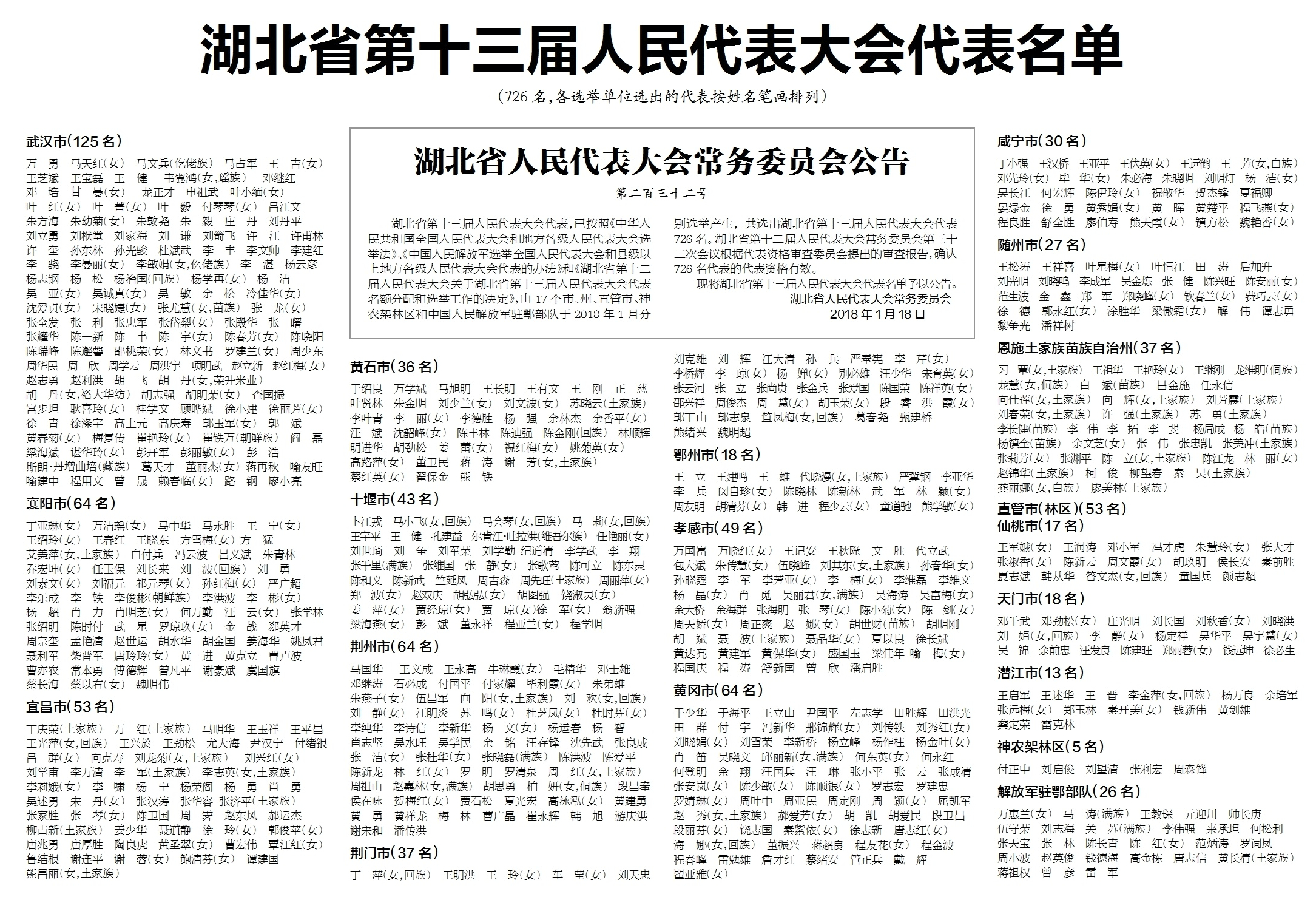
2018年开始的湖北省第十三届人大代表一共726名,其中中国人民解放军成员至少26名。
Beginning in 2018, the Thirteenth People’s Congress of Hubei Province(Hubei PPC) comprised a total of 726 deputies, among whom no fewer than 26 were members of the People’s Liberation Army(PLA) of Communist China.


湖北省人大代表中的PLA成员 PLA members in the Hubei PPC:


中文姓名Name1.万惠兰():中国人民解放军火箭指挥学院战略研究中心副主任,获得过军队科技进步奖,立过三等军功,2019年9月20日已经升为中国人民解放军火箭军指挥学院军事战略理论教研室主任


Wan Huilan (female) Deputy Director of the Strategic Research Center at the PLA Rocket Force Command College, recipient of the PLA Science and Technology Progress Award, and awarded a Third-Class Merit Citation.By September 20, 2019, she had been promoted to Director of the Military Strategy Theory Teaching and Research Office at the PLA Rocket Force Command College.


2.马 涛(满族):中国人民解放军湖北省军区司令员,曾在湖北省两会上表示,“湖北军民融合充满生机活力,随着力度持续加大,必将对地方经济社会发展和国防建设带来巨大推动作用。”


Ma Tao (Manchu):Commander of the Hubei Provincial Military District, as a deputy to the Hubei Provincial People's Congress. In comments made during the Hubei provincial legislative session, Ma publicly endorsed China's Military-Civil Fusion strategy, describing Hubei's military-civil fusion programs as a major driver of both economic development and national defense modernization.


3.王教琛:2020年8月12日,疫情期间,武汉洪山区法院院长、CCP党组书记闫小龙走访中国人民解放军代表团的湖北省人大代表王教琛,就部队改革、疫情防控工作等作交流,并征求王教琛代表对法院工作的意见和建议。根据中共国最高法院《关于全面加强接受监督工作的若干意见》(法发〔2011〕14号)要求中共国PRC的法院积极开展与人大代表、政协委员联络工作,认真办理人大代表建议、政协提案以及人大代表、政协委员关注事项,目的是为中国共产党和中共政权的工作大局提供有力司法保障,并要求各级法院强化大局意识,密切配合,要将接受人大代表、政协委员监督的工作纳入绩效考核,提供必要的经费和装备,切实调动工作主动性和积极性,对于因工作失职造成不良影响和其他不良后果的,要给予问责。中共国最高法院法发〔2011〕14号所述政协委员通常包括中国人民解放军少将曹雪涛、中国人民解放军少将陈薇、中共中央政治局常委、全国政协主席王沪宁、中科院武汉病毒研究所所长王延轶、习近平妻子彭丽媛、中科院武毒所所长王延轶的丈夫舒红兵这类政协委员。

Wang Jiaochen: On August 12, 2020, during the COVID-19 pandemic, Yan Xiaolong, President of the Hongshan District People’s Court in Wuhan and CCP Party Secretary, visited Wang Jiachen, a Hubei Provincial People’s Congress deputy from the PLA delegation, to discuss issues including military reform and COVID-19 prevention and control, and to solicit Wang Jiachen’s views and suggestions on the court’s work. According to the Supreme People’s Court of the CCP regime, in its “Several Opinions on Comprehensively Strengthening Work on Accepting Supervision” (Fa Fa [2011] No. 14), courts across the PRC are required to actively carry out liaison work with People’s Congress deputies and CPPCC members, diligently handle proposals submitted by People’s Congress deputies, motions submitted by CPPCC members, and matters that concern them, with the aim of providing strong judicial guarantees for the overall work of the CCP and the CCP regime. The document also requires courts at all levels to strengthen their sense of the larger political and strategic picture, coordinate closely, and include the work of accepting supervision from People’s Congress deputies and CPPCC members in performance evaluations, while providing the necessary funding and equipment to effectively mobilize initiative and enthusiasm. Any negligence in duty that causes adverse impact or other negative consequences must be subject to accountability. CPPCC members referred to in Supreme People’s Court document Fa Fa [2011] No. 14 typically include figures such as PLA Major General Cao Xuetao, PLA Major General Chen Wei, Wang Huning, a Standing Committee member of the CCP Politburo and Chairman of the National Committee of the CPPCC, Wang Yanyi, Director of the Wuhan Institute of Virology of the Chinese Academy of Sciences, Peng Liyuan, Xi Jinping’s wife, and Shu Hongbing, the husband of Wang Yanyi, Director of the Wuhan Institute of Virology of the Chinese Academy of Sciences.


4.亓迎川:1965年出生,男,在中国人民解放军空军预警学院担任教授、硕士研究生导师,主要研究方向为无人机控制技术及运用,获得过PLA军队科技进步二等奖2项、三等奖6项,2023年发表论文《基于态势演化博弈的无人机集群动态攻防》。

Qi Yingchuan: born in 1965, male, is a professor and master’s supervisor at the Air Force Early Warning Academy of the People’s Liberation Army of China. His main research area is unmanned aerial vehicle (UAV) control technology and applications. He has received two Second-Class and six Third-Class PLA Military Science and Technology Progress Awards. In 2023, he published a paper titled “Dynamic Offense and Defense of UAV Swarm Based on Situation Evolution Game.”


5.帅长庚:中国人民解放军海军工程大学舰船设备振动与噪声研究所副所长、教授、博士生导师,中国人民解放军的轮机工程舰船动力装置振动与噪声控制领域专家、“军队高层次科技创新学科拔尖人才培养对象”、海军“优秀青年”、“全军学习成才先进个人”,2024年发表了论文“Reconstruction of physical field characteristics of underwater vehicle wake based on data-driven approach”。

Shuai Changgen: Deputy Director of the Institute of Ship Equipment Vibration and Noise, Professor, and Doctoral Supervisor at the Naval University of Engineering of the PLA, a PLA expert in vibration and noise control for marine propulsion systems and naval engineering machinery, a “Top-Level Military Scientific and Technological Innovation Talent Training Candidate,” a “Navy Outstanding Young Talent,” and an “Advanced Individual in Learning and Professional Development Across the Armed Forces.” In 2024, he published a paper titled “Reconstruction of Physical Field Characteristics of Underwater Vehicle Wake Based on a Data-Driven Approach.”


6.伍守荣:根据2018年10月发布的湖北省人大常委会公告(第二百四十三号),离任前,湖北省人大代表中的枪杆子代表伍守荣是中国人民解放军随州军分区司令员。

Wu Shourong:According to Announcement No. 243 issued by the Standing Committee of the Hubei Provincial People's Congress in October 2018, prior to leaving office, another military representative in the Hubei Provincial People's Congress delegation, Wu Shourong, served as Commander of the Suizhou Military Sub-District of the People's Liberation Army of China.
7.刘志海:根据湖北省人大常委会2020年9月24日公告,刘志海辞去湖北省人大代表职务由中国人民解放军湖北省军区选举委员会决定接受。

Liu Zhihai: According to the September 24, 2020 announcement issued by the Standing Committee of the Hubei Provincial People's Congress, Liu Zhihai’s resignation from his post as a deputy to the Hubei Provincial People's Congress was accepted by the Election Committee of the Hubei Provincial Military District of the People's Liberation Army of China.
8.关 苏(满族):根据2018年10月发布的湖北省人大常委会公告(第二百四十三号),离任前,湖北省人大代表中的枪杆子代表关苏是中国人民解放军湖北省军区办公室主任,兼湖北省人大常委会委员、代表资格审查委员会副主任。 Guan Su (Manchu):According to Announcement No. 243 issued by the Standing Committee of the Hubei Provincial People's Congress in October 2018, prior to leaving office, Guan Su, a military representative in the Hubei Provincial People's Congress delegation, served as Director of the Office of the Hubei Provincial Military District of the People's Liberation Army of China. He also concurrently served as a member of the Standing Committee of the Hubei Provincial People's Congress and as Deputy Director of its Credentials Committee.
9.李伟强:中国人民解放军空降兵军副政治委员


Li Weiqiang: Deputy Political Commissar of the People's Liberation Army Airborne Corps


10.来承坦:1967年3月出生,是中共咸宁市委常委、PLA咸宁军分区司令员,2017年8月31日开始任代表PLA的咸宁市人大代表

Lai Chengtan: born in March 1967. He served as a member of the Standing Committee of the CCP Xianning Municipal Committee and Commander of the Xianning Military Sub-District of the People's Liberation Army of China. On August 31, 2017, he began serving as a PLA representative in the Xianning Municipal People's Congress.
11.何松利: 中国人民解放军武汉警备区司令员,同时是湖北省人大代表武汉市人大代表,2021年停止。也是武汉市第十四届人大第五次会议主席团成员。

He Songli: Commander of the Wuhan Garrison of the People's Liberation Army, and also a deputy to both the Hubei Provincial People's Congress and the Wuhan Municipal People's Congress, till 2021. also a member of of the Presidium of the Fifth Session of the 14th Wuhan Municipal People's Congress


Zhang Tianbao: Deputy Political Commissar of the PLA Air Force Wuhan Base, was announced by Hubei Provincial People's Congress Standing Committee Announcement No. 266 in November 2020 as ceasing as a deputy to the Hubei Provincial People's Congress, was promoted to the rank of Major General at the PLA National Defense University on December 16, 2020, and by November 2025 had become Deputy Political Commissar of the PLA Academy of Military Sciences.
12.张天宝:中国人民解放军空军武汉基地副政治委员,被2020年11月湖北省人大常委会公告第266号公告其已离任,2020年12月16日在PLA国防大学升为少将,2025年11月已经是中国人民解放军军事科学院副政治委员。


13.张 林:中国人民解放军联勤保障部队副参谋长,至2019年前后已出现在联勤保障部队参谋长岗位的报道中,并在2020年前后仍以该职务参与相关军队活动与会议。随后,他转入军委机关体系任职,并在2021年前后出任中央军委机关事务管理总局相关领导岗位,后进入中央军委后勤保障体系任职。2022年公开资料显示,其担任中央军委后勤保障部领导职务并晋升中将,并进入中共二十届中央委员会。2025年,全国人大常委会公告显示其全国人大代表资格被罢免,理由为“涉嫌严重违纪违法”。


Zhang Lin: Deputy Chief of Staff of the PLA Joint Logistic Support Force, and by around 2019 he was already referred to as Chief of Staff in official military media coverage, a position he continued to hold into at least 2020 in public appearances and reports. He was later reassigned to Central Military Commission (CMC) organ affairs work around 2021 and subsequently took a leadership role in the CMC Logistic Support Department. By 2022, publicly available information indicates he held a senior position in the CMC Logistic Support Department, was promoted to lieutenant general, and became a member of the 20th CCP Central Committee. In 2025, an NPC Standing Committee announcement stated that his status as a deputy to the NPC was revoked on grounds of alleged serious disciplinary and legal violations.


14.陈长青:中国人民解放军鄂州市华容区武装部部长。 Chen Changqing:Minister of the Armed Forces Department of Huarong District, Ezhou City under the PLA


15.陈 红(女):中国人民解放军(PLA)上校、海军工程大学电子工程学院学员二大队政委 Chen Hong (female):PLA Colonel and Political Commissar of the 2nd Cadet Brigade of the College of Electronic Engineering at the Naval University of Engineering.
16.范炳涛:中国人民解放军湖北陆军预备役高射炮兵师政治委员兼中国人民解放军湖北省军区政治部副主任。 Fan Bingtao:Political Commissar of the PLA Hubei Army Reserve Anti-Aircraft Artillery Division and concurrently as Deputy Director of the Political Department of the Hubei Provincial Military District.


17.罗词凤:中国人民解放军中部战区陆军舟桥旅政委


Luo Cifeng: Political Commissar of the PLA Central Theater Command Army Pontoon Bridge Brigade


18.周小波:提出辞去湖北省人大代表职务的请求,由中国人民解放军湖北省军区选举委员会接受。 Zhou Xiaobo: a military representative in the Hubei Provincial People's Congress delegation, submitted a request to resign from his position as a deputy to the Hubei Provincial People's Congress. His resignation was accepted by the Election Committee of the Hubei Provincial Military District of the People's Liberation Army of China.


19.赵英俊:中国人民解放军一个空降兵旅的政治工作部主任 Zhao Yingjun: Director of the Political Work Department of a PLA Airborne Brigade
20.钱德海:直到2020年9月24日湖北省人大常委会公告离任,中国人民解放军襄阳军分区司令员、中共襄阳市委常委、湖北省人大代表。

Qian Dehai:Until his departure from office as announced by the Standing Committee of the Hubei Provincial People's Congress on September 24, 2020, Qian Dehai served as Commander of the Xiangyang Military Sub-District of the People's Liberation Army of China, a member of the Standing Committee of the CCP Xiangyang Municipal Committee, and a deputy to the Hubei Provincial People's Congress.
21.高金栋:曾任中国人民解放军荆州军分区司令员,2018年12月18日已任中国人民解放军湖北省军区办公室主任。 Gao Jindong: former Commander of the Jingzhou Military Sub-District of the People’s Liberation Army of China, Director of the Office of the PLA Hubei Provincial Military District as of December 18, 2018.


22.唐志信:PLA恩施军分区政治委员,2021年1月23日湖北省人大常委会公告第289号已经离任。 Tang Zhixin: Political Commissar of the PLA Enshi Military Sub-District; according to Announcement No. 289 issued by the Standing Committee of the Hubei Provincial People’s Congress on January 23, 2021, he had left office by that date.


23.黄长清(土家族):中国人民解放军宜昌军分区司令员 Huang Changqing (Tujia ethnicity):Commander of PLA Yichang Military Sub-District.


24.蒋祖权:中国人民解放军大校,2019年11月湖北省人大常委会公告蒋祖权辞去湖北省人大代表职务,作为PLA武汉警备区副司令员2020年9月8日在PRC全国抗击新冠肺炎疫情表彰大会现场接受表彰,聆听习近平讲话,2020年10月已经担任PLA襄阳军分区司令员,2023年开始作为“特别邀请人士”担任担任湖北省政协委员


 Jiang Zuquan:A senior colonel in the Chinese People's Liberation Army, resigned from his position as a representative to the Hubei Provincial People's Congress in November 2019, then as the deputy commander of the Wuhan Garrison of the PLA commended at the National Commendation Conference for Fighting the COVID-19 Epidemic in the PRC on September 8, 2020, in October 2020 became the commander of the Xiangyang Military Sub-district of the PLA, Starting in 2023, as a member of the Hubei Provincial Committee of the Chinese People's Political Consultative Conference as a "specially invited person".


25.曾 彦:直到2020年9月24日湖北省人大常委会公告离任,曾彦是中共十堰市委常委、湖北省人大代表、中国人民解放军十堰军分区司令员

Zeng Yan:Until his departure from office as announced by the Standing Committee of the Hubei Provincial People's Congress on September 24, 2020, Zeng Yan served as a member of the Standing Committee of the CCP Shiyan Municipal Committee, Commander of the Shiyan Military Sub-District of the People's Liberation Army of China, and a deputy to the Hubei Provincial People's Congress.
26.雷 军:中国人民解放军大校、黄冈军分区政治委员、中共黄冈市委常委,2018年6月13日感谢中共黄冈师范学院党委加大政策、资金投入支持国防与军队建设,肯定其圆满完成大学生征兵工作任务,希望黄冈师范学院完成好2018年征兵工作任务。

Lei Jun:PLA Senior Colonel, Political Commissar of the Huanggang Military Sub-District, and a member of the Standing Committee of the CCP Huanggang Municipal Committee; on June 13, 2018, he expressed appreciation to the CCP Committee of Huanggang Normal University for increasing policy and financial support for national defense and military development, commended the university for successfully completing its student military recruitment tasks, and expressed hope that it would successfully fulfill its 2018 recruitment objectives.

27.刘红兵(2020年11月开始任湖北省人大代表):PLA大校、湖北省孝感军分区政委、中共孝感市委常委。Liu Hongbing: PLA Senior Colonel, Political Commissar of the PLA Xiaogan Military Sub-District, and a member of the Standing Committee of the CCP Xiaogan Municipal Committee, a deputy to the 13th Hubei Provincial People’s Congress from November 2020.


28.陈军:中国人民解放军黄石军分区副司令员,2020年开始担任湖北省人大代表。Chen Jun: Deputy Commander of PLA Huangshi Military Sub-District; he has served as a deputy to the Hubei Provincial People’s Congress since 2020.


29.张红军:PLA湖北省军区副司令员,2020年1月16日开始担任湖北省人大常委会委员,2020年11月湖北省人大常委会公告第266号确认其是湖北省人大代表,2021年1月23日湖北省人大常委会公告第289号不再是湖北省人大代表。 Zhang Hongjun: Deputy Commander of the PLA Hubei Provincial Military District; as a member of the Standing Committee of the Hubei Provincial People’s Congress on January 16, 2020, and his status as a provincial deputy was later reflected in Hubei Provincial People’s Congress Standing Committee Announcement No. 266 in November 2020 and remained in effect until the issuance of Announcement No. 289 on January 23, 2021.


30.龚鸿斌:PLA恩施军分区司令员、中共恩施州委常委,2023年5月29日已经离开恩施军分区,去担任PLA湖北省军区警备办公室主任,2021年已经开始担任湖北省人大代表。Gong Hongbin: Commander of the PLA Enshi Military Sub-District and a member of the Standing Committee of the CCP Enshi Prefectural Committee; he began serving as a deputy to the Hubei Provincial People’s Congress in 2021, and by May 29, 2023, had left the Enshi Military Sub-District to become Director of the Garrison Office of the PLA Hubei Provincial Military District.


31.琚万勇:PLA随州军分区司令员、中共随州市委常委,2021年已经开始担任湖北省人大代表。Ju Wanyong: Commander of the PLA Suizhou Military Sub-District and a member of the Standing Committee of the CCP Suizhou Municipal Committee, serving as a deputy to the Hubei Provincial People’s Congress in 2021.


32.孟吉东:PLA 空军95028部队副政委,被2021年1月23日湖北省人大常委会公告第289号确认为湖北省人大代表,直到湖北省人大常委会2024年1月28日第341号公告确认离开湖北,被2026年1月山西省人大常委会公告在PLA空军93601部队。Meng Jidong: Deputy Political Commissar of PLA Air Force Unit 95028; he was confirmed as a deputy to the Hubei Provincial People’s Congress by Hubei Provincial People’s Congress Standing Committee Announcement No. 289 on January 23, 2021, remained a provincial deputy until Announcement No. 341 on January 28, 2024 confirmed that he had left Hubei, and was later identified in a January 2026 announcement of the Shanxi Provincial People’s Congress Standing Committee as serving in PLA Air Force Unit 93601.


33.吕吉云:PLA湖北省军区副司令员,以前是中国人民解放军总后勤部卫生部副部长、PLA 302医院院长、PLA联勤保障部队PLA总医院副院长,2021年开始担任湖北省人大代表。Lü Jiyun: Deputy Commander of the PLA Hubei Provincial Military District who began serving as a deputy to the Hubei Provincial People’s Congress in 2021; previously served as Deputy Director of the Health Department of the PLA General Logistics Department, President of PLA Hospital 302, and Deputy President of the PLA General Hospital under the PLA Joint Logistic Support Force.


34.吴海权:中国人民解放军海军大校、十堰军分区司令员,2021到2025年之间担任湖北省人大代表,2025年1月以后在PLA东部战区浙江衢州军分区担任司令员。Wu Haiquan: PLA Navy Senior Colonel and Commander of the Shiyan Military Sub-District; he served as a deputy to the Hubei Provincial People’s Congress between 2021 and 2025, and after January 2025 was serving as Commander of the Quzhou Military Sub-District in Zhejiang under the PLA Eastern Theater Command.


35.李星河: 中国人民解放军联勤保障部队参谋长,2021年开始任湖北省人大代表Li Xinghe: Chief of Staff of the PLA Joint Logistic Support Force; he began serving as a deputy to the Hubei Provincial People’s Congress in 2021.
36.曾丛华:中国人民解放军舟桥旅旅长,2021年开始任湖北省人大代表。Zeng Conghua: Commander of a PLA Pontoon Bridge Brigade; he began serving as a deputy to the Hubei Provincial People’s Congress in 2021.
#Democracy #Christ #Peace #Freedom #Liberty #Humanrights #人权 #法治 #宪政 #独立审计 #司法独立 #独立自治

Tweets of CPA Jim