All men are created by LORD God, and are created equal by the LORD God in being endowed by the LORD God with unalienable Right of Life, Liberty and the Pursuit of Happiness equally.
Let's pray in the name of Jesus Christ for a decentralised China with no nukes, no military and no Leninist organisation. May LORD God's light shine on China. Welcome to follow CPAJim at X: https://x.com/CPAJim2021
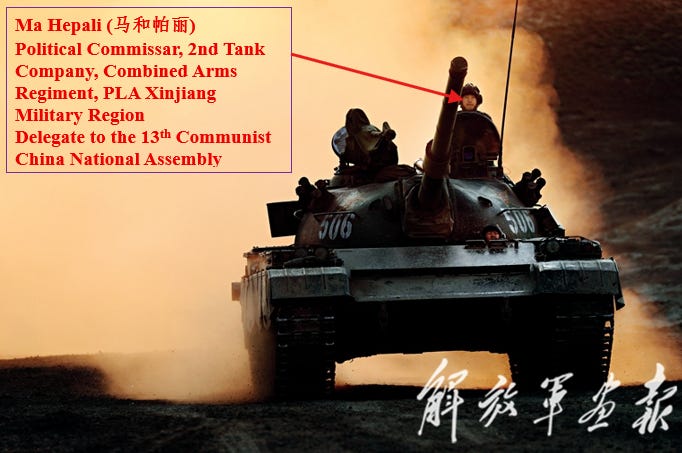
Figure 1A: Ma Hepali in military combat gear operating an armored tank in the Xinjiang Military Region. Dual Identity of a Party-Military Operator: The same individual—Ma Hepali—serving simultaneously as an active-duty tank company commander in the Chinese Communist Party Armed Forces and a voting delegate in the regime’s supreme legislative body.
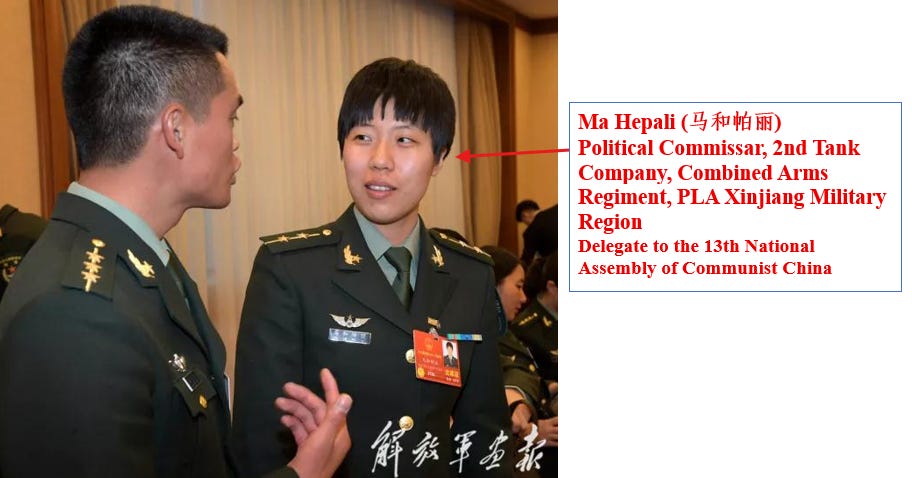
Figure 1B: Ma Hepali wearing her official delegate badge at the 13th National Soviet Assembly of Communist China. Dual Identity of a Party-Military Operator: The same individual—Ma Hepali—serving simultaneously as an active-duty tank company commander in the Chinese Communist Party Armed Forces and a voting delegate in the regime's supreme legislative body.
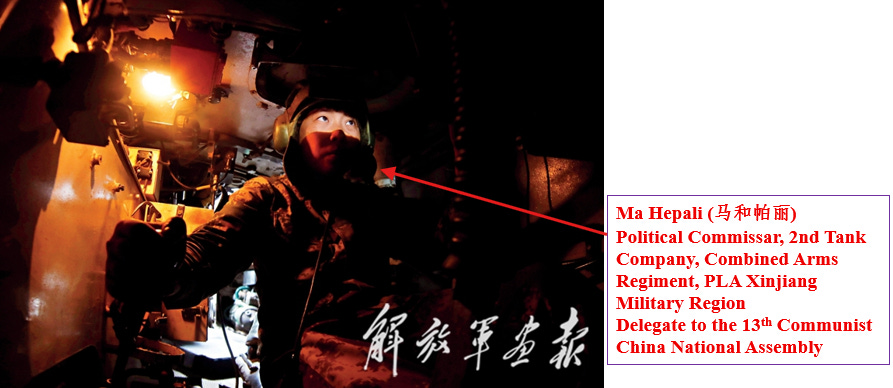
Official propaganda outlets of the Chinese Communist Party, such as the Liberative Army Press, previously exalted Ma Hepali (a/k/a Maqpal, Makpal), the first female tank company commander in the PLA Xinjiang Military Region. The official narrative painted a romanticized portrait of the Kazakh officer, claiming that “she is at her most beautiful when driving a tank,” while detailing her endurance of extreme desert training, manual maintenance of diesel components, and leadership over armored units.
Stripping away this carefully curated totalitarian aesthetics and soft propaganda, the most dangerous identity Ma Hepali holds is not her ethnicity or her role as a tank commander. It is her official position as a delegate of the armed forces to the 13th National Soviet Assembly of Communist China. As shown in Figures 1A and 1B, Ma Hepali transitions seamlessly from operating heavy armor in Xinjiang to voting on national legislation at the National Soviet Assembly of Communist China—proving that military personnel in the regime do not merely serve the state, but actively draft its laws.
Ma Hepali’s case perfectly illustrates how the Chinese Communist Party embeds active-duty military personnel directly into the highest legislative organ of the state. This system of military officers serving simultaneously as legislative representatives violates the foundational principle of popular sovereignty in constitutional democracies and poses a severe, covert threat to international security.
The Erosion of Popular Sovereignty and Civilian Control
In modern constitutional governance and international law, popular sovereignty and civilian control of the military constitute the twin pillars of state legitimacy. Armed forces exist strictly as instruments of state power, subordinated to democratically elected civilian authorities, and are fundamentally barred from drafting laws, determining state policy, or dictating budget allocations.
The governance structure of the Chinese Communist Party completely subverts this framework:
Direct Military Legislation: Active-duty officers like Ma Hepali enter the supreme legislative body as voting delegates, directly shaping and enacting state laws. The military is no longer an institution subject to statutory oversight; it acts as the primary author of the law itself.
Military Supremacy Over Civilian Will: Within the Soviet Assembly of Communist China, the military and armed police delegation forms a massive, highly disciplined bloc possessing coercive veto power. When senior commanders present operational demands or legislative mandates on the assembly floor, civilian representatives possess zero authority to question or audit them. Popular sovereignty is usurped by uniformed commanders and party apparatchiks.
The Institutionalization of Militarism and Mandatory State Extraction
When tactical officers and high-ranking generals occupy legislative seats, the armed wing of the Chinese Communist Party gains a legal mechanism to coerce the civilian economy, state administration, and scientific infrastructure.
During these assembly sessions, military delegates consistently mandate national legislation enforcing Military-Civil Fusion, demand that state economic planning prioritize combat readiness, and compel public resources to serve active and veteran military personnel. The Chinese Communist Party leverages its legislative seats to force the entire state apparatus onto a permanent war-footing, systematically diverting public welfare resources directly into defense industries and military expansionism.
Strategic Vulnerabilities for International Security
Allowing active-duty officers to serve as national legislators enables the Chinese Communist Party to convert its war intent into binding statutory law and total mobilization orders with extreme speed. This creates immediate risks for the Republic of China, Japan, the Philippines, the United States, and the broader international order:
Rapid Mobilization and Legal Laundering: Because military commanders control legislative drafting from within, the assembly can instantaneously pass war mobilization acts, maritime coercion statutes, or martial law decrees during a crisis. This grants aggressive military actions a veneer of legal authorization.
Subversion Through Propaganda Warfare: The state heavily promotes ethnic minority officers in legislative roles to obscure forced assimilation and security lockdowns in regions like Xinjiang. Using female and ethnic faces as legislative props allows the regime to project an illusion of ethnic unity while consolidating totalitarian control and external power projection.
The glorification of military violence under the guise of personal achievement remains a direct challenge to modern democratic norms. The Soviet Assembly of Communist China is not a harmless administrative entity; its military delegation functions as an operational extension of the Central Military Commission of the Chinese Communist Party. When active-duty soldiers wield legislative power, popular sovereignty ceases to exist, and the resulting militarized apparatus directly imperils global peace and regional stability.