
Since the Republic of China(ROC) never informed the United Nations of a change of name, government, or state continuity, the General Assembly had no factual or legal basis to treat the People’s Republic of China(PRC) as the same state or the legitimate successor of the ROC.
Resolution 2758 therefore rests on a non-existent factual premise.
A resolution based on a false factual assumption cannot create legal consequences beyond the mere replacement of representatives; any implication of state identity, government legitimacy, or Charter-level succession is ultra vires and void.
The General Assembly does not possess the authority—under the UN Charter—to expel or effectively remove a founding member state from participation in the Organization.
Articles 5 and 6 of the UN Charter make clear that any suspension or expulsion of a Member requires a prior recommendation of the Security Council. The General Assembly cannot initiate, authorize, or independently execute such actions.
Resolution 2758, however, bypassed this mandatory procedure. By framing the issue as one of “representation” and by using the misleading phrase “the representatives of Chiang Kai-shek”—a non-existent legal entity under UN law—the resolution attempted to effect what is, in substance, a deprivation of membership rights. This constitutes a constructive expulsion of the Republic of China, a founding Member of the United Nations, without the Security Council recommendation explicitly required by Article 6.
Because the General Assembly acted ultra vires—exceeding its Charter-based powers—the decision was procedurally unlawful at the moment of adoption. A General Assembly resolution obtained through inaccurate terminology, mischaracterization of the legal subject, and in direct conflict with Articles 4–6 and 23 of the Charter cannot alter the membership status or Council composition defined by the Charter itself. Such contradictions render the decision legally defective ab initio.
For more than fifty years the Chinese Communist Party has wielded United Nations General Assembly Resolution 2758 as an “ironclad” proof of its international legitimacy. Even more ironic: the most systematic and authoritative critique of that text has not come from the foreign critics the CCP routinely invokes, but from inside Chinese society — notably from a former PRC-registered certified public accountant who once audited state accounts and understands how official narratives and legal pretenses are constructed.
This essay advances one foundational claim: freedom of expression is not a domestic nicety — it is the logical precondition of political representation. Where expression is systematically suppressed, the claim that any government legitimately “represents the people” is incoherent. Read through that lens, Resolution 2758 is not a final legal settlement; it is a procedurally flawed, factually misleading, and politically instrumental document that has been used to mask a deeper representational deficit. Moreover, when measured against the hierarchy of UN law, the manner in which the PRC came to occupy the Security Council “China” seat raises distinct legal objections — up to and including a defensible claim that the PRC is unlawfully occupying a Charter-defined office.
1. Expression first; legitimacy second
Modern democratic theory and international human-rights doctrine converge on a minimum standard: if a people are to be said to have authorized a government, they must have had the opportunity to express preferences, contest competing claims, and choose among alternatives without fear of state sanction. Freedom of opinion and expression is thus a structural precondition for meaningful political participation — not an optional luxury.
The People’s Republic of China has for decades denied those conditions: pervasive censorship, criminalization of dissent, suppression of independent association and competitive political contestation. Under such conditions, assertions that a governing authority “represents the Chinese people” require extraordinary evidentiary support — support that does not exist. Any international instrument that treats a regime emerging from such an environment as the unambiguous representative of a people must therefore be read skeptically.
2. 1971: a diplomatic vote, not a popular mandate
On 25 October 1971, UN General Assembly Resolution 2758 was adopted with the following tally:
76 in favor
35 against
17 abstentions
128 members voting in total
Crucially, no Chinese citizen, no Taiwanese citizen, and no global public was ever consulted on whether the PRC should be recognized as the authoritative representative of the Chinese people. The resolution was the outcome of interstate diplomacy among Cold War political elites — a narrow vote of 76 diplomats, representing a tiny fraction of the world’s population.
Diplomatic seat assignment cannot substitute for popular mandate. Without free expression, open debate, and consent of the governed, a government cannot claim legitimacy on behalf of its people.
Resolution 2758 did not confer authority on the PRC to represent China’s population, and its claims of exclusivity are therefore legally and morally void under principles of self-determination and representative legitimacy.
3. Textual problem I — “Recognizing” and a false factual premise
A central clause of 2758 uses language that, on its face, treats as established a historical fact: in effect, it speaks as if the PRC already were a permanent member of the Security Council. But between 1945 and 1971 the Security Council’s “China” seat was occupied by the Republic of China (ROC). The PRC did not occupy that seat prior to the vote; the vote itself produced the changed arrangement.
In treaty drafting and diplomatic practice, the operative verb “recognizing” signals acceptance of an existing fact. Using it to describe a non-existent or contested condition creates a false factual foundation for downstream inferences. In 2758 that wording has been consequentially obscured in translations and public narratives, producing the misimpression that the UN had already affirmed a pre-existing legal reality when, in truth, the vote was the instrument that produced the new arrangement.
4. Textual problem II — seats versus legitimacy; ultra vires action
2758’s later language declares the PRC’s representatives to be the “only legitimate” representatives of China to the United Nations. That formulation goes beyond procedural credentialing and reaches into the domain of governmental legitimacy.
Under the Charter and established state practice, the General Assembly governs credentials and seating; it does not possess an unconstrained legal power to adjudicate which organization or government is the legitimate government of a member state in the sense of creating domestic legal legitimacy. Recognition of governments historically has been a matter of sovereign foreign policy and bilateral or multilateral state practice, while Charter amendment procedures prescribe the formal method to alter foundational constitutional facts about the Organization.
By issuing language that reads as a conclusive legal determination of exclusive legitimacy, Resolution 2758 crossed into ultra vires territory — an institutional overreach beyond the General Assembly’s proper competence — and in doing so blurred the line between a procedural seat allocation and a substantive, Charter-level modification.
5. The Charter, hierarchy of norms, and unlawful occupation of the P5 seat
This is the decisive legal point that demands attention.
Article 23(1) of the UN Charter (1945 text) expressly names the permanent members of the Security Council: “The Republic of China, France, the Union of Soviet Socialist Republics, the United Kingdom, and the United States shall be the permanent members of the Security Council.” That list appears in the Charter text and has never been amended by the formal amendment procedures set out in Articles 108 and 109 (which require a two-thirds GA vote and ratification by all five permanent members).

No lawful Charter amendment was ever adopted to substitute “People’s Republic of China” for “Republic of China.” The Charter therefore, as higher law of the Organization, continues to list the ROC (as “China”) in the class of permanent members.
A General Assembly resolution is a subordinate instrument; subordinate norms cannot lawfully alter or override higher law. A GA resolution cannot amend the Charter nor can it lawfully create or transfer a permanent Security Council membership. Where a subordinate instrument purports to do so, the action is ultra vires with respect to the Charter.
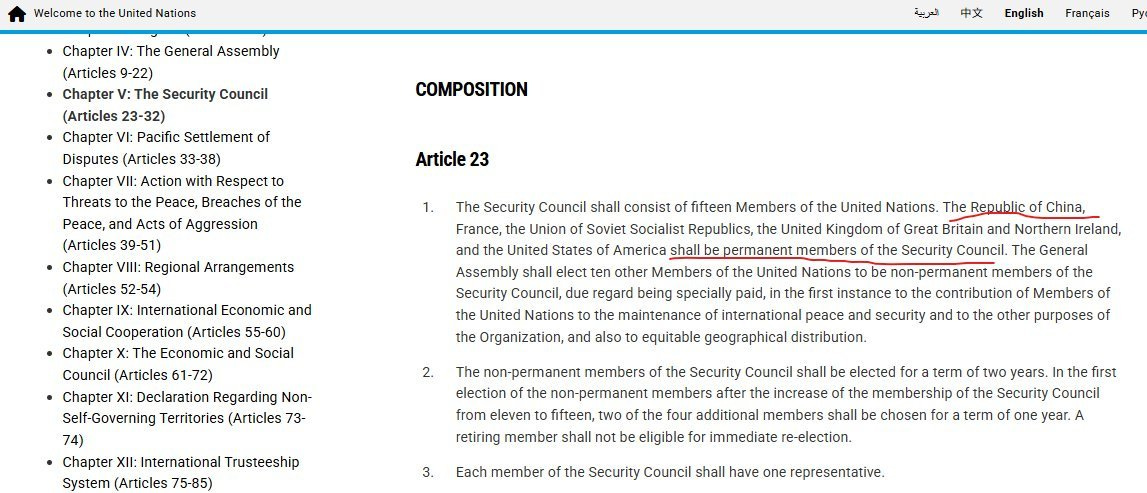
From these premises a legally robust conclusion follows:
Because the Charter remains unamended, and because the Charter explicitly identifies the ROC as the permanent member, the placement of the PRC in the P5 chair exists as a political fact (de facto occupation) rather than a de jure, Charter-based legal status. In legal terms, the PRC’s occupation of the P5 seat is not grounded in Charter amendment and thus may properly be described as an unlawful occupation of a Charter-defined office.
That phrasing is not rhetorical flourish; it is the precise application of hierarchical norm logic: where constitutional text prescribes membership and no amendment occurred, a subordinate act cannot lawfully substitute itself for the constitutional procedure.
6. Procedural deficits: no binding legal vetting, no affected-party participation
The adoption of 2758 occurred without the kind of Charter-consistency vetting or judicial review that would be required for acts bearing constitutional consequences. In 1971 there was no binding requirement that draft resolutions addressing matters of constitutional import be subject to mandatory legal review; advisory opinions were non-binding; affected populations (Taiwanese, mainland Chinese) were not participants or consultees in a decision that purported to speak on their behalf.
Nor did the Assembly undertake a Charter-level inquiry into membership criteria (e.g., Article 4’s “peace-loving” requirement) as applied to the PRC’s historical record. These omissions convert a politically consequential act into a legally vulnerable one.
7. Consequences: political myth-making, silencing, and instrumentalization
When an international instrument combines misleading factual framing, institutional overreach, and weak procedural safeguards, it becomes ripe for instrumentalization. For the CCP, 2758 has functioned as both shield and rhetorical cudgel — domestically and internationally — used to foreclose debate about representational legitimacy by invoking an allegedly definitive UN imprimatur. The practical result has been a durable conflation of seat with sovereign, democratic legitimacy, insulating the representational question from scrutiny and excluding the voices of those affected.
8. The central thesis restated: no expression → no authorization → no legitimate representation
Return to the starting axiom. If the people cannot freely express their political will, there is no mechanism for democratic authorization. Without authorization, claims to representation are empty. A diplomatic vote among states cannot fill that void; it can only allocate procedural access to international forums. Consequently, any document — even a UNGA resolution — asserting that a particular regime is the “only legitimate” representative of a people must be read skeptically when (a) domestic freedoms have been systematically suppressed, and (b) the document’s text and adoption process display factual or procedural defects.
9. Policy implications and remedial options
(1) Charter-anchored correction of factual and legal errors
Because the General Assembly cannot override or amend the Charter, any resolution that contradicts Charter realities — including the identity of the Security Council’s permanent members under Article 23 — must be subject to formal correction or withdrawal.
Member states and UN legal organs should explicitly clarify that 2758 did not and could not decide questions of governmental legitimacy, nor could it retroactively create a factual history that never existed.
(2) Mandatory Charter-consistency review for any resolution with constitutional consequences
The UN lacks a structural safeguard comparable to constitutional review. This gap enabled factual inaccuracies (e.g., PRC “is” a P5 member) and ultra vires claims (“only legitimate representatives”) to enter an operative text.
Going forward, any action touching sovereignty, representation, or Charter-defined institutional roles must undergo:
public, binding legal review by the Office of Legal Affairs,
affirmation by the Sixth Committee,
and a procedural bar preventing votes on texts that contravene Charter provisions.
(3) Prohibition of deceptive or misleading resolutions
The Charter does not tolerate Assembly actions that rely on misrepresentation, ambiguous drafting, or implied retroactive claims.
A general rule should be codified:
Resolutions based on false factual premises or structural deception shall be void ab initio or subject to compulsory corrective action.
(4) Safeguards for populations whose representation is affected
When Assembly decisions materially impact the representation of a population, the total exclusion of that population — as occurred with the 23 million people of Taiwan and the wider Chinese population lacking free expression — violates the principle of self-determination.
The UN needs mechanisms such as:
consultative hearings,
expert panels on self-determination,
or provisional mechanisms recognizing populations as stakeholders.
(5) Integrity protection against foreign influence
Where credible evidence indicates systemic influence operations, coercion, or corruption targeting UN organs, member states must pursue institutional remedies:
independent audits of voting blocs,
transparency on diplomatic interventions,
and, when required, structural resets of captured organs whose neutrality is compromised.
(6) Legal contestation, scholarly scrutiny, and the possibility of annulment
Resolution 2758 should no longer be treated as a sacred artifact beyond question.
It must be treated like any other Assembly decision:
open to legal critique,
open to procedural challenge,
and, if necessary,
subject to formal annulment, corrective resolutions, or re-articulation that place Assembly practice back within Charter limits.
10. Conclusion: UNGA Resolution 2758 as a political artifact, not a Charter-sanctioned legal warrant
UNGA Resolution 2758 should be understood primarily as a political artifact of its time — a product of Cold War geopolitics, interstate bargaining, and diplomatic expediency — not a Charter amendment, not a binding legal ruling, and not a substitute for the evidentiary and normative requirements of democratic authorization.
When we restore the foundational principle that freedom of expression underpins legitimate representation, the central claim of 2758 collapses: a regime that systematically suppresses political expression and denies its population the ability to freely consent cannot legitimately be declared, by a diplomatic vote of a small number of Assembly members, the “only legitimate representative” of its people.
In other words, Resolution 2758 did not and cannot confer lawful, Charter-compliant legitimacy upon the PRC as the sole representative of China, because the resolution bypassed procedural safeguards, relied on misleading factual premises, and ignored the democratic will of the population whose representation it purported to settle.
And for added irony: the most systematic dismantling of 2758’s textual and procedural pretenses has come from within Chinese society itself — from an auditor of the system who understands how official books and official texts can be made to tell stories. That provenance should sharpen, not dull, the urgency of reexamination.
Failure to do so risks hollowing out the Charter itself.