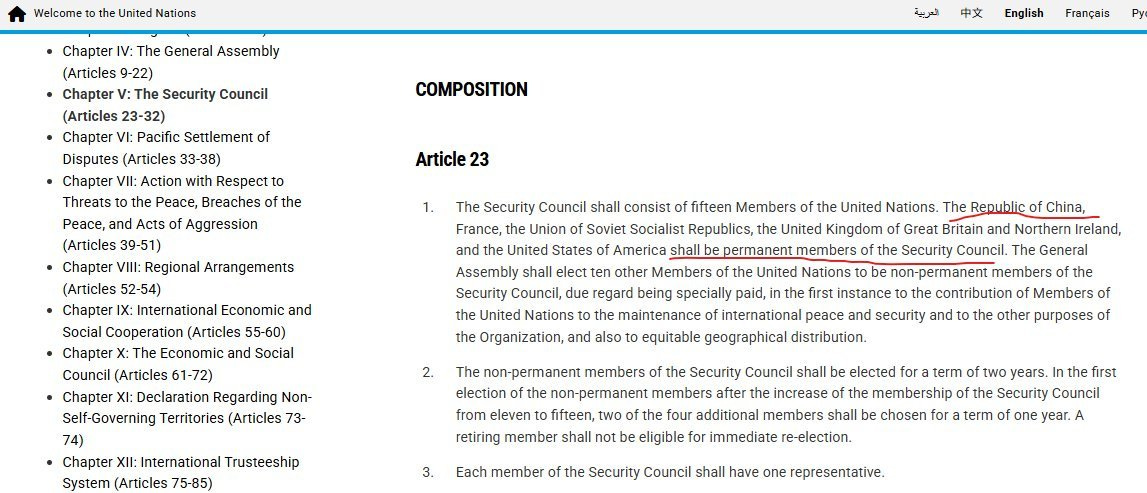
1. Higher Law: The UN Charter Explicitly Lists the Permanent Members
Article 23(1) of the Charter states:
“The Republic of China, France, the Union of Soviet Socialist Republics, the United Kingdom, and the United States shall be the permanent members of the Security Council.”
This list has never been amended via Article 108 or 109.
Therefore, in the governing text of the UN, the “Chinese” permanent member is the Republic of China (ROC), not the People’s Republic of China (PRC).
This is the supreme law of the United Nations system.
2. No Charter Amendment Means No Lawful Transfer of the P5 Seat
Under Article 108:
A Charter amendment requires a two-thirds vote of the General Assembly, and
Ratification by all five permanent members.
No such amendment occurred.
There has never been a procedure, vote, treaty action, or ratification that replaced ROC with PRC.
Thus the transfer of the P5 seat never legally happened.
Not in 1971, not afterward, not ever.**
3. A General Assembly Resolution Cannot Modify the Charter
— meaning 2758 cannot lawfully change permanent membership
Charter hierarchy is crystal clear:
UN Charter = constitutional higher law
General Assembly resolutions = non-binding political instruments
Because:
GA resolutions cannot alter Security Council composition
GA resolutions cannot amend the Charter
Thus, 2758 is legally subordinate to the Charter.
If a subordinate act contradicts a superior law, the superior law prevails.
4. Therefore, PRC’s Occupation of the P5 Seat Is Unlawful
From these principles, the conclusion follows with full legal force:
If the Charter is the supreme law,
and the Charter names ROC as the permanent member,
and no Charter amendment has replaced ROC with PRC,
then PRC’s sitting in the P5 chair is an unlawful occupation.
This is the cleanest, strongest, most legally robust formulation:
“The PRC’s presence in the P5 seat is not the product of Charter law but the result of political force, adopted through a subordinate resolution lacking the legal authority to alter higher law. Therefore, the PRC is unlawfully occupying the China permanent seat on the Security Council.”
5. Why This Terminology Is Legally Safe and Politically Devastating
“Unlawful occupation” is not rhetoric.
It is a direct consequence of:
Hierarchy of norms (Charter > GA resolutions)
Absence of Charter amendment
Incorrect legal assumption in 2758
Ultra vires action by the GA
PRC non-membership in the Charter’s permanent member list
In law, when a seat, office, or competence is held without a lawful basis, the correct descriptor is:
