Introduction
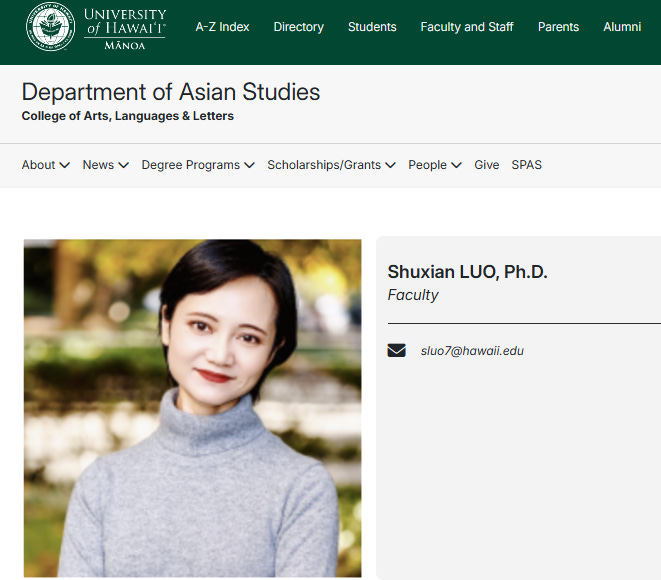
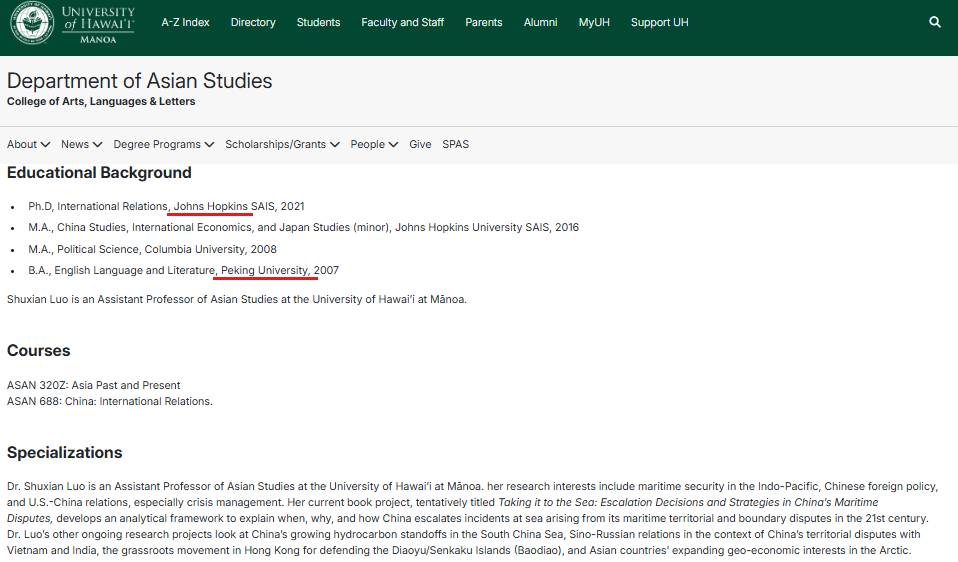
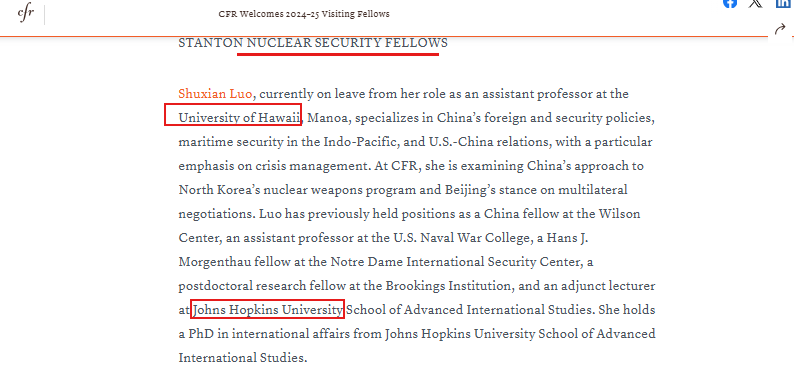
Dr. Shuxian Luo (骆舒娴), currently a Stanton Nuclear Security Fellow at the Council on Foreign Relations (CFR) and an assistant professor (on leave) at the University of Hawai‘i at Mānoa, presents a complex and increasingly urgent national security challenge for the United States. Her academic profile, professional trajectory, extensive engagement with institutions linked to the Chinese Communist Party (CCP), and direct participation in PRC academic ecosystems place her at the intersection of U.S. national security vulnerabilities and CCP influence architecture.
This analysis draws on documented facts, including her institutional affiliations, public records, Chinese-language media, and her participation in high-level events at Tsinghua University — an institution deeply integrated into CCP foreign influence and the People’s Liberation Army (PLA) strategic research ecosystem.
1. Who Is Dr. Shuxian Luo?
English name: Shuxian Luo / LUO Shuxian
Chinese name: 骆舒娴 (standard), with recorded variants including 罗淑贤 and others used across PRC and overseas Chinese media ecosystems.
U.S. affiliations: University of Hawai‘i, CFR (Stanton Fellow), U.S. Naval War College, Brookings Institution, Wilson Center, Johns Hopkins SAIS.
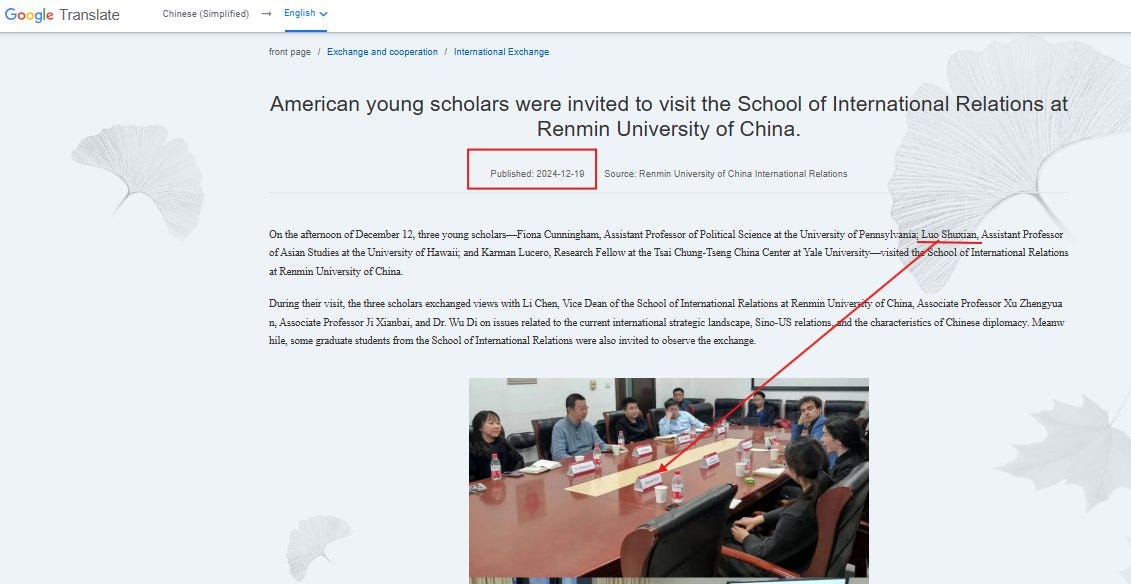
PRC-linked affiliations: Renmin University of China (中国人民大学国际关系学院), participant in CCP-aligned academic conferences. Renmin University of China (中国人民大学国际关系学院), including a December 12, 2024 closed-door visit where Luo and two U.S.-based scholars met with CCP-affiliated faculty (李晨, 徐正源, 嵇先白, 吴迪) to discuss PRC foreign policy narratives — an event constituting cooperation with Chinese Communist Party institutions after her September 3, 2024 appointment at CFR.

Additionally, Luo’s continued cooperation with CCP-linked entities after joining CFR is further demonstrated by her participation in the April 22, 2025 exchange meeting between the Council on Foreign Relations and a delegation from the Center for China and Globalization (CCG). During this event at CFR headquarters in New York, she met with CCG leadership — including Wang Huiyao, Miao Lu, Gao Zhikai, Wang Yiwei, He Zhipeng, Zhu Yuanqing, and Li Juan — all of whom hold clear roles within PRC foreign influence, United Front, or CCP-aligned academic systems. Her presence in this dialogue, held inside CFR itself, underscores ongoing collaboration with PRC-aligned influence networks even while employed by a major U.S. foreign policy institution.
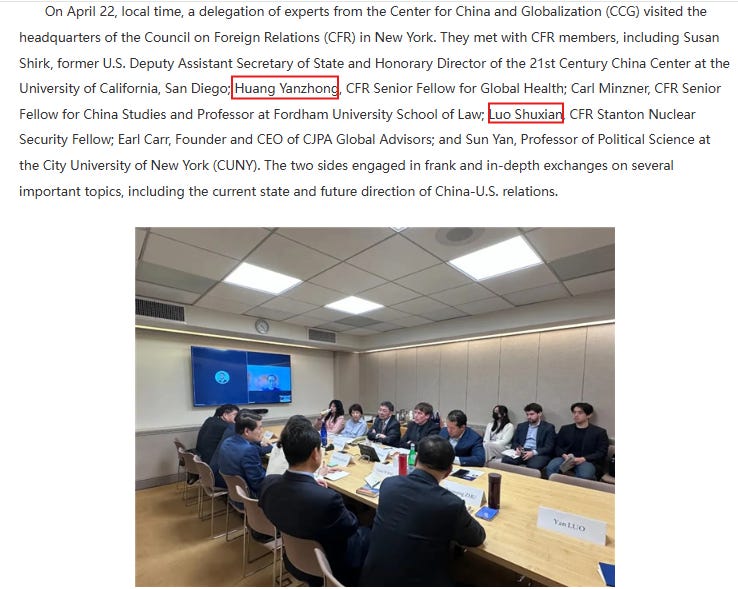
The multiplicity of name variants — some appearing in PRC institutional contexts — indicates integration into multiple information ecosystems, including those monitored by CCP internal political organs.
2. A Career Pathway Consistent With PRC State-Linked Grooming
Early Career: North American Chinese-Language Media
Previously, Luo worked as a journalist for the World Journal (世界日报) in Los Angeles and the People’s Daily. This media network, historically tied to political structures in Taiwan and consistently interacting with CCP-linked overseas Chinese affairs systems, has long served as a channel for influence, message testing, and diaspora political alignment.
This means her earliest professional environment was embedded in a Chinese-language media ecosystem that operates adjacent to CCP external propaganda and united front frameworks.
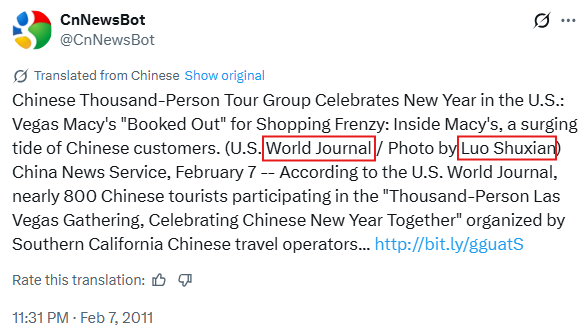
Her Ties to People’s Daily: A Direct Line Into the CCP Propaganda System
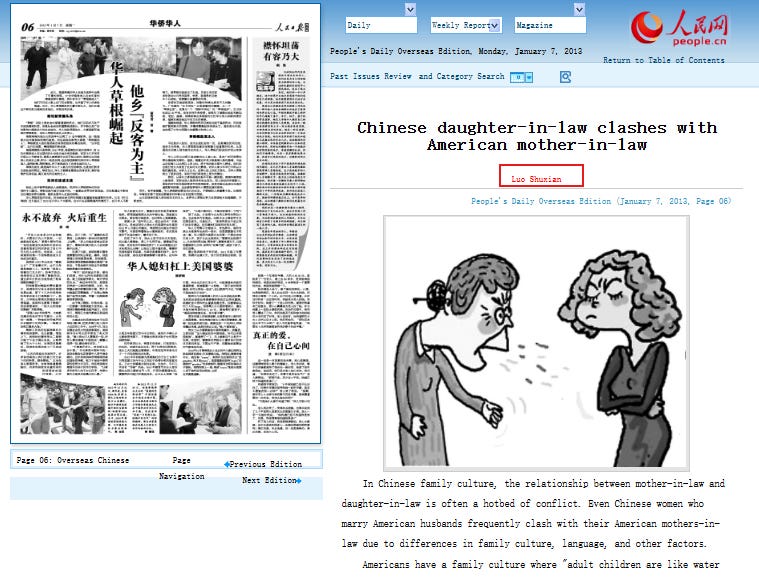
Shuxian Luo’s connection to People’s Daily—the CCP regime’s flagship propaganda outlet—is not incidental. It signals alignment with the Party’s core narrative machinery. People’s Daily is not an ordinary newspaper; it operates under the CCP Central Committee and functions as the regime’s primary channel for shaping ideological messaging, signaling political loyalty, and coordinating propaganda across ministries, universities, and overseas networks. Anyone who works with, collaborates on content for, or is platformed by People’s Daily is participating in a tightly controlled political communication ecosystem designed to advance Party objectives.
Luo’s appearance in this system is therefore not trivial. It places her inside a communication pipeline explicitly tasked with supporting the CCP’s political warfare strategy overseas, including in the United States. Whether she contributed analysis, commentary, interviews, or research, the fact remains that People’s Daily does not feature individuals unless they are politically “safe,” reliable, and aligned with the Party’s messaging requirements. In other words, Luo’s involvement signals approval from a propaganda organ that answers directly to the CCP’s highest leadership.
This relationship raises legitimate concerns for U.S. institutions evaluating foreign influence and CCP-linked narrative penetration. At minimum, it indicates that Luo has been vetted and deemed useful by a propaganda apparatus central to the regime’s external influence operations.
Academic Trajectory
Her education and research areas map closely onto subjects prioritized by the CCP for foreign influence and intelligence collection:
PRC crisis management and foreign policy
China Coast Guard (heavily militarized and connected to the PLA)
U.S.–China military interactions
Such areas carry built-in national security sensitivity and routinely attract the attention of PRC intelligence services.
3. Exposure to PRC Intelligence and Influence Networks
Luo maintains an ongoing relationship with PRC institutions, returning to China and participating in events where PLA-linked personnel and CCP-influenced scholars are present.
Her documented participation in Tsinghua University’s 2017 “Political Science and International Relations Scholarly Community Conference” places her inside one of the CCP’s highest-level academic and influence ecosystems. This conference:
Was organized by Tsinghua University’s Institute of International Relations, an institution with long-standing ties to CCP foreign affairs, intelligence research, and military-civil fusion structures.
Included speakers from PRC ministries, the People’s Republic of China’s Ministry of Commerce, PLA-affiliated institutions, and CCP Central Propaganda Department media systems.
Her presence alongside:
PRC security researchers
PLA-linked foreign policy analysts, Examples of PLA‑linked or security‑linked participants at the same event ecosystem include:
Dan Xiufa (单秀法) — Researcher, PLA Academy of Military Sciences (军事科学院研究员)
Xing Guangmei (邢广梅) — Researcher, PLA Naval Military Studies Research Institute (海军军事学术研究所研究员)
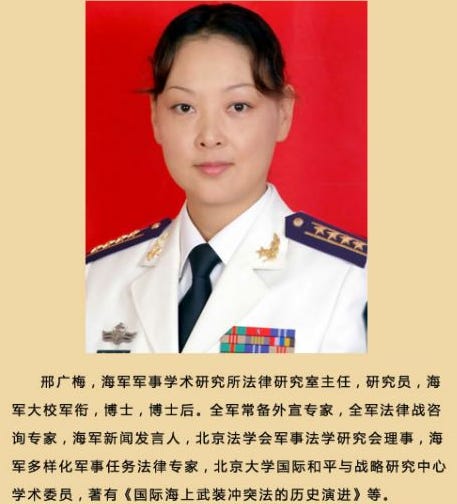
Li Shuo (栗硕) — Lecturer, PLA Foreign Languages Institute(解放军外国语学院讲师)
Liu Yanpeng (刘延鹏) — PhD, PLA International Relations Academy(中国人民解放军国际关系学院博士)
State-directed Belt and Road propagandists
United Front–associated academic organs


…illustrates her integration into a network that the CCP routinely uses for foreign influence, narrative shaping, and intelligence-adjacent information circulation.
4. National Security Vulnerabilities Created by Her PRC Engagement
Every PRC trip carries inherent security risks:
Mandatory digital inspection at PRC borders
Potential device cloning
Data extraction under PRC cybersecurity laws
Interactions with intelligence officers disguised as scholars or administrators
Academic Cover as an Influence Vector
Her participation in Tsinghua’s forum provides:
Access to foreign experts and policy influencers
An opportunity to track U.S. narratives and policy sentiment
A platform to subtly shape discussions aligned with PRC objectives
Academic spaces remain one of the primary zones where CCP influence can be exercised under the veneer of scholarly exchange.
5. Implications for U.S. National Security and Policy Institutions
Given her exposure to PRC intelligence environments and her field specialization in U.S.–China military and nuclear issues, U.S. institutions should:
Apply enhanced vetting for individuals embedded in PRC-linked research ecosystems.
Restrict participation in sensitive national security discussions where classified or sensitive information could be inferred.
Evaluate eligibility for access to U.S. academic programs with defense relevance.
The Department of Homeland Security (DHS), the Department of Defense (DoD), and institutions hosting her should investigate whether her continued presence poses undue risk.
6. Why Her Case Illustrates a Systemic Problem
Luo is not an isolated example—she represents an entire demographic of PRC-trained scholars who maintain strong linkages to China’s political, academic, and security systems while holding influential positions in the United States.
This dual positioning:
Facilitates potential intelligence collection
Allows CCP narrative infiltration into Western policy spaces
Creates vulnerabilities within U.S. academic and think tank networks
The CCP does not treat academic interactions as neutral—and neither should the United States.
Conclusion
Dr. Shuxian Luo’s profile reveals a convergence of risk factors: PRC academic integration, exposure to PLA-linked networks, early career within overseas Chinese propaganda-linked media, and deep involvement in U.S. national security-relevant research fields.
Her continued access to sensitive U.S. policy institutions must undergo rigorous scrutiny. The United States cannot afford to ignore the structural vulnerabilities created when PRC-aligned scholars enter nuclear, military, or geopolitical research spaces without appropriate safeguards.
Her case should motivate a broader national reevaluation of how PRC-linked academics are integrated into U.S. institutions — and what must change to protect American national security.
