When the BBC announced its 2012 strategic partnership with University College London (UCL), it framed the initiative as a bold step to accelerate digital media innovation. Eighty researchers from BBC R&D and UCL were to co-locate at 1 Euston Square, focusing on communications technologies, user experience, and media access systems.
On the surface, it was a story of domestic collaboration. But an in-depth look at the research network surrounding Anthony Finkelstein, then Dean of UCL Engineering, reveals a more complex and potentially alarming pattern of knowledge flows extending into strategically sensitive Chinese institutions.
Finkelstein and the Harman-Led CREST Network
Central to UCL’s software engineering ecosystem is Professor Mark Harman, director of the Centre for Research on Evolution, Search and Testing (CREST) from 2006–2017 and Head of Software Systems Engineering from 2012–2017. Harman, together with Finkelstein and a tightly knit cohort of researchers — including Yuanyuan Zhang, Yue Jia, Federica Sarro, Jian Ren, and Yijun Yu — produced a series of publications between 2008 and 2017 on search-based software engineering (SBSE), multi-objective optimisation, and predictive decision-making algorithms.
These works were far from abstract exercises: they tackled project staffing optimisation, multi-objective evolutionary algorithms, fairness in requirements assignments, and app-store mining for predictive insights. In other words, the network was developing advanced algorithmic capabilities directly applicable to digital infrastructure, logistics, and decision-support systems.
Timeline of International Knowledge Transfer
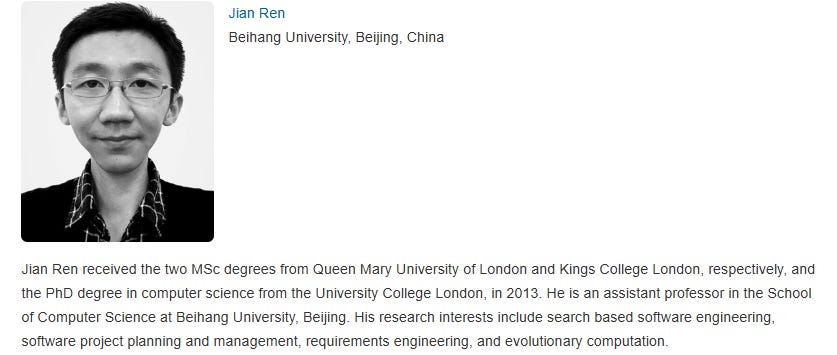
Jian Ren (任健)
PhD from UCL in 2013.
By 2017, employed at Beihang University (BUAA) — one of China’s seven major national defense universities with direct PLA affiliations.
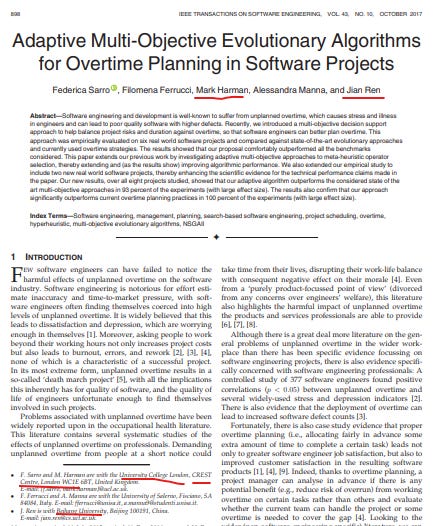
Co-authored the 2017 IEEE paper “Adaptive Multi-Objective Evolutionary Algorithms for Overtime Planning in Software Projects” with UCL researchers Mark Harman, and Federica Sarro, showing active cross-border collaboration.
This demonstrates that high-level algorithmic expertise from UCL was flowing directly into a PLA-linked institution, not after-the-fact, but as part of ongoing research.
Yijun Yu(俞一峻)
Education: B.Sc., M.Sc., Ph.D. from Fudan University, Shanghai.
UK affiliation: Senior Lecturer at Open University.
Critically, he served as PI for multiple knowledge-transfer projects with Huawei, Shenzhen, a company repeatedly linked to dual-use technologies and Chinese military programs.
Co-authorship with Harman and Zhang in 2017 paper shows another channel through which advanced SBSE methods were connected to strategically sensitive technology networks in China.
Other co-authors
Yuanyuan Zhang, Yue Jia, Federica Sarro and others maintained active collaborations across these projects, creating a dense network of algorithmic expertise that spans UCL, Chinese universities, and multinational tech entities.
Strategic Implications
Dual-use potential: Multi-objective optimisation, project staffing algorithms, and predictive decision-support tools are directly applicable to military logistics, digital infrastructure, and national security systems.
Knowledge pipeline: The Finkelstein–Harman UCL network functioned as a conduit, moving sophisticated software engineering knowledge into PLA-affiliated and Huawei-connected institutions.
Amplified risk through media tech partnership: Finkelstein’s BBC–UCL collaboration meant the same personnel were embedded in publicly funded media innovation, digital infrastructure experimentation, and advanced algorithm development, creating multi-channel vectors for technology transfer.
Conclusion
What the BBC heralded as an innovation hub is now revealed to be part of a global network of advanced research that includes PLA-linked universities and Huawei-affiliated projects.
Timeline and co-authorship patterns show ongoing collaboration rather than one-off academic ties, raising serious questions about how public research networks intersect with international strategic technology flows.
For observers of UK national security and digital infrastructure, this is a case study in how academic partnerships can unintentionally serve as strategic channels for knowledge transfer, underscoring the need for heightened scrutiny of ostensibly domestic “innovation hubs.”
When the BBC–UCL partnership was launched in 2012, one name stood publicly beside Anthony Finkelstein’s — BBC R&D.
But beneath that alliance lay another, quieter ecosystem: an academic network anchored at UCL’s Centre for Research on Evolution, Search and Testing (CREST), led by Professor Mark Harman, one of Finkelstein’s closest collaborators for nearly a decade.
The UCL Software Systems Core
Between 2008 and 2017, a series of publications reveal the breadth of the Finkelstein–Harman collaboration:
Search Based Requirements Optimisation: Existing Work and Challenges (Zhang, Finkelstein, Harman, 2008)
A Search-Based Approach to Fairness Analysis in Requirement Assignments (Finkelstein et al., 2009)
App Store Mining and Analysis (Al-Subaihin, Finkelstein, Harman, Jia, Sarro, Zhang, 2015)
Mining App Stores: Extracting Technical, Business and Customer Rating Information for Analysis and Prediction (Finkelstein, Harman et al., 2013)
Investigating the Relationship between Price, Rating, and Popularity in the Blackberry World App Store (Finkelstein, Harman et al., 2017)
These papers connect Finkelstein to a tightly knit research community — including Yuanyuan Zhang, Yue Jia, Federica Sarro, and Jian Ren — focused on the emerging discipline of search-based software engineering (SBSE).
From UCL’s Department of Computer Science, this group formed the operational backbone of CREST, which Harman directed from its founding in 2006 until 2017, while simultaneously serving as Head of Software Systems Engineering (SSE) from 2012 to 2017.
Optimising People, Projects, and Code
The group’s technical work often blended human-resource allocation algorithms, evolutionary optimisation, and multi-objective project planning.
For example:
Cooperative Co-Evolutionary Optimization of Software Project Staff Assignments and Job Scheduling (Ren, Harman, Di Penta, 2011) explored algorithmic ways to optimise staffing decisions — a convergence of software analytics and organisational management.
Exact Scalable Sensitivity Analysis for the Next Release Problem (Harman et al., 2014, ACM TOSEM) introduced scalability techniques for strategic release planning in software projects.
Adaptive Multi-Objective Evolutionary Algorithms for Overtime Planning in Software Projects (Sarro, Ferrucci, Harman, Manna, Ren, 2017) extended these concepts into predictive workforce modelling.
These were not small experiments — they were highly technical frameworks capable of influencing how software systems and personnel were jointly optimised, with direct applications in commercial project planning, automated testing, and data-driven management systems.
A Global Network of Co-Authors
Several of Finkelstein and Harman’s collaborators — notably Jian Ren, who received MSc degrees from Queen Mary University of London and King’s College London and a PhD in Computer Science from UCL in 2013 — would later appear in multinational research circles.
By 2017, CREST’s academic footprint spanned Europe, East Asia, and industry partners, mirroring the global diffusion of British software-engineering expertise into collaborative projects abroad.
Date: November 21, 2012
Source: BBC News — “BBC and University College London announce new strategic partnership”
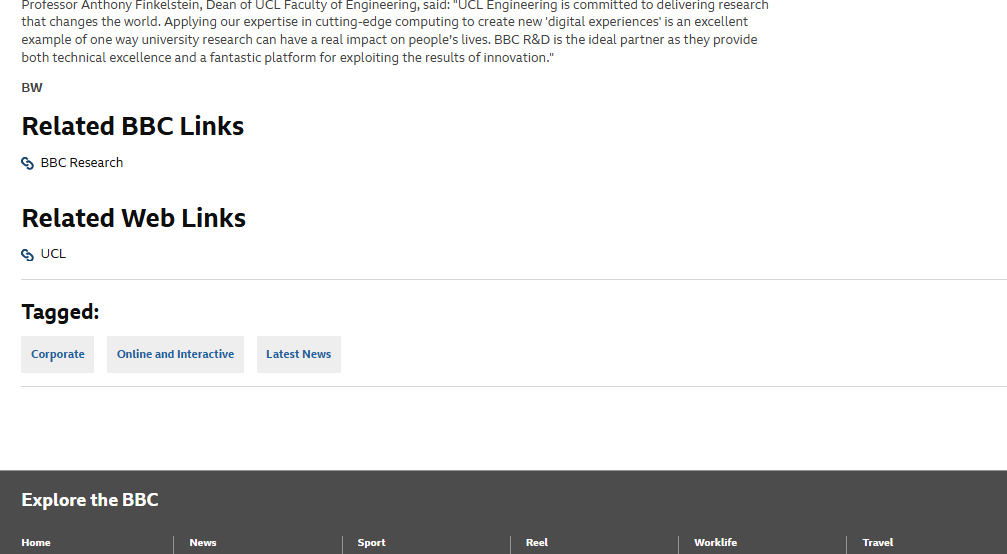
In 2012, the BBC proudly unveiled what it called a “strategic partnership” with University College London (UCL). On paper, it looked like progress — a four-year plan to fuse the broadcaster’s Research & Development division with UCL’s Faculty of Engineering, creating a new innovation hub at 1 Euston Square.
But behind the optimistic press language — “innovation,” “knowledge-sharing,” “future collaboration” — the deal also opened the BBC’s technology pipeline to external academic networks whose future partnerships would stretch far beyond domestic media engineering.
A “Gateway” — to Whom?
BBC R&D’s controller, Matthew Postgate, called the alliance “a gateway to further innovation.” Indeed, eighty researchers from the BBC and UCL would work side-by-side developing communications technologies, content-production tools, and user-experience systems — precisely the kind of infrastructure that overlaps with data analytics, content control, and digital signal processing.
The BBC announcement also emphasized that this new hub would “act as a gateway for participation with other universities and organisations.” In principle, that meant open collaboration. In practice, it meant the BBC’s engineering environment became a shared sandbox — one potentially accessible to international research partners of UCL, including those later identified as having Huawei or PLA-linked ties in adjacent projects.
Finkelstein’s Central Role
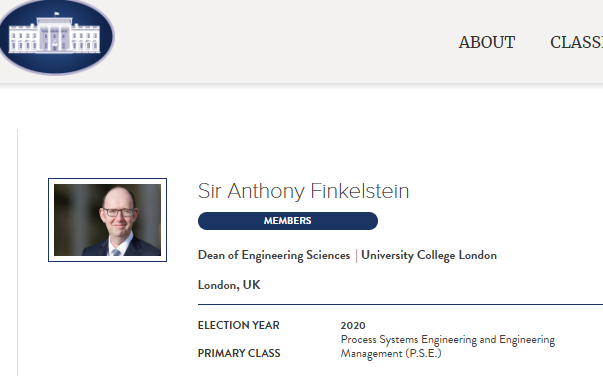
Quoted prominently was Professor Anthony Finkelstein, then Dean of UCL Engineering. He praised BBC R&D as “the ideal partner” for exploiting the results of innovation. His statement reveals how tightly academia and state media were being woven together: public broadcasting infrastructure on one side, academic computing power on the other.
Finkelstein’s later career trajectory — from UCL’s engineering dean to Chief Scientific Adviser for National Security — now casts this collaboration in a different light. It suggests that the BBC–UCL venture functioned not only as a research exchange but also as a cross-sector pipeline between Britain’s media, academia, and national-security apparatus.
Strategic Risks Hidden in Plain Sight
The partnership’s stated goals — “communications technology,” “user experience,” “access services” — sound harmless. Yet these are the very domains where dual-use technologies emerge: advanced networks, data compression, content filtering, and AI-driven media analytics. When such systems are co-developed in shared research environments, questions of data exposure and foreign influence become unavoidable.
UCL’s subsequent research ecosystem included collaborations and co-authorships involving Chinese institutions and firms later scrutinized for links to Huawei and the People’s Liberation Army (PLA). That doesn’t mean this specific BBC–UCL project was compromised — but it underscores how “innovation hubs” can unintentionally serve as transmission belts for technology and expertise into far less transparent networks.
Conclusion
The BBC portrayed the partnership as a triumph of British creativity. A decade later, the same arrangement looks more ambiguous: a case study in how open innovation, without strict geopolitical vetting, can blur the lines between public service broadcasting, academic freedom, and national-security exposure.
What was sold as a research milestone in 2012 may, in hindsight, mark the opening chapter of a much deeper technological entanglement.
#Democracy #Christ #Peace #Freedom #Liberty #Humanrights #人权 #法治 #宪政 #独立审计 #司法独立 #联邦制 #独立自治
No comments:
Post a Comment