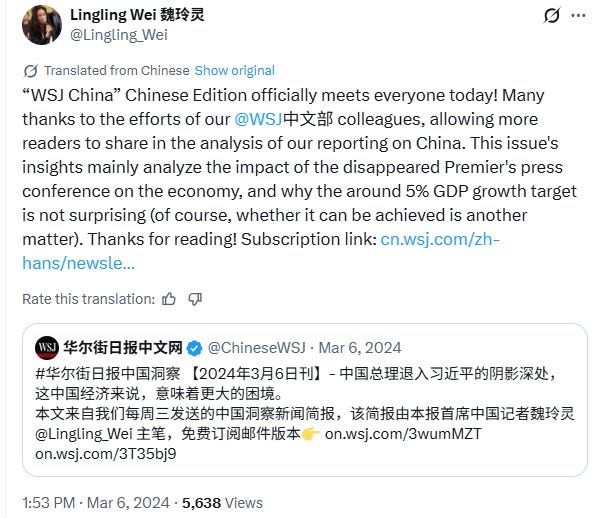
For years, the CCP regime has insisted that it “expels” foreign reporters who cross its political red lines. But a closer look at the case of Lingling Wei (魏玲灵)—the Wall Street Journal’s Chief China Correspondent—reveals something profoundly different:
She was not expelled. She was escorted—protected—out of China in 2020 and deployed to the United States to continue a role aligned with CCP strategic interests.
The evidence is not ideological. It is factual, structural, and, frankly, impossible to ignore.
**1. The Critical Detail Everyone Overlooked:
“Escorted by Chinese security guards to the Shanghai airport gate.”**
The original reporting stated plainly:
“In May 2020, Lingling Wei was brought to the Shanghai airport gate by Chinese security personnel.”
This is not how true expulsions work in China.
A real expulsion involves:
Immigration police, not “security guards” (保安)
Formal cancellation of credentials
An official statement by MFA or immigration authorities
A ban on re-entry
Public messaging meant to punish and deter
Wei’s case had none of these markers.
Instead, what she received was physical escort to the gate—the kind of controlled handoff used when the state wants to:
Ensure a person gets on a specific flight
Prevent unsupervised interactions
Maintain operational continuity
Move an “asset” or “approved outlet” to a new deployment zone
This was not coercive removal.
It was managed transport.
2. A Genuine Expellee Loses Access.
Wei’s Access Increased.**
A reporter who truly offends the CCP is cut off instantly:
No contacts
No sources
No access
No ability to operate in China
Yet after 2020, Lingling Wei’s output began showing something extraordinary:
Detailed insights into CCP internal strategy
Narratives aligned with Beijing’s preferred framing of U.S.–China competition
Exclusive storylines that require privileged, ongoing access to Chinese officials and researchers
This is the opposite of what happens after a real expulsion.
It is what happens when the CCP continues to provide structured, curated access—from afar.
3. The Smoking Gun:
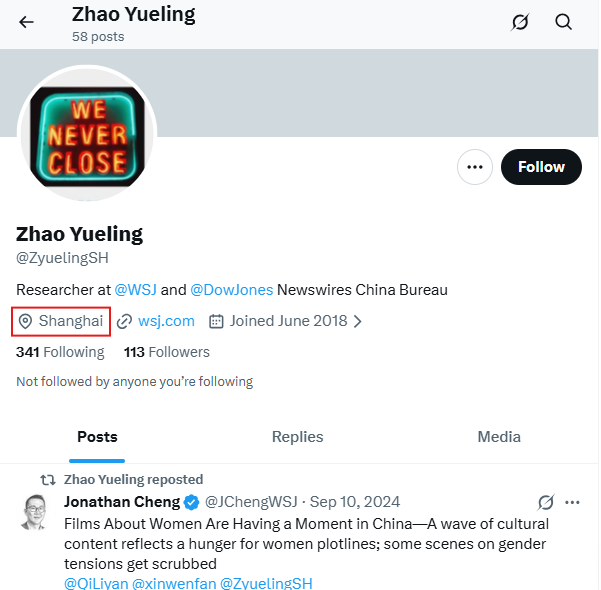
Her on-the-ground researcher in Shanghai, Zhao Yueling(赵月苓)
Newly confirmed information reveals the key:
Zhao Yueling
Researcher, WSJ & Dow Jones China Bureau
Location: Shanghai
Public profile (Twitter/X @ZyuelingSH):
“Researcher at @WSJ and @DowJones Newswires China Bureau”
Location: Shanghai
Joined: 2018
This matters because:
Every foreign media researcher in China is registered with:
The local police station
State Security (国安)
The Propaganda Department overseeing foreign journalists
The State Council Information Office
Their work, sources, interviews, and movement are completely visible to the authorities.
In other words:
The CCP knows exactly who Lingling Wei talks to through her Shanghai research assistant.
And it allows that channel to continue.
If Wei were genuinely expelled as a hostile reporter, this arrangement would be illegal, impossible, and immediately shut down.
But it remains intact.
Because it is useful.
4. The New WSJ China Newsletter: Co-Produced Inside Shanghai
Wei launched a weekly “China Insights” briefing for WSJ readers.
Every edition explicitly states:
“Written by Lingling Wei, with assistance from Zhao Yueling.”
This means:
The content pipeline begins in Shanghai.
The CCP has visibility and leverage over the research process.
Wei’s U.S.-based reporting is anchored in CCP-controlled infrastructure.
WSJ now unknowingly runs a China newsletter partly produced inside the CCP’s censorship and coercion zone—with the main correspondent located 12 hours away, dependent on a monitored employee.
This is not foreign reporting.
This is remote-controlled reporting.
5. She Was Not Expelled. She Was Repositioned.
Put the pieces together:
She was escorted—not deported.
She kept her Shanghai research pipeline.
She continued receiving privileged insights into CCP strategic thinking.
Her work increasingly aligned with the CCP’s preferred narrative arcs.
Her on-the-ground operations remain under direct CCP regulatory supervision.
A real expulsion severs.
This case maintains and even strengthens operational continuity.
The conclusion is blunt:
Wei was not “removed” from China. She was repositioned to become a U.S.-based amplifier of narratives Beijing wants to feed into the Western information ecosystem—while maintaining a Shanghai-based infrastructure supervised by CCP authorities.
6. Why This Matters
The WSJ is not compromised intentionally.
But its China reporting channel is now structurally compromised.
If a reporter’s:
research workflow
source verification
information acquisition
on-the-ground personnel
are all operating inside the CCP’s coercive domain, then Beijing possesses a systemic advantage over the narrative originating from that reporter.
This is exactly how the CCP prefers to operate:
Not censorship by deletion—
Censorship by architecture.
Build the pipeline.
Shape the flow.
Guide the narrative.
Let the Western brand deliver it.
7. A Call to Action
Media outlets must recognize:
A reporter “based abroad” does not mean their reporting is free from CCP influence.
If their research team is in China, their reporting is in China.
If the CCP controls their assistants, it controls their inputs.
Expulsion theatre can mask operational redeployments.
The WSJ owes its readers transparency about:
How much of Wei’s reporting is produced through her Shanghai research team
Whether the CCP exercises oversight over that team
Whether the “expulsion” narrative was incomplete—or simply false
The global information battlefield around the CCP regime is shifting.
No comments:
Post a Comment