
This view treats current policies—ranging from aggressive state intervention and intense information blockades to deep military-industrial integration—as a tragic derailment caused by one man’s personal ambition.
A rigorous examination of Chinese Communist Party (CCP) historical records reveals a different reality: Xi Jinping’s playbook is not original.
He has not inverted the system; he has simply inherited, consolidated, and accelerated an operational blueprint constructed by previous generations of party leaders. From the institutional washing of political violence to information control and economic financialization, the current regime represents the logical execution of a long-established institutional architecture.
1. Laundering Violence: The Institutional Blueprint
The conventional view paints Deng Xiaoping and his contemporaries as pragmatists who temporarily departed from party norms during the 1989 Tiananmen Square crackdown. However, the subsequent institutional response laid the groundwork for how the Party legitimizes state power today.
[ State Coercion / Violence ]
             │
             ▼
[ National Soviet Assembly (NPC) ]
             │
             ▼
[ Institutional "Legality" & Historical Erasure ]
Following the June 4th massacre, the Party executed a systematic campaign to grant the crackdown full legislative endorsement.
The 1990 Legislative Endorsement: During the Third Session of the 7th National Soviet Assembly (NPC) in March–April 1990, the assembly formally reviewed and approved the Standing Committee’s work report.
Framing the Narrative: Presented by Vice Chairman Peng Chong, the report explicitly defined the pro-democracy movement as “counter-revolutionary turmoil” aimed at overthrowing the socialist state. It declared that the State Council’s imposition of martial law was “necessary and legal,” officially ratifying the military action.
Collective Endorsement: The leadership circle of that 7th NPC—including figures like Xi Zhongxun, alongside key delegates such as Deng Xiaoping, army general Chi Haotian, and future premier Zhu Rongji—unanimously underwrote this resolution.
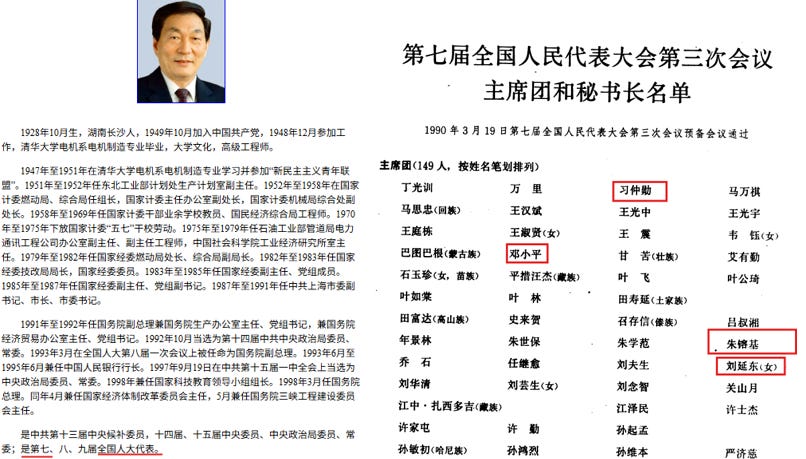
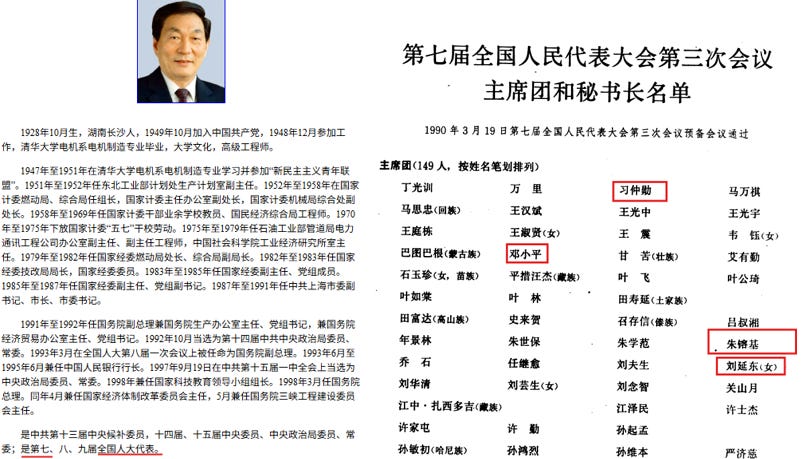
When modern observers watch Beijing impose sweeping national security legislation or retroactively reframe mass internments as “vocational training,” they are watching the exact same mechanism at work: use raw state power to enforce stability, then utilize formal legislative bodies to retroactively codify it into law.
2. The Consensus Model: The Myth of the “Technocratic Reformer”
Perhaps no figure embodies the Western myth of CCP reform more than Zhu Rongji, Premier from 1998 to 2003. Often celebrated as a ruthless market reformer who restructured state-owned enterprises (SOEs) and brought China into the World Trade Organization (WTO), Zhu’s career illustrates how economic technocracy operates alongside military and political hardliners.
Throughout his tenure as Premier, Zhu’s annual Government Work Report and state budgets were directly reviewed, voted on, and approved by the military delegation in the National Soviet Assembly.
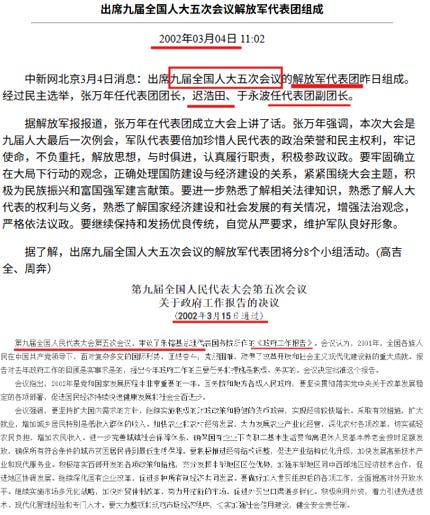
   [ Military Apparatus ] ◄── (Budget & Policy Approval) ──► [ Technocratic Cabinet ]
(Gen. Chi Haotian / PLA)                                     (Zhu Rongji / State Council)
The Military Interlock: General Chi Haotian—a key PLA commander during the 1989 martial law enforcement and later Vice Chairman of the Central Military Commission—headed the PLA delegation’s election committee jointly.
Mutual Reliance: The technocratic cabinet relied on the military’s legislative votes to pass national budgets and secure executive authority. In return, the state machinery provided funding and institutional coverage for military modernization.
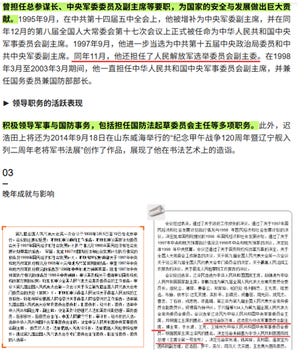
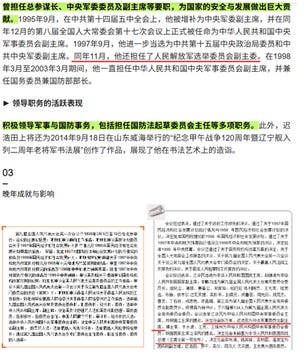
The technocratic “reforms” of the 1990s were never designed to transition China into a liberal market economy. They were engineered to streamline state assets, generate liquidity, and build a fiscal engine capable of supporting both internal security and external power projection.
3. The Information Black Box as an Economic Precondition
A central feature of current Chinese governance is the severe restriction of capital flows, economic data, and independent journalism. Yet, this “information black box” was constructed decades ago—not merely for ideological control, but as a structural necessity for state-led financial management.
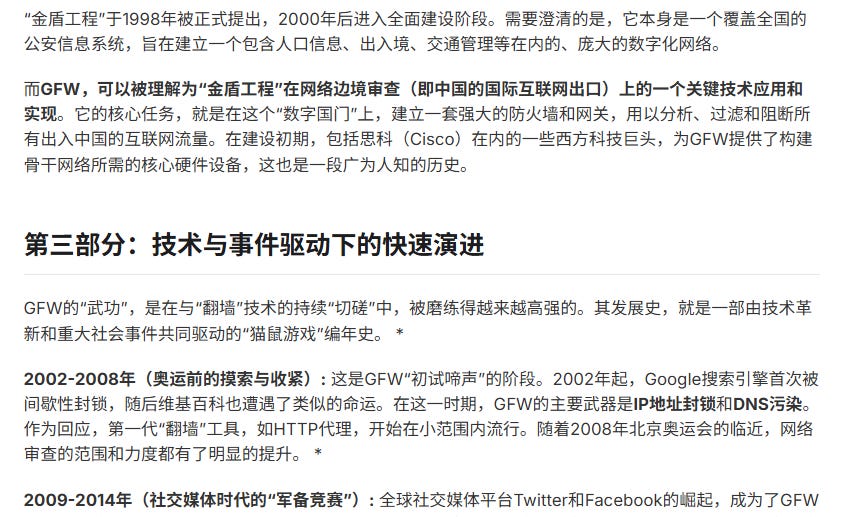
During Zhu’s premiership in the late 1990s, the government launched the “Golden Shield Project,” constructed the early architecture of the Great Firewall (GFW), and strictly prohibited private satellite receivers.
[ Information Black Box (GFW / Data Suppression) ]
                        │
                        ▼
    [ Artificial Consumer & Macroeconomic Data ]
                        │
                        ▼
[ Ingestion of Foreign Capital & Financial Engineering ]
This information curtain served two primary functions:
Ideological Erasure: It systematically suppressed domestic discussion of state violence, historical human rights abuses, and the severe societal costs of forced population control policies.
Financial Asymmetry: Financial instruments, asset-backed securitizations, and state-directed credit rely on market confidence. By controlling macroeconomic data, hiding structural debt, and obscuring underlying consumer demand, the state created an opaque environment. This allowed domestic financial institutions to package liabilities and attract foreign capital without exposing internal economic vulnerabilities.
As investment experts often observe regarding asset securitization, high-leverage financial engineering operates like nuclear power: “Used correctly, it is a nuclear energy; used recklessly, it is an atomic bomb.” In a state-managed information vacuum, financial leverage becomes a tool to absorb risk internally while projecting economic crisis bomb outward.
4. Structural Extraction and Structural Weakness
The long-term consequence of these combined policies—coercive extraction, information control, and top-down capital allocation—is visible in today’s domestic economy.
Decades of aggressive state campaigns, including severe forced demographic controls and direct asset seizures at the local level, systematically eroded the wealth of ordinary households. By stripping away private security guarantees and suppressing consumer income shares relative to GDP, the system drove household savings into defensive reserves and real estate.
[ Coercive Asset Extraction & Demographic Controls ]
                         │
                         ▼
   [ Erosion of Private Household Wealth Base ]
                         │
                         ▼
 [ Deflationary Pressures & Suppressed Consumption ]
Today’s structural challenges—persistent deflationary pressure, weak domestic consumption, and heavy reliance on state-directed manufacturing exports—are not recent miscalculations. They are the cumulative result of a governance model that has consistently prioritized state extraction and capital accumulation over household purchasing power for forty years.
5. Human Rights Disasters as a Financial Risk Factor
For decades, mainstream Wall Street analysts, ESG rating agencies, and corporate risk models treated international human rights reports—whether issued by the UN High Commissioner for Refugees, Human Rights Watch, or the U.S. State Department—as soft “reputational concerns” rather than material financial variables.
Economic realities demonstrate that human rights disasters are directly correlated with asset impairment, structural demand collapse, and the invalidation of financial models.
[ Systematic Human Rights Violations ]
                   │
    ┌──────────────┴──────────────┐
    ▼                             ▼
[ Micro Level ]            [ Macro Level ]
Property Destruction       Deflation & Demographic Collapse
Preventative Savings       Unenforceable Securitization
    │                             │
    └──────────────┬──────────────┘
                   ▼
  [ Material Asset Impairment & Loss ]
A. Micro-Level Asset Impairment and Collateral Risk
Arbitrary Property Deprivation: Coercive state campaigns—such as historic forced eviction, property confiscation, or Xinjiang-style supply chain disruptions—destroy household balance sheets. When private property rights are subordinate to state political campaigns, the underlying collateral of securitized consumer credit, mortgage-backed securities (MBS), and local debt becomes inherently unstable.
Capital Flight & Discount Rates: Systemic human rights abuses undermine legal predictability.
B. Macro-Level Destruction of Underlying Cash Flows
Demographic Collapse and Deflation: Decades of aggressive forced demographic control directly destroyed future consumption base. Financial models that assumed perpetual growth in domestic retail consumption, real estate absorption, and municipal tax revenue fail because the human foundation of that demand was artificially truncated.
The “Toxic Cash Flow” Problem in Securitization: Asset-backed securitization (ABS) relies on predictable, legally enforceable cash flows. In an economy where household income is systematically extracted to finance state objectives, consumer default rates rise quietly while official data remains suppressed. Investors who ignore human rights indicators fail to detect that the underlying cash flows supporting their yield products have already degraded.
C. Can Financial Analysis Continue to Ignore Human Rights Documentation?
The short answer is no. Integrating documentation from the UN, U.S. State Department, and international human rights NGOs is no longer an exercise in corporate virtue signaling; it is essential due diligence.
Sanctions and Exclusion Risk: Early human rights reporting is now a leading indicator for secondary sanctions, entity list designations, and trade bans (e.g., the Uyghur Forced Labor Prevention Act). Analysts who read human rights disclosures early anticipate regulatory write-downs before they hit corporate earnings.
Early Warning for Sovereign and Corporate Default: Severe human rights violations signal a regime’s willingness to sacrifice market mechanisms and private wealth for political survival. When a government engages in widespread domestic coercion, sovereign default risk, currency manipulation, and debt restructuring inevitably follow.
Ignoring human rights data in modern financial modeling is equivalent to ignoring credit ratings or macroeconomic indicators. Human rights reports document the physical and legal destruction of the real economy—the precise foundation upon which all financial assets ultimately rest.
Conclusion: Recognizing the Architecture
Xi Jinping’s governance style appears drastic only if one assumes the CCP was once on an inevitable trajectory toward Western-style liberal reform.
When stripped of rhetorical packaging, today’s policy environment is a continuation of established practices:
Legalizing Coercion: Utilizing state assemblies to ratify political crackdowns.
Civil-Military Integration: Ensuring the economic apparatus directly funds and aligns with defense priorities (Military-Civil Fusion).
Information Engineering: Maintaining strict control over data to manage domestic stability and international capital perception.
Xi Jinping has not rewritten the playbook. He is executing it with greater technological integration and centralized control. Understanding this continuity is essential for evaluating current geopolitical strategies, supply chain risks, and the structural dynamics of modern Chinese statecraft.
No comments:
Post a Comment