02 May 2026

Rethinking “Independence” in the Case of William W. Helman IV

If traditional definitions of corporate governance still assume that “independent directors” operate at arm’s length from geopolitical and institutional complexity, the profile of William W. Helman IV suggests that assumption is no longer tenable.

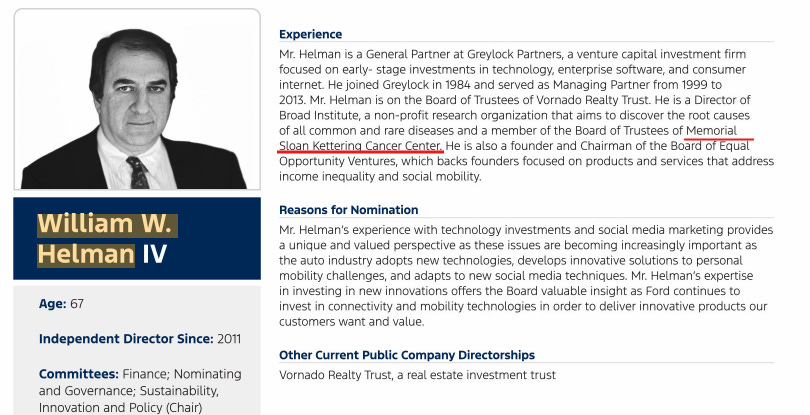
Helman, an independent director of Ford Motor Company since 2011, holds influential positions across venture capital, biomedical research, and nonprofit governance. He serves on Ford’s Finance and Nominating and Governance Committees and chairs Sustainability, Innovation and Policy—placing him at the center of how the company evaluates long-term strategic risk.

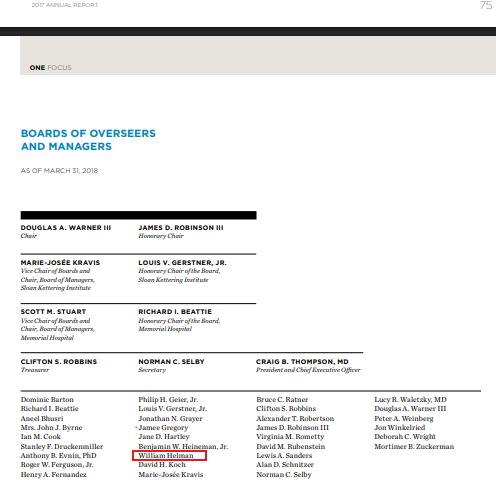
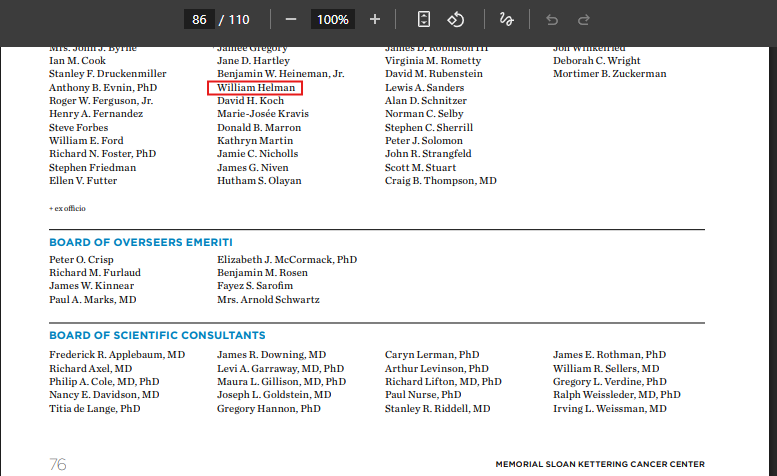
At the same time, he is a General Partner at Greylock Partners, a major force in early-stage technology investment, and a trustee or board member of leading scientific institutions including the Broad Institute and Memorial Sloan Kettering Cancer Center (MSKCC).

Individually, these roles reflect prestige and influence. Collectively, they reveal something more complicated: deep embedding in global systems where technology, healthcare, and international collaboration increasingly intersect with state-linked structures and strategic competition.


Biomedical Governance in a Globalized—and Uneven—System

Institutions like MSKCC and the Broad Institute sit at the forefront of biomedical innovation, including oncology, genomics, and data-intensive research. These are fields no longer confined to purely academic or clinical domains; they carry growing strategic significance due to their implications for biotechnology, population health data, and advanced therapeutics.

As a trustee of MSKCC, Helman is part of the governance structure responsible for overseeing institutional direction, partnerships, and ethical frameworks. That responsibility extends, at least in principle, to how the institution engages internationally.
And those engagements are not abstract.


Global Health Collaboration or Network Convergence?

In December 2023, MSKCC co-hosted the inaugural Cure4Cancer conference in New York alongside the China Thoracic Oncology Group (CTONG) and the Asia Society Policy Institute. The event brought together more than 200 participants, including cancer experts, public health leaders, biotech executives, hospital CEOs, advocacy groups, and policymakers, under the banner of advancing “global health equity.”

The stated goal—accelerating collaboration to improve cancer outcomes—is broadly uncontroversial. But the structure of the participating network warrants closer examination.

Publicly available information shows that CTONG’s member institutions include entities such as:

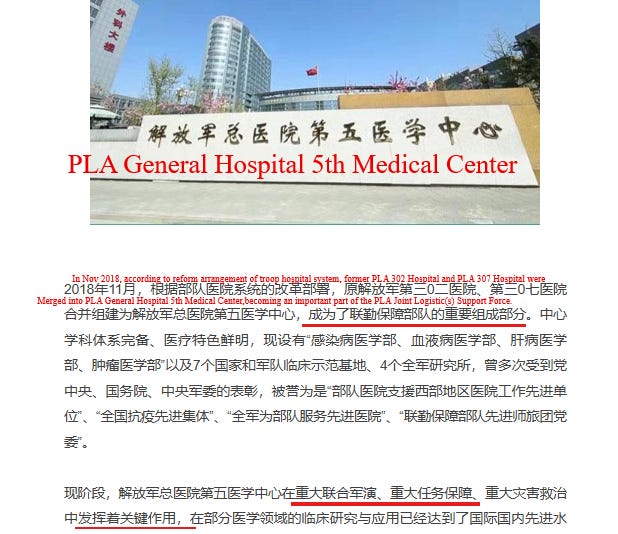
  • PLA-affiliated hospitals (including the former PLA 307 Hospital, now part of the PLA General Hospital system)

  • Military-region general hospitals such as those tied to the Nanjing Military Command

both under Joint Logistics Support Force of PLA founded by Xi Jinping.
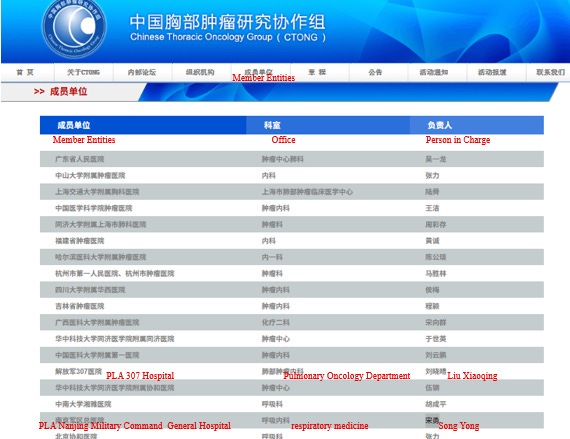
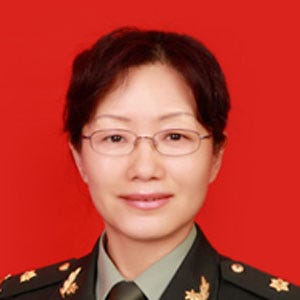
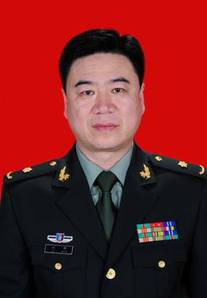
Liu Xiaoqing(刘晓晴) in charge of former PLA General Hospital 5th Medical Center (former PLA 307 Hospital) in relation to CTONG.
中国人民解放军东部战区总医院
Song Yong(宋勇 in charge of General Hospital of the Eastern Theater Command (formerly Nanjing Military Region) of the Chinese People’s Liberation Army in relation to CTONG

These are not purely civilian medical institutions. They operate within a system where military, research, and healthcare functions are often intertwined.


Institutional Responsibility Without Direct Participation

There is no indication that Helman personally participated in the Cure4Cancer conference or in any specific collaboration with CTONG. That is not the point.

The relevant issue is institutional governance:

  • As a trustee, Helman is part of the body that oversees MSKCC’s global engagement strategy

  • That strategy includes partnerships and convenings involving organizations with military-linked components

  • These interactions take place within a broader system where data, research, and expertise may have dual-use implications

This creates what can be described as second-order exposure—not direct involvement, but governance-level connection to complex international networks.


The Asia Society Link and Cross-Sector Convergence

The involvement of the Asia Society in the Cure4Cancer initiative adds another layer. The Asia Society ecosystem overlaps with figures such as John L. Thornton, another Ford board member with extensive ties to Chinese institutions.

This highlights a broader pattern:

finance, policy, academia, and healthcare are no longer operating in silos—they are converging through shared platforms and networks.

Cure4Cancer itself explicitly aims to unite:

  • Governments and regulators

  • Industry and investors

  • Academic and medical institutions

  • Advocacy groups and media

Such “whole-of-society” frameworks increase collaboration—but also reduce separation between domains that were once more clearly distinct.

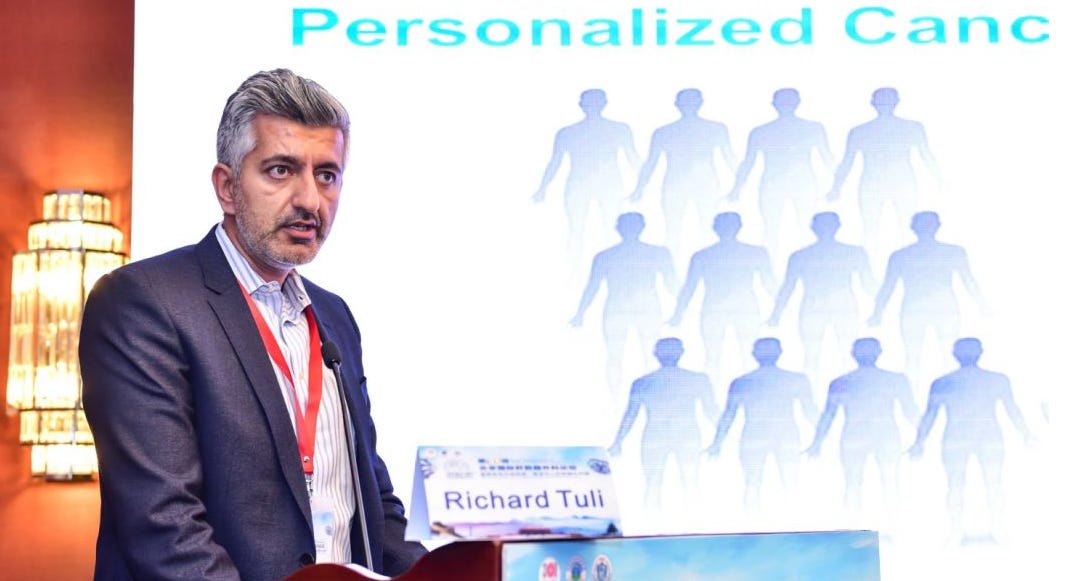
Importantly, this pattern of engagement is not limited to the 2023 Cure4Cancer conference. Earlier examples show a longer trajectory of interaction. In 2019, a physician from Memorial Sloan Kettering Cancer Center, Dr. Richard Tuli, participated in the 20th Beijing International Hepatobiliary and Pancreatic Surgery Forum, an event hosted by institutions directly affiliated with the Chinese PLA medical system, including departments of the PLA General Hospital. This demonstrates that MSKCC-linked participation in exchanges involving military-associated medical institutions predates recent initiatives and reflects an ongoing pattern rather than a one-off collaboration. For governance analysis, the implication is straightforward: the issue is not a single conference, but a sustained set of institutional interactions occurring over multiple years within complex, state-linked environments
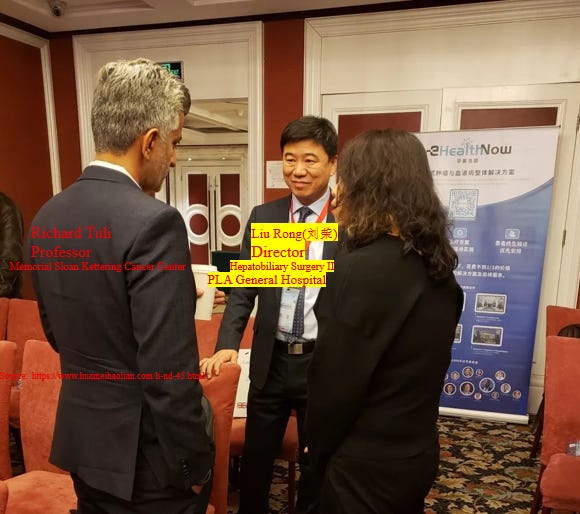
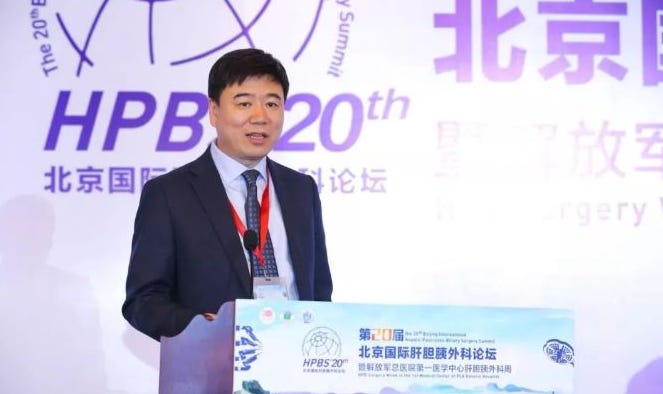
Liu Rong(刘荣), Director of the Department of Hepatobiliary Surgery II at the General Hospital of the PLA, delivered a speech at the Beijing International Hepatobiliary and Pancreatic Surgery Forum.
Dr. Richard Tuli, Professor of Biomedical Sciences, Associate Professor of Radiation Oncology, Clinical Director of Radiation Oncology, and Medical Director of Pancreatic Oncology at Memorial Sloan Kettering Cancer Center, was invited by E-Health Now to attend a special session of the Beijing International Hepatobiliary and Pancreatic Surgery Forum and shared his insights on “Comprehensive Treatment and Cutting-Edge Technologies for Biliary and Pancreatic Tumors” at the Comprehensive Cancer Treatment session.

.

Liu Rong(刘荣)

Liu Rong(刘荣):

I. Education Background

1981.09-1986.07 Bachelor of Clinical Medicine, Lanzhou Medical College

1990.09-1993.07 Master of Hepatobiliary Surgery, Second Military Medical University

1993.09-1995.07 Doctor of Hepatobiliary Surgery, Second Military Medical University

II. Work Experience

1986.07-1990.08 Resident Physician, Department of Oncology Surgery, First Affiliated Hospital of Lanzhou University

1995.07-1998.06 Attending Physician, Department of Hepatobiliary Surgery, General Hospital of the People’s Liberation Army

1998.07-2003.09 Associate Professor, Deputy Chief Physician, and Master’s Supervisor, Department of Hepatobiliary Surgery, General Hospital of the People’s Liberation Army

2003.09-2005.09 Professor (Qualified), Chief Physician (Qualified), and Doctoral Supervisor, Department of Hepatobiliary Surgery, General Hospital of the People’s Liberation Army

2005.09-2008.12 Professor, Chief Physician, and Doctoral Supervisor of Hepatobiliary Surgery, Department of Surgical Clinical Medicine, PLA General Hospital

2008.12-2011.05: Deputy Director of Administration, Professor, Chief Physician, and Doctoral Supervisor of Hepatobiliary Surgery, Department of Surgical Clinical Medicine, PLA General Hospital

2011.05-2013.12: Deputy Director of Administration, Professor, Chief Physician, and Doctoral Supervisor of Oncology Surgery, Department of Internal Medicine, PLA General Hospital

2013.12-2016.09: Director of Administration, Professor, Chief Physician, and Doctoral Supervisor of Department of Oncology Surgery II, Department of Internal Medicine, PLA General Hospital

2016.09-Present: Director of the PLA General Hospital Hepatobiliary Surgery Research Institute, Department of Surgical Clinical Medicine, PLA General Hospital; Director of Administration, Professor, Chief Physician, and Doctoral Supervisor of Department of Hepatobiliary Surgery II


Venture Capital and Strategic Technology Exposure

Helman’s long tenure at Greylock Partners adds further complexity. Venture capital firms play a central role in shaping the future of:

  • Artificial intelligence

  • Enterprise software

  • Data infrastructure

These sectors are increasingly subject to national security scrutiny due to their dual-use potential and strategic importance.

A director operating simultaneously in:

  • Venture capital

  • Biomedical governance

  • Global institutional collaboration

is positioned at the intersection of multiple high-sensitivity domains.


Rethinking Independence

Under current governance standards, Helman qualifies as independent. He has no direct employment relationship with Ford and no obvious financial conflict tied to the company.

But this definition is narrow—and increasingly outdated.

It fails to account for:

  • Institutional affiliations with global reach

  • Indirect exposure to state-linked systems

  • Cross-sector networks where influence flows through relationships rather than contracts

Independence, in today’s environment, is not just about who pays you.

It is about which systems you are embedded in—and how those systems interact.


Conclusion

William W. Helman IV’s profile does not point to misconduct. But it does reveal how modern governance risk operates.

Not through clear-cut conflicts of interest.

Not through direct actions alone.

But through networks—of institutions, collaborations, and overlapping domains where boundaries between civilian, commercial, and state-linked activity are increasingly blurred.

For a company like Ford, this raises a critical question:

Is formal independence enough, or should boards begin evaluating the deeper structural environments their directors are part of?

Until that question is addressed, the label “independent director” risks describing a legal status—rather than a meaningful safeguard.

#Democracy #Christ #Peace #Freedom #Liberty #Humanrights #人权 #法治 #宪政 #独立审计 #司法独立 #联邦制 #独立自治

Famine, Sovereignty, and the Missing Layer in Most Political Analysis

Most discussions about the Great Chinese Famine of 1959–1961 revolve around a familiar axis: central planning versus market systems, or authoritarianism versus democracy. While these frameworks capture part of the story, they often skip a more fundamental layer of analysis — sovereignty.

The key question is not simply how centralized decision-making was, but who had ultimate control over regional resources and whether that control was externally binding or internally negotiable.

Consider a counterfactual. If provinces like Sichuan, Anhui, and Henan had been independent states — comparable to Germany, France, or the United Kingdom — or even subnational units within the United States, the logic of food extraction would have been fundamentally different.

In such systems, no external central authority could unilaterally compel large-scale grain transfers that override local survival needs. Independent states retain sovereignty over agricultural output, and even in federal systems like the United States, states do not transfer food resources to an external government. The United States itself is a sovereign country and does not answer to any foreign authority.

This matters because sovereignty introduces a hard constraint: resource extraction must remain politically and legally accountable to the population experiencing scarcity. When famine conditions emerge, governments are forced — by institutional design — to prioritize local survival, suspend exports, and reallocate resources internally.

The critical structural difference, then, is not simply “centralization vs decentralization,” but whether a region has exit power — the ability to refuse or condition external demands on its resources.

Without sovereignty, local units cannot credibly resist extraction even under extreme scarcity. With sovereignty, such extraction becomes politically impossible or rapidly reversible.

This distinction is often missing in popular debates, which tend to moralize governance styles rather than examine the underlying architecture of authority. But in reality, governance outcomes are often less about ideology and more about who has enforceable control over what resources, and whether that control is bounded by autonomous political accountability.

Seen through this lens, the tragedy of famine is not only a story of policy failure, but also a story of structural power without local veto capacity — a configuration where resource flows can continue even when local survival conditions collapse.

#Democracy #Christ #Peace #Freedom #Liberty #Humanrights #人权 #法治 #宪政 #独立审计 #司法独立 #联邦制 #独立自治

30 April 2026

When “Independent” Isn’t Neutral: The Case of John L. Thornton on Ford’s Board


The designation of “independent director” is supposed to signal neutrality, objectivity, and freedom from external influence. But in today’s geopolitical reality, that label is increasingly outdated—especially when applied without regard to global institutional entanglements.

The appointment of John L. Thornton as Lead Independent Director of Ford Motor Company highlights this problem in stark terms.

Thornton is not a conventional outside director with limited external exposure. Instead, he sits at the intersection of Western corporate governance and a dense network of high-level institutional roles connected to Beijing.

Deep Institutional Integration in Beijing

Thornton has long-standing, formal ties to Tsinghua University School of Economics and Management, where he serves as a professor, director of its Global Leadership Program, and advisory board member. These are not ceremonial affiliations—they represent sustained engagement with one of the most politically connected academic institutions in China.

Tsinghua is widely recognized as a key training ground for elite political and economic leadership. Its governance structure and strategic direction are closely aligned with national priorities. Participation at this level implies ongoing interaction with policy-linked networks.

Advisory Roles to Chinese State Financial Regulators

More significantly, Thornton serves on the advisory board of the China Securities Regulatory Commission (CSRC), the top securities regulator in China under Central Committee of the Chinese Communist Party. According to official disclosures, the CSRC’s International Advisory Council was established with State Council approval and is designed to provide expert input into regulatory development.

This is not a private-sector role—it is direct advisory engagement with a central regulatory authority.

In addition, Thornton has served as an advisor or board member connected to the China Investment Corporation (CIC), China’s sovereign wealth fund responsible for managing hundreds of billions in state assets.

Taken together, these roles place Thornton in ongoing advisory proximity to core financial organs of the Chinese state. 


Recognition by the Chinese Government

Thornton was awarded the PRC “Friendship Award,” the highest honor granted to foreign nationals by the Chinese government. Such recognition is typically reserved for individuals who have made sustained contributions aligned with state priorities.

While awards in themselves do not imply improper conduct, they signal a level of political endorsement that goes well beyond routine professional interaction.

Overlapping Roles in Global Corporate and Policy Networks

At the same time, Thornton holds leadership roles across major global institutions:

  • Chairman of Barrick Mining Corporation
  • Chairman of RedBird Capital Partners
  • Lead director at Lenovo Group Limited
  • Senior roles in Asia Society and Brookings Institution

This portfolio reflects influence—but also complexity. It spans corporate governance, policy advisory, academia, and cross-border investment, with substantial overlap between Western institutions and Chinese state-linked structures.

The Core Question: Functional Independence

As Lead Independent Director at Ford, Thornton plays a critical role in:

  • Overseeing executive compensation
  • Shaping governance standards
  • Influencing board nominations
  • Acting as a counterweight to management

These responsibilities assume a baseline of independence not just in form, but in function.

Yet Thornton’s extensive, ongoing engagement with Chinese state-affiliated institutions raises a fundamental question:

Can a director simultaneously advise key regulatory and financial bodies in China while serving as the lead independent overseer of a major American industrial company?

The issue is structural:

  • Advisory roles to regulators and sovereign funds create alignment, or at minimum familiarity, with state priorities
  • Academic and institutional roles embed long-term relationships within elite policy networks
  • Recognition by the state reinforces those ties

Independence, in this context, becomes harder to define as purely financial or contractual.

A Governance Standard That Hasn’t Kept Up

Current corporate governance frameworks—particularly in the United States—define independence narrowly. They focus on:

  • Employment relationships
  • Financial conflicts
  • Board tenure

What they largely ignore is geopolitical exposure.

In an era where state and market are deeply intertwined in certain jurisdictions, especially China, this omission is no longer sustainable.

John L. Thornton’s career reflects global influence at the highest levels. But that same breadth of engagement complicates his role as Lead Independent Director at Ford.

The question is no longer whether a director is independent on paper.

The real question is whether they are independent in a world where corporate governance, state power, and global capital are increasingly inseparable.

Until boards, regulators, and shareholders confront that reality, the label “independent director” risks becoming more of a formality than a safeguard.

Advising a Sovereign Wealth Fund While Serving as “Independent” Director: A Structural Tension

Public disclosures from China Investment Corporation (CIC) clarify the substantive role of its International Advisory Council. According to CIC’s own description, this body is not symbolic—it is an internal, though non-standing, advisory mechanism composed of global experts that provides input on major development strategy, overseas investment strategy, and significant decision-making, while maintaining ongoing communication with the institution.

This matters directly in evaluating the role of John L. Thornton.

Thornton is listed as a member of this advisory structure. That places him in a position of regular, structured engagement with a sovereign wealth fund whose core mandate is global capital deployment on behalf of the Chinese state. CIC is not a passive investor; it is a strategic financial arm with visibility into international markets, assets, and policy-aligned investment priorities.

The implication is not that advisory council members control decisions—but that they contribute to how those decisions are framed, informed, and evaluated.

This creates a structural overlap:

  • On one side, Thornton serves as Lead Independent Director of Ford Motor Company, with responsibilities including governance oversight, compensation review, and acting as a counterbalance to management.
  • On the other, he participates in an advisory mechanism designed to inform the global investment strategy of a state-owned sovereign fund.

Even if both roles are performed in good faith, the alignment of incentives and informational ecosystems cannot be ignored.

CIC’s own language underscores that its advisory council exists to:

  • Shape strategic thinking
  • Enhance understanding of global markets
  • Support major investment decisions

That is precisely the domain in which a director of a major multinational company is also expected to operate—only from the perspective of shareholder interests.

The overlap raises a straightforward but uncomfortable question:

Can an individual simultaneously contribute to the strategic worldview of a state-backed global investor and act as a fully independent guardian of shareholder interests at a major U.S. corporation?

This is not a question of rule-breaking. It is a question of role convergence.

Corporate governance frameworks have traditionally focused on financial conflicts—equity stakes, compensation ties, or employment relationships. But CIC’s own disclosure highlights a different kind of connection: strategic advisory integration.

In an era where sovereign capital, state policy, and global markets are increasingly intertwined, that type of connection may be just as relevant—if not more so—than traditional definitions of conflict.


#Democracy #Christ #Peace #Freedom #Liberty #Humanrights #人权 #法治 #宪政 #独立审计 #司法独立 #联邦制 #独立自治

Corporate Governance, Cross-Border Influence, and Risk Exposure: The Case of Ford Director John Weinberg and Evercore’s Beijing Nexus


The nomination of John Weinberg—Chairman and CEO of Evercore Inc.—as an independent director on Ford Motor Company’s board, including service on its Compensation, Nominating and Governance, and Policy committees, raises serious questions about the meaning of “independence” in a deeply globalized but politically fragmented environment.

At first glance, Weinberg’s credentials fit the classic profile of a high-level independent director: long-standing leadership in a major advisory firm, deep capital markets experience, and exposure to global transactions. However, the underlying structure and operational footprint of Evercore complicate this narrative in ways that are not trivial.

1. Embedded Presence in Beijing and CCP Jurisdictional Exposure

Evercore maintains a direct operational presence in Beijing through its subsidiary, Evercore Consulting (Beijing) Co. Ltd. (致承咨询(北京)有限公司), and employs senior dealmakers such as Ye Ting Liu(刘育廷 or  Liu Ye Ting), a Senior Managing Director based in Hong Kong (actually in Beijing as indicated by record of Ministry of Commerce of Communist China),and Chenfei Wang, a Managing Director based in Beijing. Wang’s role is not peripheral—he is actively engaged in cross-border transactions spanning healthcare, consumer, industrial, and technology sectors. Operating in Beijing is not a neutral fact. It places personnel, data flows, and business activities within the jurisdictional reach of the CCP(Chinese Communist Party) regime, the CCP's military PLA and Central Military Commission of CCP. Under that system, corporate entities are subject to a legal and political environment where regulatory, national security, and party-state priorities are intertwined. This is not comparable to operating in a standard market economy governed solely by commercial law.


2. Track Record of Transactions Involving Politically Exposed Chinese Conglomerates

The transaction history associated with Evercore’s Beijing-based team further amplifies the concern. Notable deals include:

  • Advising on GNC’s sale of assets to Harbin Pharmaceutical Group (a major Chinese state-linked pharmaceutical company)
  • Advising Hilton’s board on a 25% investment from HNA Group
  • Participation in transactions involving Chinese consortia acquiring strategic technology assets (e.g., Source Photonics)

The involvement of HNA Group is particularly relevant. HNA has long been viewed as a politically entangled conglomerate with opaque ownership structures and documented financial instability. Its investment into Hilton Worldwide Holdings Inc. became a high-profile example of Chinese outbound capital targeting strategic Western assets.

These are not isolated advisory engagements—they reflect a consistent pattern of facilitating capital flows and asset transfers between Western firms and Chinese entities operating within, or closely aligned to, the CCP system.

3. Overlapping Governance Roles and Conflict-of-Interest Risks

Weinberg’s simultaneous leadership of Evercore and governance role at Ford creates a structural tension:

  • At Ford, he helps oversee executive compensation, governance standards, and long-term corporate strategy.
  • At Evercore, his firm actively advises on cross-border transactions involving Chinese counterparties, including those with potential geopolitical sensitivities.

This dual role raises a fundamental question: can a director be meaningfully “independent” while leading an organization whose revenue model depends on facilitating deals within a system where political considerations are inseparable from commercial ones?

Even absent any wrongdoing, the risk lies in incentive alignment and information asymmetry:

  • Incentive alignment: Evercore benefits from maintaining access to Chinese markets and deal flow.
  • Information asymmetry: Cross-border advisory work may expose Evercore leadership to insights—formal or informal—about strategic industries, capital movements, or regulatory intentions.

4. Regulatory and Legal Exposure via Hong Kong and Mainland Structures

Evercore’s Asia operations extend beyond Beijing into Hong Kong through Evercore Asia Limited, regulated by the Securities and Futures Commission under a legal environment reshaped by the Hong Kong National Security Law.

The imposition of this law fundamentally altered Hong Kong’s regulatory independence, increasing the potential for political intervention in corporate and financial activities. This introduces additional layers of uncertainty for any global firm operating there, including:

  • Data access and compliance risks
  • Political exposure in sensitive transactions
  • Reputational risk in Western markets

5. Governance Optics vs. Governance Reality

Ford’s board materials emphasize Weinberg’s independence and broad committee participation, including sustainability and policy oversight. But independence, in this context, appears defined narrowly—primarily in terms of lack of direct employment ties to Ford.

What is missing is a more modern standard of independence that accounts for:

  • Geopolitical entanglement
  • Exposure to authoritarian regulatory systems
  • The strategic implications of cross-border advisory roles

In today’s environment, independence is not just about who pays you—it is about which systems you are structurally tied into.

The case of John Weinberg illustrates a broader problem in corporate governance: legacy definitions of independence have not kept pace with the realities of global capital flows and political risk.

A director can be formally independent under SEC rules while simultaneously embedded in a network of relationships, incentives, and operational exposures that introduce non-trivial strategic risk—especially when those exposures involve jurisdictions where the boundary between state and market is fundamentally blurred.

For companies like Ford, this is not an abstract concern. It goes directly to board oversight quality, risk management, and ultimately shareholder trust.

Advising the Seller—or Serving the System? Independence Questions in Evercore’s China-Linked Deals

The role of a financial advisor in a sale transaction is straightforward in principle: represent the seller, maximize value, and act with undivided loyalty. But when cross-border deals intersect with politically embedded counterparties, that clarity begins to erode.

Recent disclosures surrounding Evercore Inc. raise legitimate questions about whether that line has remained intact in transactions involving Chinese buyers.

Senior Evercore bankers based in Beijing and Hong Kong—including Managing Director Chenfei Wang and Asia cross-border lead YeTing Liu—have advised on multiple transactions where Western assets were acquired, in whole or in part, by Chinese entities. These include deals involving Harbin Pharmaceutical Group, Chinese investor consortia, and the well-known case of a strategic stake in Hilton Worldwide Holdings Inc. by HNA Group.

On paper, Evercore was advising the seller side in these transactions. That designation carries strict fiduciary expectations: independence of judgment, rigorous price discovery, and a singular focus on the client’s best interests.

However, the operating context complicates that assumption.

Structural Pressures in Beijing-Based Advisory Work

Evercore maintains personnel and subsidiaries in Beijing, placing part of its advisory function within the jurisdiction of the CCP regime. In such an environment, commercial activity does not occur in isolation from political considerations. Regulatory access, deal approvals, and relationship networks can all influence transaction outcomes.

For advisors physically and professionally embedded in that system, a key question arises:
Can they remain fully independent when deal execution itself may depend on alignment—explicit or implicit—with local political and institutional expectations?

This is not a question of individual intent. It is a question of structural incentives and constraints.

Repeat Deal Flow and Incentive Alignment

Advisory firms depend on continued deal flow. In cross-border China-related transactions, that often means maintaining working relationships with repeat buyers—many of whom are either state-linked or operate within a system where political backing is decisive.

When the same advisor repeatedly facilitates acquisitions by similar categories of buyers, a tension can emerge:

  • Maximizing value for the current seller may conflict with preserving long-term access to future deals.
  • Pushing aggressively on valuation, disclosure, or conditions may risk jeopardizing relationships with influential counterparties.

In theory, fiduciary duty overrides all such concerns. In practice, the durability of that principle under these conditions deserves scrutiny.

The Seller’s Blind Spot

From the perspective of Western companies engaging an advisor like Evercore, the assumption is clear: the advisor is aligned entirely with the seller’s interests.

Yet sellers often lack visibility into:

  • The advisor’s broader pipeline of transactions involving similar buyers
  • The extent of its reliance on access to Chinese markets
  • The constraints faced by its personnel operating in Beijing

This asymmetry creates a potential blind spot. Even without misconduct, the perception risk alone can undermine confidence in the fairness of the process.

Hong Kong as an Extension of the Same Risk Environment

Evercore’s Asia operations also run through Beijing.

For an advisor handling sensitive cross-border transactions, these factors are not theoretical—they directly affect the conditions under which advice is formulated and delivered.

Independence: A Formal Label vs. A Functional Reality

In transaction documents, independence is typically defined in narrow financial terms—fee structures, prior engagements, or ownership stakes. By those metrics, firms like Evercore can satisfy all formal requirements.

But independence, in its functional sense, is more demanding. It requires:

  • Freedom from external pressures that could shape advice
  • The ability to challenge counterparties without constraint
  • A clear separation between client interests and institutional incentives

When advisory work is conducted within, and dependent on, a politically mediated market environment, that functional independence becomes harder to verify—and harder to trust.


Are existing standards for financial advisor independence adequate in transactions involving politically embedded buyers and jurisdictions with limited transparency?

For boards, shareholders, and regulators, that question can no longer be sidestepped. The credibility of the advisory process—and the integrity of cross-border M&A itself—depends on answering it honestly.

Mismatch in Executive Location Disclosures: A Red Flag in Evercore’s China Operations

A closer look at publicly available records reveals a discrepancy that raises additional questions about transparency and governance within Evercore Inc.’s Asia operations.

On Evercore’s official website, Ye Ting Liu (also rendered as Liu Ye Ting) is presented as a Hong Kong–based Senior Managing Director leading cross-border advisory activities across Asia. This positioning suggests that her professional base—and by extension, her regulatory and operational environment—is Hong Kong.

However, official records from the Ministry of Commerce of the People’s Republic of China (MOFCOM) tell a different story. These filings identify Liu Ye Ting as the legal representative (法定代表人) of Evercore’s Beijing subsidiary, 致承咨询(北京)有限公司 (Evercore Consulting (Beijing) Co. Ltd.), a role that carries formal legal responsibility under mainland Chinese law.

This is not a minor administrative detail.

1. Legal Representative Status Is Substantive, Not Symbolic

In the PRC corporate system, the legal representative is not merely a nominal title. It designates the individual who:

  • Holds formal authority to act on behalf of the company
  • Bears potential legal liability for corporate actions
  • Serves as the primary accountable party under regulatory scrutiny

That Liu Ye Ting holds this position ties her directly into the mainland legal framework, regardless of how her location is described in corporate marketing materials.

2. Hong Kong vs. Beijing: Two Different Legal Universes

The distinction between being “based in Hong Kong” and serving as legal representative of a Beijing entity is not cosmetic—it reflects exposure to fundamentally different systems:

  • Hong Kong operates under a partially internationalized financial regime, albeit reshaped by the Hong Kong National Security Law
  • Beijing operates under a system where corporate governance, regulatory enforcement, and political authority are deeply intertwined

Presenting an executive as Hong Kong-based while they hold a key legal role in a Beijing entity may obscure the extent of their integration into the mainland system.

3. Disclosure Gap and Its Implications

This discrepancy raises several governance-relevant questions:

  • Transparency: Why is the Beijing legal representative role not clearly highlighted alongside the Hong Kong designation?
  • Risk signaling: Are clients and counterparties given a full picture of where decision-making authority and legal accountability reside?
  • Regulatory exposure: Does the public-facing narrative understate the firm’s operational entanglement within mainland China?

Even if there is a benign explanation—such as dual roles or administrative structuring—the lack of alignment between disclosures creates ambiguity.

4. Implications for Advisory Independence

When viewed alongside Evercore’s involvement in cross-border transactions with Chinese counterparties, this inconsistency becomes more than a technical issue.

If senior leadership is formally embedded in mainland corporate structures while simultaneously advising on transactions involving Chinese buyers, it raises the question of whether:

  • The advisory function is fully insulated from local legal and political pressures
  • Clients are adequately informed about where influence and accountability truly sit

Again, the issue is not proof of misconduct—but the erosion of confidence that comes from incomplete or inconsistent disclosure.

Conclusion

In global finance, credibility depends not just on formal compliance, but on clarity. When an executive is publicly presented as operating in one jurisdiction while officially registered as the legal representative in another—particularly one with a very different legal and political environment—it invites scrutiny.

For a firm like Evercore, whose value proposition rests on independent, conflict-free advice, even small inconsistencies can carry outsized implications.

Because in cross-border deals involving sensitive jurisdictions, where you stand legally often matters more than where you say you sit geographically.

#Democracy #Christ #Peace #Freedom #Liberty #Humanrights #人权 #法治 #宪政 #独立审计 #司法独立 #联邦制 #独立自治

糯米团推文⬜️ Tweets of @NUOMT

Tweets of CPA Jim