Mark Harman’s 2019 Visit to Beihang University: Academic Exchange or Unrestricted Bio-Warfare Coordination?


Source:BUAA

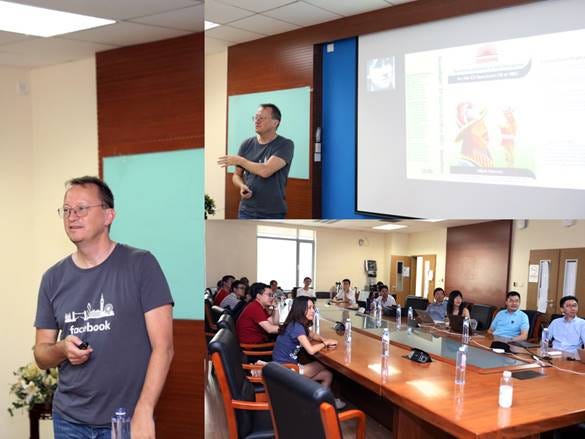
According to an official report from the Beihang University (BUAA) Software Engineering Institute website, dated July 15, 2019, Professor Mark Harman of University College London (UCL) and Engineering Manager of Facebook London’s Sapienz Team visited BUAA’s School of Computer Science, as invited by BUAA. The visit featured a lecture titled “The Joys and Frustrations of Software Engineering”, focusing on search-based software engineering (SBSE), software testing, and source code analysis. The event included detailed discussions with faculty, including Professor Wu Wenjun, and presentations by BUAA researchers on topics such as software models, human-centered software engineering, and cost estimation techniques.

While the report frames this visit as a routine academic exchange, a closer inspection of the actors and the context raises questions about possible strategic implications.

1. Ren Jian’s Role and Network

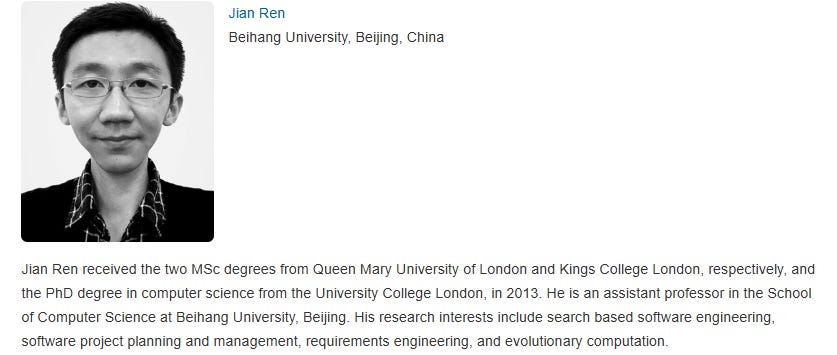
Although the BUAA report does not explicitly name the organizer, the evidence strongly suggests that Dr. Ren Jian (任健), a lecturer and CCF Software Engineering Committee member, was a key figure in facilitating the visit. Ren Jian’s profile includes:

  • PhD from UCL, with a long-term research collaboration with Mark Harman, including co-authored papers as recent as 2017.

  • Dual MSc degrees from Queen Mary University of London (QMUL) and King’s College London (KCL).

  • Research focus on SBSE, artificial intelligence, and natural computation, directly overlapping Harman’s own research areas.

  • Committee membership in the CCF Software Engineering Professional Committee, a national-level academic body with significant connections to industry and military-linked universities.

Given these credentials, Ren Jian could easily have orchestrated the invitation, serving as a bridge between UK-based software engineering expertise and Beihang University and the People’s Liberation Army of Chinese Communist Party (PLA-CCP), such as Academy of Military Sciences which has a subsidiary Academy of Military Medical Sciences a core of CCP’s bio-warfare program including COVID-19. This makes the visit more than a simple academic lecture; it could have provided direct pathways for knowledge transfer relevant to both advanced software engineering and military applications and influence channel for Central Military Commission of Chinese Communist Party, which is in control of PLA’s Academy of Military Medical Sciences, to censor reporting and opinions on COVID-19 origin by UCL’s collaborators such as BBC and Facebook. Facebook is also known for censoring opinions of COVID-19 origin during the pandemic.

Lawrence Sellin’s Newsletter
THE LABORATORY ORIGIN OF COVID-19 AND THE ONGOING COVER-UP OF ITS ORIGIN, THE STRUCTURE OF CHINA’S BIOWARFARE PROGRAM AND CHINA’S MASSIVE INFILTRATION OF U.S. VIRUS LABORATORIES
Executive Summary…
Read more

2. Timing Relative to the 2019 Military World Games

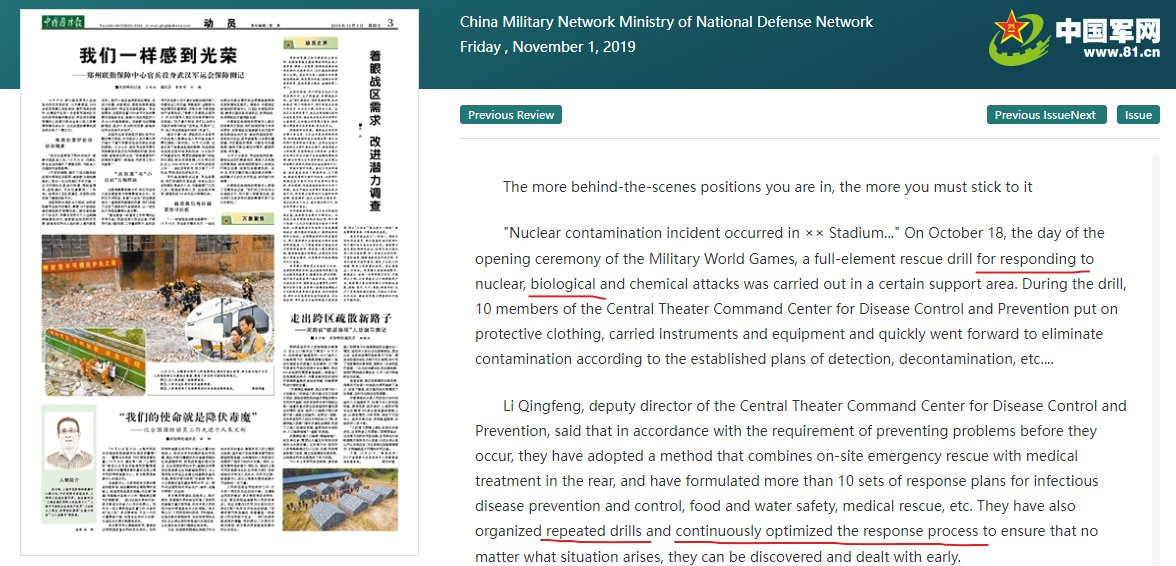
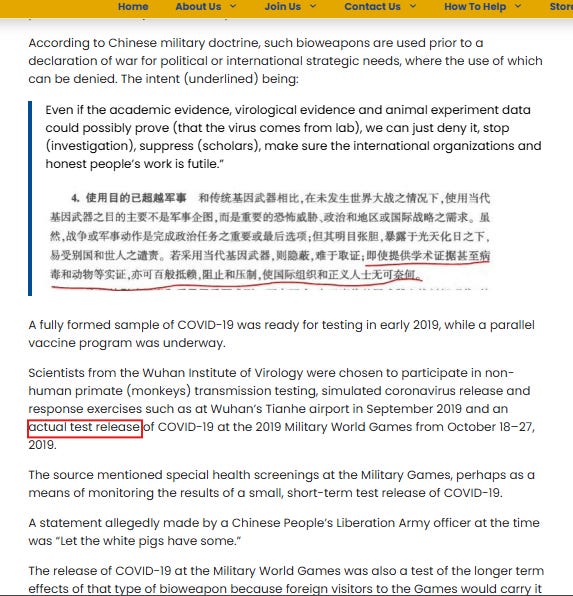
The CCP's invitation of  Mark Harman's visit occurred on July 15, 2019, just three months before the 2019 Military World Games and PLA’s Military Drill to Release COVID-19 virus in Wuhan (October 2019). The timing is striking for several reasons:

  • High-level PLA-affiliated institutions like BUAA often contribute technical expertise to national projects, including large-scale events with military logistics and coordination requirements.

  • Techniques in SBSE and algorithmic optimization, which Harman specializes in, could be highly applicable to real-time scheduling, operational simulations, and large-scale event software management.

  • Inviting Harman shortly before the Games provided a window for rapid application of advanced software engineering methods in environments of national strategic significance.

  • Possibly Making Preparation for PLA’s Military Drill to Release COVID-19 virus.
Image

3. Yijun Yu and Huawei Connections

Further complexity arises when examining the extended network:

  • Yijun Yu (俞一峻), another academic who has co-authored a paper with Harman, appeared in Doctoral Symposium Committee of APSEC 2017 with the organizing committee including Wang Qianxiang, a Huawei technical expert and Secretary-General of the CCF Software Engineering Committee.

  • This demonstrates that Harman’s collaborators are embedded in networks involving corporate and strategic entities, not isolated academia.

  • Such connections suggest that the invitation to Harman may have been facilitated not only by Ren Jian but possibly coordinated with Yijun Yu, leveraging the Huawei-linked committee infrastructure to create a formal academic platform for collaboration.

4. Implications of the Network

This layered network highlights a broader pattern:

  • Academic exchanges at PLA-linked universities, such as BUAA, can act as channels for Western technical expertise to flow into systems with strategic or military relevance.

  • Committee memberships, conference participation, and co-authorships provide soft mechanisms of technology transfer, united front work and censorship influence, where collaborations appear academic but have embedded strategic oversight.

  • Individuals like Ren Jian and Yijun Yu function as nodes connecting Western research leaders (e.g., Harman) to PLA-affiliated institutions and corporate actors like Huawei, creating a dense web of academic-industry-military interaction.

Conclusion

While publicly framed as an academic lecture, Mark Harman’s 2019 visit to Beihang University should be viewed within the context of:

  1. PLA-linked institutional involvement (BUAA as a national defense university).

  2. Strategically placed facilitators (Ren Jian and Yijun Yu), whose dual roles bridge UCL and the PLA-academic-industrial ecosystem.

  3. Timing relative to a major military-oriented event, the 2019 Military World Games.

  4. Embedded corporate ties, including Huawei’s involvement in committee leadership and prior APSEC 2017 events.

Taken together, these factors indicate that the visit was not merely an academic exchange but may have served strategic, applied purposes—demonstrating how Western academic collaboration can inadvertently intersect with PLA-aligned institutions and technology networks.

CCF Software Engineering Professional Committee (TCSE) – Full Member List

Chair

  • Jin Zhi, Professor, Peking University – zhijin@pku.edu.cn

Secretary-General

  • Wang Qianxiang, Technical Expert, Huawei Technologies – wangqianxiang@huawei.com

Vice-Chairs

  • Liu Chao, Professor, Beihang University (Beijing University of Aeronautics and Astronautics) – liuchao@buaa.edu.cn

  • Wang Ji, Professor, National University of Defense Technology of the People’s Liberation Army – wj@nudt.edu.cn

  • Zhao Jianjun, Professor, Shanghai Jiao Tong University – zhao-jj@cs.sjtu.edu.cn

  • Zhao Wenyun, Professor, Fudan University – wyzhao@fudan.edu.cn

Committee Members

  • Bai Xiaoying, Professor, Tsinghua University – baixy@tsinghua.edu.cn

  • Ben Kerong, Professor, Naval University of Engineering of PLA – benkerong08@21cn.com

  • Cai Kaiyuan, Professor, Beihang University – kycai@buaa.edu.cn

  • Cai Lizhi, Shanghai Computer Software Technology Development Center – clz@ssc.stn.sh.cn

  • Chen Qi, College of Information Science and Technology, Hainan University – chcq@hainu.edu.cn

  • Chen Rong, College of Information Science, Dalian Maritime University – rchen@dl.cn

  • Chen Lichao, Taiyuan University of Technology – Lc_chen@sohu.com

  • Chen Luping, China Software Testing Center – clp@cstc.org.cn

  • Chen Ningjiang, Guangxi University, Department of Computer Science – calmriver@263.net.cn

  • Chen Shizhan, Tianjin University – shizhan@tju.edu.cn

  • Chen Yixiang, Professor, East China Normal University – yxchen@sei.ecnu.edu.cn

  • Chen Zelin, Associate Professor, South China University of Technology – cszlchen@scut.edu.cn

  • Cui Xining, 631 Research Institute, China Aviation Industry Corporation – cuixining@tom.com

  • Cui Xiaohui, International Software College, Wuhan University – xcui@whu.edu.cn

  • Dan Jinhui, Beijing Special Engineering Design Institute – shanjh@163.com

  • Ding Zuohua, Zhejiang University of Technology – zouhuading@hotmail.com

  • Dong Yunwei, Associate Professor, Northwestern Polytechnical University – yunweidong@nwpu.edu.cn

  • Du Chenglai, Professor, Northwestern Polytechnical University – ducl@nwpu.edu.cn

  • Du Junwei, Qingdao University of Science & Technology – djwqd@163.com

  • Fan Guisheng, East China University of Science & Technology – gsfan@ecust.edu.cn

  • Fang Liechao, Huawei Technologies – alex.fangliechao@huawei.com

  • Feng Zhiyong, Tianjin University – zyfeng@tju.edu.cn

  • Gao Haichang, School of Software, Xidian University – hchgao@xidian.edu.cn

  • Gu Jianhua, Northwestern Polytechnical University – gujh@nwpu.edu.cn

  • Gu Chunhua, East China University of Science & Technology – chgu@ecust.edu.cn

  • Guo Tao, Director, China Information Security Testing Center – guotao@itsec.gov.cn

  • Han Qiang, Beifang Minzu University – hanqiang@bupt.edu.cn

  • Hong Mei, Sichuan University – hongmei@scu.edu.cn

  • Huang Linpeng, Shanghai Jiao Tong University – lphuang@sjtu.edu.cn

  • Huang Zhiqiu, Executive Deputy Dean, School of Information, Nanjing University of Aeronautics and Astronautics – zqhuang@nuaa.edu.cn

  • Jiang He, Dalian University of Technology – jianghe@dlut.edu.cn

  • Jiang Ying, Deputy Director, Department of Computer Science, Kunming University of Science & Technology – jy_910@163.com

  • Jiang Shujuan, China University of Mining and Technology – shjjiang@cumt.edu.cn

  • Li Bing, State Key Laboratory of Software Engineering, Wuhan University – bingli@whu.edu.cn

  • Li Hu, Senior Enterprise Architect Consultant, Beijing Miracle Zhongcheng Software Co., Ltd. – lihu@miraclet.cn

  • Li Jing, Researcher, Institute of Software, Chinese Academy of Sciences – lij@otcaix.iscas.ac.cn

  • Li Tong, Associate Dean, School of Software, Yunnan University – tli@ynu.edu.cn

  • Li Ying, Researcher, IBM China Research – lying@cn.ibm.com

  • Li Zheng, School of Information, Beijing University of Chemical Technology – lizheng@buct.edu.cn

  • Li Zhi, Guangxi Normal University – zhili@mailbox.gxnu.edu.cn

  • Li Bixin, Southeast University – bx.li@seu.edu.cn

  • Li Minglu, Shanghai Jiao Tong University – mlli@sjtu.edu.cn

  • Li Qingshan, Xidian University – qshli@mail.xidian.edu.cn

  • Li Xiaohong, Tianjin University, School of Computer Science & Technology – xiaohongli@tju.edu.cn

  • Li Xuandong, Nanjing University – lxd@nju.edu.cn

  • Li Xueqing, Shandong University – xqli@sdu.edu.cn

  • Liu Hui, Beijing Institute of Technology – Liuhui08@bit.edu.cn

  • Liu Jin, State Key Laboratory of Software Engineering, Wuhan University – mailjinliu@yahoo.com

  • Liu Lin, Tsinghua University – linliu@tsinghua.edu.cn

  • Liu Qiang, Professor, Tsinghua University – liuq880077@gmail.com

  • Liu Qin, Tongji University – qin.liu@tongji.edu.cn

  • Liu Xiaohua, East China Normal University – xliu@sei.ecnu.edu.cn

  • Liu Xiyang, Director, Research Institute, Xidian University – xyliu@xidian.edu.cn

  • Lu Lu, School of Computer Science, South China University of Technology – lul@scut.edu.cn

  • Lü Jian, Nanjing University – lj@nju.edu.cn

  • Mao Xiaoguang, Director, Computer Science Department, National University of Defense Technology of PLA – xgmao@sina.com

  • Mao Xinjun, Professor, National University of Defense Technology of PLA – xjmao@nudt.edu.cn

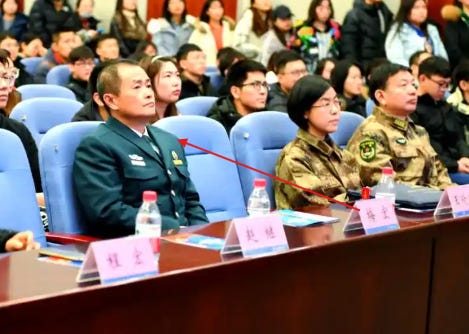
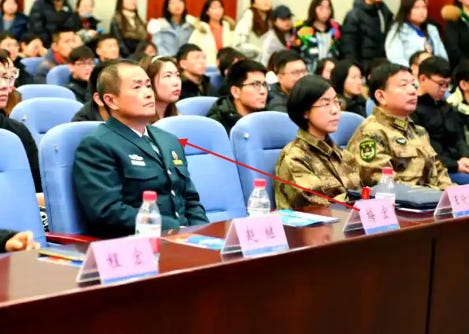
  • Mei Hong, Dean, School of Information Science & Technology, Peking University & (commencing from July 2019)Vice President of Academy of Military Sciences of PLA – meih@pku.edu.cn
    Image
  • Meng Jiayu, Huawei Technologies – mengjiayu@huawei.com

  • Meng Youxin, Director, Research Office, Qingdao University of Science & Technology – 222myx@163.com

  • Ming Zhong, Shenzhen University – mingz@szu.edu.cn

  • Nie Changhai, Nanjing University – changhainie@nju.edu.cn

  • Peng Rong, State Key Laboratory of Software Engineering, Wuhan University – adony_pr@qq.com

  • Peng Xin, Associate Dean, School of Software, Fudan University – pengxin@fudan.edu.cn

  • Qu Yuzhong, Nanjing University – yzqu@seu.edu.cn

  • Ren Jian, Beihang University – renjian@buaa.edu.cn

  • Ren Jicheng, Zhongke Fulong Computer Technology Co., Ltd. – renjc@fulong.com.cn

  • Rong Guoping, School of Software, Nanjing University – ronggp@software.nju.edu.cn

  • Shao Kun, Director, Software Institute, Hefei University of Technology – sk671227@yahoo.com

  • Shen Junrong, Morgan Stanley Asia – Junrong.Shen@morganstanley.com

  • Shen Limin, Vice Dean, Yanshan University – shenllmm@sina.com

  • Shen Beijun, Associate Professor, Shanghai Jiao Tong University – bjshen@sjtu.edu.cn

  • Song Yu, North China Electric Power University – syu1999@163.com

  • Song Qinbao, Xi’an Jiaotong University – qbsong@mail.xjtu.edu.cn

  • Sun Chang’ai, Beijing University of Science & Technology – casun@ustb.edu.cn

  • Sun Chaoyi, Chief Engineer, China Shipbuilding Industry 709 Research Institute – scy@709.net.cn

  • Tan Guozhen, Dalian University of Technology – gztan@dlut.edu.cn

  • Tao Xianping, Nanjing University – txp@ics.nju.edu.cn

  • Tong Weiqin, Director, School of Computer Science, Shanghai University – wqtong@mail.shu.edu.cn

  • Wang Wenyong, University of Electronic Science & Technology of China – wangwy@uestc.edu.cn

  • Wang Dan, Beijing University of Technology – wangdan@bjut.edu.cn

  • Wang Qing, Institute of Software, Chinese Academy of Sciences – wq@iscas.ac.cn

  • Wang Wei, Yunnan University – wangwei@ynu.edu.cn

  • Wang Guiling, North University of China – wangguiling@ncut.edu.cn

  • Wang Guojun, Central South University – csgjwang@gmail.com

  • Wang Maoguang, Central University of Finance and Economics – wangmg@cufe.edu.cn

  • Wang Shuxi, Xi’an University of Posts & Telecommunications – wsylxj@126.com

  • Wang Zhongjie, Harbin Institute of Technology – rainy.wang@gmail.com

  • Wei Jun, Deputy Director/Researcher, Institute of Software, Chinese Academy of Sciences – wj@otcaix.iscas.ac.cn

  • Wen Bin, Hainan Normal University – binwenwebb@gmail.com

  • Wen Junhao, Chongqing University – jhwen@cqu.edu.cn

  • Wu Ji, Beihang University – wuji@buaa.edu.cn

  • Xie Bing, Director, Software Engineering Research Center, Peking University – xiebing@sei.pku.edu.cn

  • Xie Tao, Associate Professor, UIUC, USA – taoxie@illinois.edu

  • Xing Chunxiao, Director, Web & Software Research Center, Tsinghua University – xingcx@tsinghua.edu.cn

  • Xu Tao, President, Civil Aviation University of China – txu@cauc.edu.cn

  • Xu Baowen, Nanjing University – bwxu@nju.edu.cn

  • Xu Jing, Nankai University – xujing@nankai.edu.cn

  • Xuan Qi, Associate Professor, Zhejiang University of Technology – crestxq@hotmail.com

  • Yang Jufeng, Nankai University – yangjufeng@nankai.edu.cn

  • Ye Junmin, Central China Normal University – jmye@mail.ccnu.edu.cn

  • Yin Jianwei, Zhejiang University – zjuyjw@cs.zju.edu.cn

  • Ying Jing, Zhejiang University – yingj@zucc.edu.cn

  • Ying Shi, Deputy Director, State Key Laboratory of Software Engineering, Wuhan University – yingshi@whu.edu.cn

  • Yu Dongjin, Hangzhou Dianzi University – yudj@hdu.edu.cn

  • Yu Huiqun, East China University of Science & Technology – yhq@ecust.edu.cn

  • Yuan Xiaojie, Nankai University – yuanxi@nankai.edu.cn

  • Zhan Dechen, Harbin Institute of Technology – dechen@hit.edu.cn

  • Zhang Bin, Director, Institute of Computer Applications, Northeastern University – zhangbin@mail.neu.edu.cn

  • Zhang He, Nanjing University – he@software.nju.edu.cn

  • Zhang Li, Vice Dean, School of Computer Science, Beihang University – lily@buaa.edu.cn

  • Zhang Chunhai, Ocean University of China – chai@ouc.edu.cn

  • Zhang Dongmei, Microsoft Research Asia – dongmeiz@microsoft.com

  • Zhang Guangquan, Soochow University – gqzhang@suda.edu.cn

  • Zhang Jiachen, Jilin University – zhangjc@jlu.edu.cn

  • Zhang Zhenyu, Institute of Software, Chinese Academy of Sciences – zhangzy@ios.ac.cn

  • Zhang Cheng, Anhui University – cheng.zhang@ahu.edu.cn

  • Zhao Fengyu, University of Shanghai for Science & Technology – zhaofengyv@126.com

  • Zhao Huiqun, North University of China – zhaohq6625@sina.com

  • Zheng Qinghua, Xi’an Jiaotong University – qhzheng@mail.xjtu.edu.cn

  • Zhou Xiaocong, Associate Director, School of Computer Science, Sun Yat-sen University – isszxc@mai.sysu.edu.cn

  • Zhu Guiliang, Director, Software Engineering Research Institute, North China University of Water Resources & Electric Power – zgg500@126.com

  • Zou Fengyi, Shandong Provincial Computing Center
Original content with minor modification to add titles omitted:

中国计算机学会软件工程专业委员会成员

主任

金 芝  

北京大学教授

zhijin[at]pku.edu.cn

秘书长
王千祥

华为公司技术专家

wangqianxiang@huawei.com

副主任
刘 超

北京航空航天大学教授

liuchao[at]buaa.edu.cn

王 戟

中国人民解放军国防科技大学教授

wj[at]nudt.edu.cn

赵建军

上海交通大学教授

zhao-jj[at]cs.sjtu.edu.cn

赵文耘

复旦大学教授

wyzhao[at]fudan.edu.cn

委员

  • 白晓颖清华大学教授baixy[at]tsinghua.edu.cn

  • 贲可荣中国人民解放军海军工程大学教授benkerong08[at]21cn.com

  • 蔡开元北京航空航天大学教授kycai[at]buaa.edu.cn

  • 蔡立志上海计算机软件技术开发中心clz[at]ssc.stn.sh.cn

  • 陈 绮海南大学信息科学与技术学院chcq[at]hainu.edu.cn

  • 陈 荣大连海事大学信息学院rchen[at]dl.cn

  • 陈立潮太原科技大学Lc_chen[at]sohu.com

  • 陈渌萍中国软件评测中心clp[at]cstc.org.cn

  • 陈宁江广西大学计算机系calmriver[at]263.net

  • 陈世展天津大学shizhan[at]tju.edu.cn

  • 陈仪香华东师范大学教授yxchen[at]sei.ecnu.edu.cn

  • 陈泽琳华南理工大学副教授cszlchen[at]scut.edu.cn

  • 崔西宁中国航空工业集团第六三一研究所cuixining[at]tom.com

  • 崔晓晖武汉大学国际软件学院xcui[at]whu.edu.cn

  • 单锦辉北京特种工程设计研究所高工shanjh[at]163.com

  • 丁佐华浙江理工大学zouhuading[at]hotmail.com

  • 董云卫西北工业大学副教授yunweidong[at]nwpu.edu.cn

  • 杜承烈西北工业大学教授ducl[at]nwpu.edu.cn

  • 杜军威青岛科技大学djwqd[at]163.com

  • 范贵生华东理工大学gsfan[at]ecust.edu.cn

  • 房列朝华为公司alex.fangliechao[at]huawei.com

  • 冯志勇天津大学教授zyfeng[at]tju.edu.cn

  • 高海昌西安电子科技大学软件学院hchgao[at]xidian.edu.cn

  • 谷建华西北工业大学教授gujh[at]nwpu.edu.cn

  • 顾春华华东理工大学教授chgu[at]ecust.edu.cn

  • 郭 涛中国信息安全测评中心实验室主任guotao[at]itsec.gov.cn

  • 韩 强北方民族大学计算机学院hanqiang[at]bupt.edu.cn

  • 洪 玫四川大学hongmei[at]scu.edu.cn

  • 黄林鹏上海交通大学教授lphuang[at]sjtu.edu.cn

  • 黄志球南京航空航天大学信息学院常务副院长zqhuang[at]nuaa.edu.cn

  • 江 贺大连理工大学jianghe[at]dlut.edu.cn

  • 姜 瑛昆明理工大学计算机系副主任jy_910[at]163.com

  • 姜淑娟中国矿业大学shjjiang[at]cumt.edu.cn

  • 李 兵武汉大学软件工程国家重点实验室bingli[at]whu.edu.cn

  • 李 虎北京奇迹众成软件有限公司资深企业架构顾问lihu[at]miraclet.cn

  • 李 京中科院软件研究所研究员lij[at]otcaix.iscas.ac.cn

  • 李 彤云南大学软件学院副院长tli[at]ynu.edu.cn

  • 李 影IBM中国研究院研究员lying[at]cn.ibm.com

  • 李 征北京化工大学信息学院lizheng[atbuct.edu.cn

  • 李 智广西师范大学教师zhili[at]mailbox.gxnu.edu.cn

  • 李必信东南大学教授bx.li[at]seu.edu.cn

  • 李明禄上海交通大学教授mlli[at]sjtu.edu.cn

  • 李青山西安电子科技大学qshli[at]mail.xidian.edu.cn

  • 李晓红天津大学计算机科学与技术学院xiaohongli[at]tju.edu.cn

  • 李宣东南京大学教授lxd[at]nju.edu.cn

  • 李学庆山东大学教授xqli[at]sdu.edu.cn

  • 刘 辉北京理工大学Liuhui08[at]bit.edu.cn

  • 刘 进武汉大学软件工程国家重点实验室mailjinliu[at]yahoo.com

  • 刘 璘清华大学linliu[at]tsinghua.edu.cn

  • 刘 强清华大学教授liuq880077[at]gmail.com

  • 刘 琴上海同济大学qin.liu[at]tongji.edu.cn

  • 刘 晓华东师范大学xliu[at]sei.ecnu.edu.cn

  • 刘西洋西安电子科技大学研究所所长xyliu[at]xidian.edu.cn

  • 陆 璐华南理工大学计算机学院lul[at]scut.edu.cn

  • 吕 建南京大学教授lj[at]nju.edu.cn

  • 毛晓光中国人民解放军国防科学技术大学计算机学院室主任xgmao[at]sina.com

  • 毛新军中国人民解放军国防科学技术大学教授xjmao[at]nudt.edu.cn

  • 梅宏北京大学信息科学技术学院院长、2019年7月开始中国人民解放军军事科学院副院长meih[at]pku.edu.cn

  • 蒙家玉华为公司mengjiayu@huawei.com

  • 孟友新青岛科技大学研究室主任222myx[at]163.com

  • 明 仲深圳大学教授mingz[at]szu.edu.cn

  • 聂长海南京大学计算机系changhainie[at]nju.edu.cn

  • 彭 蓉武汉大学软件工程国家重点实验室adony_pr[at]qq.com

  • 彭 鑫复旦大学软件学院副院长pengxin[at]fudan.edu.cn

  • 瞿裕忠南京大学教授yzqu[at]seu.edu.cn

  • 任 健北京航空航天大学renjian[at]buaa.edu.cn

  • 任继成中科辅龙计算机技术股份公司renjc[at]fulong.com.cn

  • 荣国平南京大学软件学院ronggp[at]software.nju.edu.cn

  • 邵 堃合肥工业大学软件所所长sk671227[at]yahoo.com

  • 申峻嵘摩根士丹利亚洲有限公司Junrong.Shen[at]morganstanley.com

  • 申利民燕山大学信息科学与工程学院shenllmm[at]sina.com

  • 申利民燕山大学信息科学与工程学院副院长shenllmm[at]sina.com

  • 沈备军上海交通大学副教授bjshen[at]sjtu.edu.cn

  • 宋 雨华北电力大学教授syu1999[at]163.com

  • 宋擒豹西安交通大学教授qbsong[at]mail.xjtu.edu.cn

  • 孙昌爱北京科技大学副教授casun[at]ustb.edu.cn

  • 孙潮义中船重工709所总工scy[at]709.net.cn

  • 谭国真大连理工大学教授gztan[at]dlut.edu.cn

  • 陶先平南京大学副教授txp[at]ics.nju.edu.cn

  • 童维勤上海大学计算机学院室主任wqtong[at]mail.shu.edu.cn

  • 汪文勇电子科技大学教授wangwy[at]uestc.edu.cn

  • 王 丹北京工业大学副教授wangdan[at]bjut.edu.cn

  • 王 青中科院软件所wq[at]iscas.ac.cn

  • 王 炜云南大学wangwei[at]ynu.edu.cn

  • 王桂玲北方工业大学wangguiling[at]ncut.edu.cn

  • 王国军中南大学教授csgjwang[at]gmail.com

  • 王茂光中央财经大学信息学院wangmg[at]cufe.edu.cn

  • 王曙燕西安邮电大学计算机学院wsylxj[at]126.com

  • 王忠杰哈尔滨工业大学rainy.wang[at]gmail.com

  • 魏 峻中科院软件研究所副主任/研究员wj[at]otcaix.iscas.ac.cn

  • 文 斌海南师范大学binwenwebb[at]gmail.com

  • 文俊浩重庆大学jhwen[at]cqu.edu.cn

  • 吴 际北京航空航天大学wuji[at]buaa.edu.cn

  • 谢 冰北京大学软件工程研究中心所长xiebing[at]sei.pku.edu.cn

  • 谢 涛美国 UIUC副教授taoxie[at]illinois.edu

  • 邢春晓清华大学WEB与软件研究中心主任xingcx[at]tsinghua.edu.cn

  • 徐 涛中国民航大学院长txu[at]cauc.edu.cn

  • 徐宝文南京大学教授bwxu[at]nju.edu.cn

  • 许 静南开大学教授xujing[at]nankai.edu.cn

  • 宣 琦浙江工业大学副教授crestxq[at]hotmail.com

  • 杨巨峰南开大学yangjufeng[at]nankai.edu.cn

  • 叶俊民华中师范大学计算机科学系jmye[at]mail.ccnu.edu.cn

  • 尹建伟浙江大学zjuyjw[at]cs.zju.edu.cn

  • 应 晶浙江大学教授yingj[at]zucc.edu.cn

  • 应 时武汉大学软件工程国家重点实验室副主任yingshi[at]whu.edu.cn

  • 俞东进杭州电子科技大学yudj[at]hdu.edu.cn

  • 虞慧群华东理工大学教授yhq[at]ecust.edu.cn

  • 袁晓洁南开大学信息学院教授yuanxi[at]nankai.edu.cn

  • 战德臣哈尔滨工业大学dechen[at]hit.edu.cn

  • 张 斌东北大学计算机应用研究所所长zhangbin[at]mail.neu.edu.cn

  • 张 贺南京大学教授he[at]software.nju.edu.cn

  • 张 莉北京航空航天大学计算机学院副院长lily[at]buaa.edu.cn

  • 张春海中国海洋大学教授chai[at]ouc.edu.cn

  • 张冬梅微软亚洲研究院dongmeiz[at]microsoft.com

  • 张广泉苏州大学教授gqzhang[at]suda.edu.cn

  • 张家晨吉林大学教授zhangjc[at]jlu.edu.cn

  • 张震宇中国科学院软件研究所zhangzy[at]ios.ac.cn

  • 章 程安徽大学cheng.zhang[at]ahu.edu.cn

  • 赵逢禹上海理工大学zhaofengyv[at]126.com

  • 赵会群北方工业大学教授zhaohq6625[at]sina.com

  • 郑庆华西安交通大学教授qhzheng[at]mail.xjtu.edu.cn

  • 周晓聪广州中山大学计算机科学系副主任isszxc[at]mai.sysu.edu.cn

  • 朱贵良华北水利水电学院软件工程研究所所长zgg500[at]126.com

  • 邹丰义山东省计算中心zoufy[at]keylab.net

#Democracy #Christ #Peace #Freedom #Liberty #Humanrights #人权 #法治 #宪政 #独立审计 #司法独立 #联邦制 #独立自治

BBC–UCL and the Finkelstein–Harman Network: A Conduit of Advanced Research into PLA-Linked and Huawei-Connected Institutions


When the BBC announced its 2012 strategic partnership with University College London (UCL), it framed the initiative as a bold step to accelerate digital media innovation. Eighty researchers from BBC R&D and UCL were to co-locate at 1 Euston Square, focusing on communications technologies, user experience, and media access systems.

On the surface, it was a story of domestic collaboration. But an in-depth look at the research network surrounding Anthony Finkelstein, then Dean of UCL Engineering, reveals a more complex and potentially alarming pattern of knowledge flows extending into strategically sensitive Chinese institutions.

Finkelstein and the Harman-Led CREST Network


Central to UCL’s software engineering ecosystem is Professor Mark Harman, director of the Centre for Research on Evolution, Search and Testing (CREST) from 2006–2017 and Head of Software Systems Engineering from 2012–2017. Harman, together with Finkelstein and a tightly knit cohort of researchers — including Yuanyuan Zhang, Yue Jia, Federica Sarro, Jian Ren, and Yijun Yu — produced a series of publications between 2008 and 2017 on search-based software engineering (SBSE), multi-objective optimisation, and predictive decision-making algorithms.

These works were far from abstract exercises: they tackled project staffing optimisation, multi-objective evolutionary algorithms, fairness in requirements assignments, and app-store mining for predictive insights. In other words, the network was developing advanced algorithmic capabilities directly applicable to digital infrastructure, logistics, and decision-support systems.

Timeline of International Knowledge Transfer


Jian Ren (任健)

PhD from UCL in 2013.


By 2017, employed at Beihang University (BUAA) — one of China’s seven major national defense universities with direct PLA affiliations.


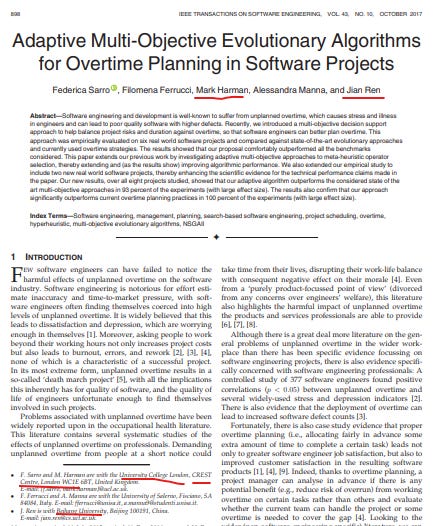
Co-authored the 2017 IEEE paper “Adaptive Multi-Objective Evolutionary Algorithms for Overtime Planning in Software Projects” with UCL researchers Mark Harman, and Federica Sarro, showing active cross-border collaboration.


This demonstrates that high-level algorithmic expertise from UCL was flowing directly into a PLA-linked institution, not after-the-fact, but as part of ongoing research.


Yijun Yu(俞一峻)

Education: B.Sc., M.Sc., Ph.D. from Fudan University, Shanghai.


UK affiliation: Senior Lecturer at Open University.


Critically, he served as PI for multiple knowledge-transfer projects with Huawei, Shenzhen, a company repeatedly linked to dual-use technologies and Chinese military programs.


Co-authorship with Harman and Zhang in 2017 paper shows another channel through which advanced SBSE methods were connected to strategically sensitive technology networks in China.


Other co-authors

Yuanyuan Zhang, Yue Jia, Federica Sarro and others maintained active collaborations across these projects, creating a dense network of algorithmic expertise that spans UCL, Chinese universities, and multinational tech entities.

Strategic Implications


Dual-use potential: Multi-objective optimisation, project staffing algorithms, and predictive decision-support tools are directly applicable to military logistics, digital infrastructure, and national security systems.


Knowledge pipeline: The Finkelstein–Harman UCL network functioned as a conduit, moving sophisticated software engineering knowledge into PLA-affiliated and Huawei-connected institutions.


Amplified risk through media tech partnership: Finkelstein’s BBC–UCL collaboration meant the same personnel were embedded in publicly funded media innovation, digital infrastructure experimentation, and advanced algorithm development, creating multi-channel vectors for technology transfer.

Conclusion


What the BBC heralded as an innovation hub is now revealed to be part of a global network of advanced research that includes PLA-linked universities and Huawei-affiliated projects.

Timeline and co-authorship patterns show ongoing collaboration rather than one-off academic ties, raising serious questions about how public research networks intersect with international strategic technology flows.

For observers of UK national security and digital infrastructure, this is a case study in how academic partnerships can unintentionally serve as strategic channels for knowledge transfer, underscoring the need for heightened scrutiny of ostensibly domestic “innovation hubs.”

When the BBC–UCL partnership was launched in 2012, one name stood publicly beside Anthony Finkelstein’s — BBC R&D.
But beneath that alliance lay another, quieter ecosystem: an academic network anchored at UCL’s Centre for Research on Evolution, Search and Testing (CREST), led by Professor Mark Harman, one of Finkelstein’s closest collaborators for nearly a decade.
The UCL Software Systems Core


Between 2008 and 2017, a series of publications reveal the breadth of the Finkelstein–Harman collaboration:

Search Based Requirements Optimisation: Existing Work and Challenges (Zhang, Finkelstein, Harman, 2008)


A Search-Based Approach to Fairness Analysis in Requirement Assignments (Finkelstein et al., 2009)


App Store Mining and Analysis (Al-Subaihin, Finkelstein, Harman, Jia, Sarro, Zhang, 2015)


Mining App Stores: Extracting Technical, Business and Customer Rating Information for Analysis and Prediction (Finkelstein, Harman et al., 2013)


Investigating the Relationship between Price, Rating, and Popularity in the Blackberry World App Store (Finkelstein, Harman et al., 2017)

These papers connect Finkelstein to a tightly knit research community — including Yuanyuan Zhang, Yue Jia, Federica Sarro, and Jian Ren — focused on the emerging discipline of search-based software engineering (SBSE).

From UCL’s Department of Computer Science, this group formed the operational backbone of CREST, which Harman directed from its founding in 2006 until 2017, while simultaneously serving as Head of Software Systems Engineering (SSE) from 2012 to 2017.
Optimising People, Projects, and Code


The group’s technical work often blended human-resource allocation algorithms, evolutionary optimisation, and multi-objective project planning.
For example:

Cooperative Co-Evolutionary Optimization of Software Project Staff Assignments and Job Scheduling (Ren, Harman, Di Penta, 2011) explored algorithmic ways to optimise staffing decisions — a convergence of software analytics and organisational management.


Exact Scalable Sensitivity Analysis for the Next Release Problem (Harman et al., 2014, ACM TOSEM) introduced scalability techniques for strategic release planning in software projects.


Adaptive Multi-Objective Evolutionary Algorithms for Overtime Planning in Software Projects (Sarro, Ferrucci, Harman, Manna, Ren, 2017) extended these concepts into predictive workforce modelling.

These were not small experiments — they were highly technical frameworks capable of influencing how software systems and personnel were jointly optimised, with direct applications in commercial project planning, automated testing, and data-driven management systems.
A Global Network of Co-Authors


Several of Finkelstein and Harman’s collaborators — notably Jian Ren, who received MSc degrees from Queen Mary University of London and King’s College London and a PhD in Computer Science from UCL in 2013 — would later appear in multinational research circles.
By 2017, CREST’s academic footprint spanned Europe, East Asia, and industry partners, mirroring the global diffusion of British software-engineering expertise into collaborative projects abroad.


Date: November 21, 2012
Source: BBC News — “BBC and University College London announce new strategic partnership”

In 2012, the BBC proudly unveiled what it called a “strategic partnership” with University College London (UCL). On paper, it looked like progress — a four-year plan to fuse the broadcaster’s Research & Development division with UCL’s Faculty of Engineering, creating a new innovation hub at 1 Euston Square.

But behind the optimistic press language — “innovation,” “knowledge-sharing,” “future collaboration” — the deal also opened the BBC’s technology pipeline to external academic networks whose future partnerships would stretch far beyond domestic media engineering.
A “Gateway” — to Whom?


BBC R&D’s controller, Matthew Postgate, called the alliance “a gateway to further innovation.” Indeed, eighty researchers from the BBC and UCL would work side-by-side developing communications technologies, content-production tools, and user-experience systems — precisely the kind of infrastructure that overlaps with data analytics, content control, and digital signal processing.

The BBC announcement also emphasized that this new hub would “act as a gateway for participation with other universities and organisations.” In principle, that meant open collaboration. In practice, it meant the BBC’s engineering environment became a shared sandbox — one potentially accessible to international research partners of UCL, including those later identified as having Huawei or PLA-linked ties in adjacent projects.
Finkelstein’s Central Role


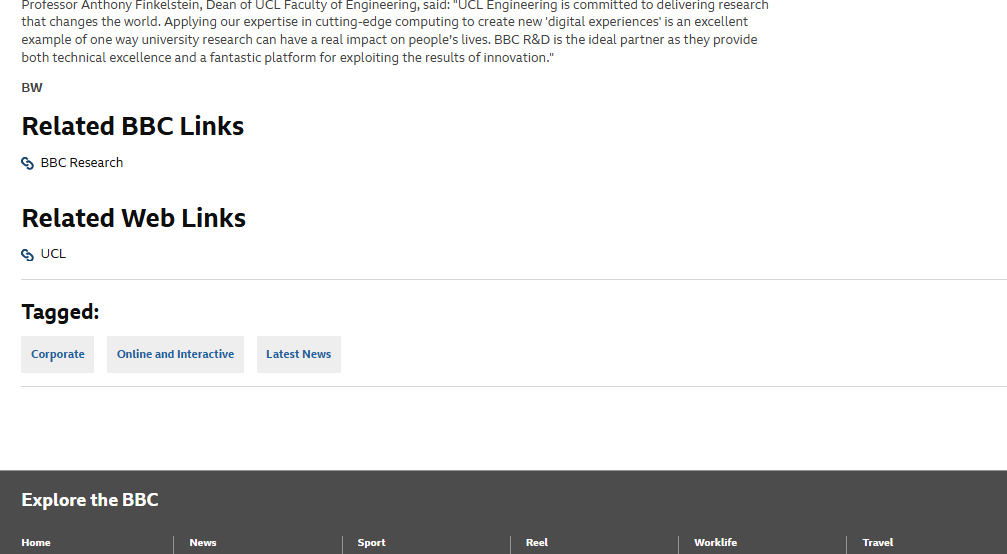
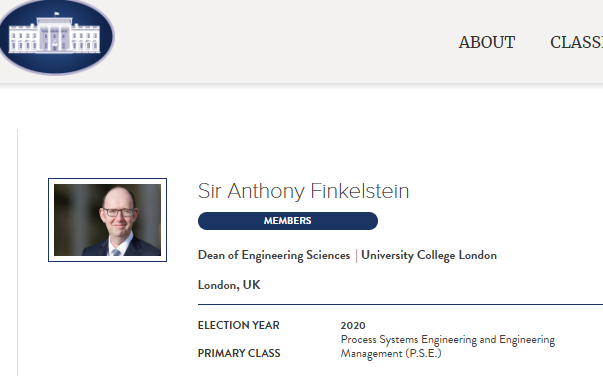
Quoted prominently was Professor Anthony Finkelstein, then Dean of UCL Engineering. He praised BBC R&D as “the ideal partner” for exploiting the results of innovation. His statement reveals how tightly academia and state media were being woven together: public broadcasting infrastructure on one side, academic computing power on the other.

Finkelstein’s later career trajectory — from UCL’s engineering dean to Chief Scientific Adviser for National Security — now casts this collaboration in a different light. It suggests that the BBC–UCL venture functioned not only as a research exchange but also as a cross-sector pipeline between Britain’s media, academia, and national-security apparatus.
Strategic Risks Hidden in Plain Sight


The partnership’s stated goals — “communications technology,” “user experience,” “access services” — sound harmless. Yet these are the very domains where dual-use technologies emerge: advanced networks, data compression, content filtering, and AI-driven media analytics. When such systems are co-developed in shared research environments, questions of data exposure and foreign influence become unavoidable.

UCL’s subsequent research ecosystem included collaborations and co-authorships involving Chinese institutions and firms later scrutinized for links to Huawei and the People’s Liberation Army (PLA). That doesn’t mean this specific BBC–UCL project was compromised — but it underscores how “innovation hubs” can unintentionally serve as transmission belts for technology and expertise into far less transparent networks.
Conclusion


The BBC portrayed the partnership as a triumph of British creativity. A decade later, the same arrangement looks more ambiguous: a case study in how open innovation, without strict geopolitical vetting, can blur the lines between public service broadcasting, academic freedom, and national-security exposure.

What was sold as a research milestone in 2012 may, in hindsight, mark the opening chapter of a much deeper technological entanglement.


#Democracy #Christ #Peace #Freedom #Liberty #Humanrights #人权 #法治 #宪政 #独立审计 #司法独立 #联邦制 #独立自治

The Controlled Liberal: How Feng Chongyi Became Beijing’s Perfect Messenger

被控制的自由派:冯崇义如何成为北京的完美代言人

2017年,悉尼科技大学(UTS)副教授、杨恒均博士导师冯崇义成为一场高度政治化事件的中心。冯崇义被天津国安局以“危害国家安全”名义限制出境,滞留广州期间每天接受五小时约谈。获释条件是签署声明,承诺不对外泄露讯问细节或地点

This episode marked Feng as a “controlled liberal”—someone whose personal freedom and professional credibility were intact, but who was now a monitored conduit for politically sensitive information. Years later, when Yang Hengjun’s prison correspondence letter to Australian Prime Minister Albanese was publicly disclosed, it was Feng who transmitted the letter, ensuring it passed both Beijing’s implicit approval and Western media’s scrutiny.

这一事件标志着冯崇义成为一个**“被控制的自由派”——个人自由和学术身份看似完整,但已成为受监控的政治信息通道**。多年后,当杨恒均致澳大利亚总理阿尔巴尼斯的狱中书信公开时,正是冯崇义提供了传递渠道,确保信件既符合北京的暗中审批,也能通过西方媒体的审查。

Feng’s role was far from purely academic. He is known for his admiration of Wen Jiabao, and he reportedly had indirect connections to Peng Liyuan and the PLA Military Medical Academy, as well as direct links to at least two PLA personnel, one holding the rank of Senior Colonel. His academic and personal credibility provided a credible veneer, allowing sensitive content—like Yang Hengjun’s gratitude towards the Chinese government from prison—to appear as a personal, voluntary expression rather than a controlled narrative.

冯崇义的角色绝非纯粹学术。他以崇拜温家宝闻名,据报道与彭丽媛及中国人民解放军军事医学科学院存在间接关联,并与至少两名解放军军人能直接关联,其中一人为陆军大校。他的学术与个人信誉提供了可信外衣,使得诸如杨恒均从狱中表达对中国政府感激之类敏感内容,看起来像是个人自愿表达,而非政治操控的产物。

This combination of overseas academic credibility, political oversight, and prison correspondence illustrates a sophisticated Beijing strategy: using ostensibly independent actors to project influence, control narrative, and shape international perception. Feng Chongyi exemplifies how a “controlled liberal” can become the perfect messenger, bridging the gap between a monitored domestic system and the global academic and media landscape.

这种“海外学术信誉 + 政治监控 + 监狱书信传递”的组合,展示了北京的精密策略:利用表面独立的个人来投射影响力、控制叙事、塑造国际舆论。冯崇义正是这种“被控制的自由派”的典型例子——成为完美的代言人,连接受监控的国内体系与全球学术、媒体网络。#Democracy #Christ #Peace #Freedom #Liberty #Humanrights #人权 #法治 #宪政 #独立审计 #司法独立 #联邦制 #独立自治

Yang Hengjun: Diplomacy, Prison, and CCP Gray Node Operations


The story of Yang Hengjun, a former employee of the Chinese Ministry of Foreign Affairs (MFA), is far more complex than media portrayals suggest. His public résumé hides a gray role at the intersection of diplomacy, the united front, and the CCP’s internal control mechanisms.


Background: MFA Experience

Yang publicly acknowledged his work for China’s MFA—a crucial detail. The MFA’s role involves building international networks, collecting foreign intelligence, and advancing China’s foreign policy interests. Such experience positions Yang as a high-value individual within China’s political and intelligence ecosystem.


Connections to CCP Power Networks

Yang has known ties to:

  • The CCP United Front Work Department

  • The PLA's Academy of Military Medical Sciences

  • The PLA General Political Department Song and Dance Troupe

  • Networks associated with Peng Liyuan

The PLA institutions ultimately report to the Central Military Commission. Connections placed him at the periphery of China’s core soft power, united front, and cultural diplomacy apparatus.

Suspended Death Sentence: Legal Framework

Yang was sentenced to a suspended death sentence (death with reprieve). The legal framework for this is codified in Article 23 of China’s Criminal Procedure Law (2018 revision):

Article 23 (translation):
"Criminals sentenced to death with a two-year reprieve, if they commit no intentional crimes during the reprieve period, shall be eligible for commutation. The executing authority shall submit a written opinion to the higher court for approval.
If an intentional crime is committed during the reprieve period, and the circumstances are serious, execution of the death sentence shall be carried out upon verification, and the higher court shall request approval from the Supreme People’s Court.
For intentional crimes not resulting in execution, the period of the suspended death sentence shall be recalculated and filed with the Supreme People’s Court."

This law provides flexibility that CCP leadership can exploit:

  • Retain political value: The prisoner can continue to serve in controlled capacities.

  • Threat enforcement: Death execution can be applied if disobedience occurs.

China’s 2018 revision of the Criminal Procedure Law increased flexibility, making such sentences a convenient tool for politically sensitive figures.


Media Omissions

Both domestic and foreign media rarely mention Yang’s links to military cultural institutions or Peng Liyuan’s network. Reports of his alleged sale of intelligence to Taiwan’s NSB and the role of Hainan security dominate narratives, omitting his MFA background and potential gray node role. Deleted reports about overseas offices or extended networks are themselves a signal of CCP concealment.


Letters and Political Messaging

Yang’s letters—such as those addressed to the Australian Prime Minister—reveal careful political positioning:

  • Explicit reference to China’s “24-character socialist core values”

  • Expressions of loyalty to China while acknowledging Australia

  • Crafted to demonstrate political reliability

Even in prison, CCP uses such letters to promote China’s story, converting prisoners into controlled instruments of diplomacy and propaganda.

The letter from Yang Hengjun to Australian Prime Minister Albanese originated from prison correspondence and was transmitted via multiple channels before reaching his PhD supervisor, Professor Feng Chongyi. Feng Chongyi served as Yang Hengjun’s doctoral advisor. Feng, a Vice Professor at the University of Technology Sydney, is known for his admiration of Wen Jiabao. He had indirect connections to Peng Liyuan and Academy of Military Medical Sciences, AMMS, of the Chinese People’s Liberation Army . Additionally, Feng had direct links with at least two PLA personnel, one of whom holds the rank of PLA Army Senior Colonel.


Prison Education and Labor: Institutionalized Control

China’s prison system enforces a dual framework:

High-value prisoners like Yang (in Beijing's No.2 Prision) may also complete diplomatic or united front tasks while in prison, receiving extra compensation.

  • Such compensation can be averaged with regular labor wages, allowing CCP to claim “Beijing prisons do not use forced labor”—a deliberate public relations mechanism.


A Systematized Gray Node

Yang’s case demonstrates a sophisticated, institutionalized gray node operation system:

  • Political control through suspended death and ideological training

  • Narrative shaping through letters and media manipulation

  • Diplomatic engagement via controlled communication with foreign governments

  • Economic leverage through prison labor and compensation mechanisms

In effect, he is both a captive and a tool, serving CCP interests while his story is carefully curated for public perception.


Takeaways

  • High-value prisoners can be integrated into CCP gray networks, performing diplomatic and united front tasks under supervision.

  • Prison labor, compensation, and education are used as multi-purpose control tools, blurring the line between punishment and political utility.

  • Media omissions and narrative framing form a critical part of CCP strategy, leaving international observers largely unaware of underlying risks.

Yang Hengjun’s story is a case study in how the CCP institutionalizes gray operations, leveraging individuals as nodes in a broader network of influence, diplomacy, and controlled messaging.


#YangHengjun #CCPUnitedFront #Diplomacy #MilitaryNetworks #SuspendedDeath #PrisonGrayNode #Australia

胡为美夫妇可能是中国共产党用于影响台湾的国家安全的有用特殊目的工具SPV

胡宗南,原名胡琴斋,1896年4月4日出生于浙江镇海。早年毕业于黄埔军校一期,是第一个追随蒋介石的人,因此号称“天子门生第一人”,是蒋介石最宠爱、最重要的军事将领之一。1955年9月,胡宗南晋任陆军二级上将,1962年2月病逝后被追晋为陆军一级上将。


胡为真,1947年8月4日生于南京,本籍浙江镇海,为中华民国著名将领胡宗南长子。1969年,22岁的胡为真毕业于台湾政治大学外交学系。1972年,获得美国乔治城大学硕士学位。1988年,又获得博士学位。2000年和2007年曾到美国哈佛大学做访问学者。胡为真曾经担任台湾驻美代表处组长、驻芝加哥办事处处长、台湾外交部礼宾司司长、驻德国代表、驻新加坡代表、台湾国家安全局副局长以及台湾国家安全会议副秘书长。此外,胡为真亦还在政大外交系兼任副教授。

胡为美,1952年出生于台湾,本籍浙江镇海,为中华民国著名将领胡宗南的小女儿。美籍华人。台湾辅仁大学图书馆系毕业,威斯康辛大学教育硕士。她曾任美国北加州华文作家协会第三任会长,美国文化大学青少年儿童福利系讲师及侨生外籍生主任、妇女杂志编辑、中文学校校长等职。胡为美现任职于北京房地产投资顾问。另外,她还著有《做一个快快乐乐的人》、《婚姻传奇》等书籍。胡为美的丈夫是IBM公司大中华区软件部总监王世毅。

2014年5月14日下午,湖州中学校友胡为美女士来到湖州中学,在湖州中学校长、中共党员吴维平、湖州中学党总支书记、中共党员沈培健的陪同下,参观了校园和校史陈列室,并在多次校园景观前拍照留念。胡为美女士的丈夫王世毅陪同访问。


胡为美于2023年3月27日到29日访问湖州师范学院,被湖州师范学院党委书记、中共党员许慧霞,湖州师范学院党委委员、党校办主任、中共党员劳士健等人接待,并收受礼品。据了解,胡为美女士始终心系中华人民共和国,多次去中华人民共和国探访,积极促进台湾与中国共产党的教育文化交流与合作,为中国共产党所统治地区的发展贡献自己的力量。


#Democracy #Christ #Peace #Freedom #Liberty #Humanrights #人权 #法治 #宪政 #独立审计 #司法独立 #联邦制 #独立自治#Democracy #Christ #Peace #Freedom #Liberty #Humanrights #人权 #法治 #宪政 #独立审计 #司法独立 #联邦制 #独立自治

Ad1