30 June 2026

Beyond the 2020 Narrative: Why the Public Record No Longer Supports Claims That Dr. Li-Meng Yan Was Associated with Miles Guo

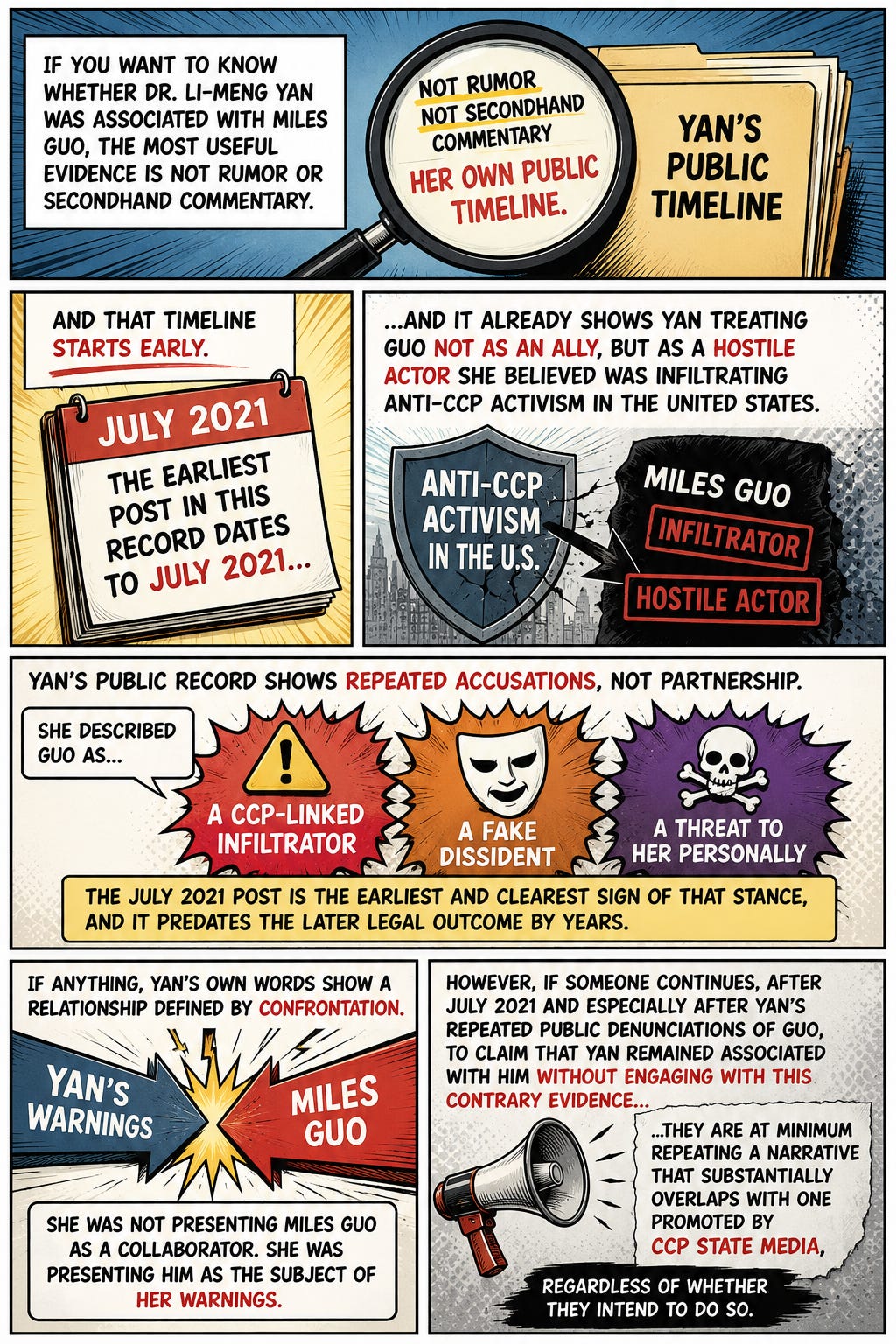
If you want to know whether Dr. Li-Meng Yan was associated with Miles Guo, the most useful evidence is not rumor or secondhand commentary. It is her own public timeline.

And that timeline starts early.

The earliest post in this record dates to July 2021, and it already shows Yan treating Guo not as an ally, but as a hostile actor she believed was infiltrating anti-CCP activism in the United States.

July 2021: the earliest public accusation

Dr. Li-Meng YAN @DrLiMengYAN1

CCP agent Miles, WenGui Guo organized his followers to break in to my apartment! And he is bragging with photos taken by them on Gettr! That’s how CCP infiltrated America and gave real life-threats to people who fight for freedom!

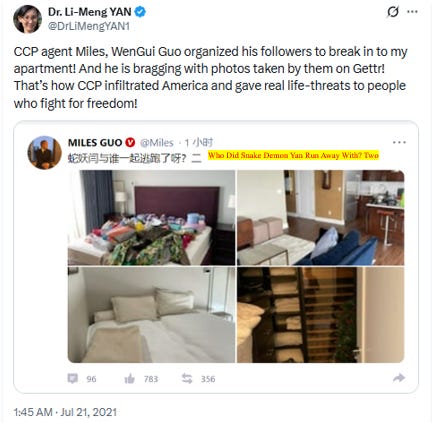
This July 2021 post matters because it sets the tone from the beginning. Yan was not describing a working relationship with Guo. She was accusing him of organizing a break-in, bragging about it online, and using that episode as evidence of CCP-style infiltration in the United States.

Miles Guo himself published posts attacking Yan. One post was titled:

“Who Did Snake Demon Yan Run Away With? Two”

The phrase “Snake Demon Yan” is a derogatory label directed at Dr. Yan, while the title insinuates that she fled with someone else.

In a July 14, 2021 livestream on his official YouTube channel titled “Snake Demon Yan...”, Guo repeatedly attacked Dr. Yan, referred to her using the derogatory label “Snake Demon Yan” (蛇妖闫), stated that legal action had already been initiated against her, and, elsewhere in the broadcast, reportedly said he wanted to “send Dr. Yan back to Hong Kong.” These statements are difficult to reconcile with claims that the two remained political allies after July 2021.

It was partly translated into English here, here and here.

The July 14, 2021 livestream lasted approximately 111 minutes. It was not limited to attacks on Dr. Yan. Guo also targeted other critics, including retired U.S. Army Reserve Colonel Lawrence Sellin. The broader context suggests that the broadcast formed part of a wider public campaign against individuals who had broken with or criticized him, rather than reflecting an ongoing alliance with Dr. Yan.

Here is the original livestream conducted in Chinese by Mils Guo.

To many international readers, Guo’s reported statement about “sending Dr. Yan back to Hong Kong” may sound like ordinary political rhetoric. However, the context is important.

Dr. Yan left Hong Kong in 2020 as she feared communist persecution for her research and public statements concerning COVID-19. She subsequently sought protection in the United States.

Since 2020, Hong Kong’s legal and political environment has changed significantly following the implementation of the National Security Law. Human rights organizations have documented the prosecution, detention, and imprisonment of numerous activists, journalists, and political figures under the law.

Against that backdrop, a public statement suggesting that Dr. Yan should be sent back to Hong Kong could reasonably be interpreted as implying exposure to legal or political risks, rather than merely a change of residence.

In other words, the earliest public record here does not suggest proximity. It suggests confrontation.

Yan’s broader view of Guo

Yan later expanded that accusation into a much broader political claim:

Dr. Li-Meng YAN @DrLiMengYAN1

No, Miles Guo WenGui is NOT a good guy at all.

Guo works for Xi Jinping, pretending to be a dissident. So his emphasized “NEVER against Xi.” Guo helps Xi

• Remove Xi’s political opponents in CCP

• Set traps to real dissidents

• Create chaos & division in 🇺🇸

• Try to KILL Me!。。。。。

This is Yan’s own language, and it is unusually direct. She is not presenting Guo as a fellow traveler or a useful contact. She is accusing him of being a covert operator who pretends to oppose the CCP while actually serving Xi Jinping’s interests.

The structure of the tweet matters too. Yan does not hedge. She says Guo is “NOT a good guy at all,” that he “works for Xi Jinping,” and that he helps Xi by removing political opponents, setting traps for dissidents, and creating chaos in the United States. Whether one accepts those allegations or not, the point for this discussion is clear: Yan was publicly positioning herself against Guo, not beside him.

After Guo’s conviction

Yan returned to the subject again in a later post after Guo’s federal conviction and sentencing:

Dr. Li-Meng YAN @DrLiMengYAN1

Great news!

Miles Guo (AKA Wengui Guo, or Kwok) — a fake anti-CCP figure who, in reality, served Xi Jinping’s Operation Trust in the United States — was sentenced today to 30 years in federal prison for the massive fraud he committed under the banner of “anti-CCP.”

• The prosecution’s sentencing calculation even reached Offense Level 55 (capped at Level 43 under the Federal Sentencing Guidelines), underscoring the extraordinary severity of his crimes.

• Guo’s RICO enterprise, also conducted cognitive warfare under the guise of fighting the CCP—mixing CCP-desired false narratives into otherwise truthful information to poison the information environment.

• Lude and I were the first whistleblowers to report Miles Guo’s organization to the U.S. government and expose it as a fake anti-CCP operation engaged in unrestricted warfare. Today’s sentence is justice served.

• It is also a direct rebuke to those media outlets and individuals who echoed the CCP’s smears by falsely accusing Lude and me of being associated with Miles Guo’s criminal enterprise!

This post is especially important because Yan explicitly rejects the idea that she and Lude were associated with Guo. In her telling, they were the first whistleblowers to expose him to the U.S. government. She frames herself not as a participant in Guo’s orbit, but as one of the people who warned against it.

That distinction is the heart of the matter.

So, was Dr. Yan associated with Miles Guo?

Based on these tweets, the answer is no—not in any cooperative or allied sense.

Yan’s public record shows repeated accusations, not partnership. She described Guo as a CCP-linked infiltrator, a fake dissident, and a threat to her personally. The July 2021 post is the earliest and clearest sign of that stance, and it predates the later legal outcome by years.

If anything, Yan’s own words show a relationship defined by confrontation. She was not presenting Miles Guo as a collaborator. She was presenting him as the subject of her warnings.

The July 2021 tweet is an important chronological marker. By that point, Dr. Li-Meng Yan had already publicly accused Miles Guo of acting against her interests and alleged that his followers had broken into her apartment. In subsequent years, she repeatedly expanded those accusations, ultimately stating that she and Lude had reported Guo’s organization to U.S. authorities and rejecting claims that they were associated with his enterprise.

Against that timeline, continuing to assert after July 2021 that Yan was “associated with Miles Guo” requires evidence that outweighs her own subsequent public conduct and statements. Simply repeating an earlier narrative without addressing the later public record risks presenting an incomplete picture.

It is also notable that Chinese state media and affiliated outlets have, over the years, portrayed Yan as being tied to Guo and Steve Bannon as part of a broader effort to discredit her.

That does not automatically mean that everyone who repeats such claims is echoing CCP messaging. People may rely on outdated reporting, incomplete information, or independent reasoning. However, if someone continues, after July 2021 and especially after Yan’s repeated public denunciations of Guo, to claim that Yan remained associated with him without engaging with this contrary evidence, they are at minimum repeating a narrative that substantially overlaps with one promoted by CCP state media, regardless of whether they intend to do so.

#Democracy #Christ #Peace #Freedom #Liberty #Humanrights #人权 #法治 #宪政 #独立审计 #司法独立 #独立自治

中共中央军委指挥的枪杆子现役和李学纯一起担任第9届山东省人大代表The Roots of a Military Junta: 35 Armed Enforcers Shared Parliament with Fufeng's Chairman in 1998


To grasp the full scope of why the United States Pentagon and local authorities blocked a massive land grab by Fufeng Group in North Dakota, one must look at the deep, generational roots of its leadership. This is not a story of an ordinary, independent commercial enterprise that suddenly strayed into geopolitics. Fufeng has been synchronized with the regime’s military machine for nearly three decades.

Under Beijing’s authoritarian system, local and provincial congresses are carefully stage-managed to look like civilian legislative bodies to the outside world. In reality, they serve as the operational core of "military-civil fusion," where corporate billionaires and the regime's active-duty military brass govern from the exact same benches.

According to official government archives from the 9th Shandong Provincial People's Congress starting in 1998, at least 35 active-duty personnel of the Chinese People's Liberation Army (PLA) served directly alongside Fufeng's Chairman, Li Xuechun (李学纯).

These "men in uniform" are the physical manifestation of the party-state's brute force. Sitting on the same legislative floor as corporate tycoons, they are the ones who ensure the "unanimous" passage of bloated internal security, high-tech surveillance, and military mobilization budgets.

Below is the verified roster of the 35 active-duty military "gunsticks" who held parliamentary power, controlled regional resources, and co-legislated alongside Fufeng's chairman during this foundational term:

  • Ding Guige (丁桂阁)

  • Yu Fuzhen (于福臻)

  • Wang Jue (王珏)

  • Wang Shunhai (王顺海)

  • Feng Xianglai (冯祥来)

  • Liu Qingjun (刘庆俊)

  • Liu Junxian (刘君贤)

  • Liu Guofu (刘国福)

  • Liu Xiangqin (刘相勤)

  • Sun Yijun (孙一军)

  • Li Huili (李惠礼)

  • Yang Binghe (杨炳河)

  • He Faxiang (何法祥)

  • Zhang Meng (张猛)

  • Zhang Jiwen (张吉文)

  • Zhang Qihong (张齐红)

  • Zhang Zhihe (张志河)

  • Zhang Huiling (张惠玲)

  • Lin Changkai (林长凯)

  • Guo Zhaoxin (国兆新)

  • Jin Peichang (金培昌)

  • Zheng Quande (郑全德)

  • Zhao Shengyi (赵胜一)

  • Hu Zhiming (胡志明)

  • Duan Zhiying (段志英)

  • Nie Keming (聂克明)

  • Xu Shoufu (徐守福)

  • Xu Xiaoqing (徐晓青)

  • Gao Houping (高厚平)

  • Guo Deqi (郭德启)

  • Cao Kexi (曹可希)

  • Dong Jinhang (董金杭)

  • Han Puming (韩朴明)

  • Lu Xiaoying (鲁笑英)

  • Yan Jixiong (颜纪雄)

Dating back to 1998, this historical record shatters the illusion that Fufeng is merely a "private company." Long before they ever attempted to buy land near a strategic American drone and satellite node, their chairman was already broken into a system run by the gun. In this regime, the line between private business and military command was erased before the turn of the century.


至少有35名中国人民解放军现役人员和阜丰集团董事长李学纯一起担任1998年开始的第九届山东省人大代表。这35名中共中央军委指挥的枪杆子现役成员如下:
丁桂阁,于福臻,王珏,王顺海,冯祥来,刘庆俊,刘君贤,刘国福,刘相勤,孙一军,李惠礼,杨炳河,何法祥,张猛,张吉文,张齐红,张志河,张惠玲,林长凯,国兆新,金培昌,郑全德,赵胜一,胡志明,段志英,聂克明,徐守福,徐晓青,高厚平,郭德启,曹可希,董金杭,韩朴明,鲁笑英,颜纪雄。


#Democracy #Christ #Peace #Freedom #Liberty #Humanrights #人权 #法治 #宪政 #独立审计 #司法独立 #独立自治

中共中央军委指挥的枪杆子现役参与选举李学纯担任山东省人大代表20 Years, 20 Summits, 135 Bayonets: The Interlocking Ties of Fufeng’s Chairman and the PLA Junta


To fully understand why US national security officials sounded the alarm over Fufeng Group’s attempt to buy land near a strategic drone and missile base in North Dakota, one must look at the mathematical reality of its leadership’s integration into the Chinese party-state.

This is a comprehensive analytical breakdown of a 20-year structural intersection between Fufeng's Chairman, Li Xuechun (李学纯), and the active-duty "gunsticks" of the Chinese People's Liberation Army (PLA).

1. The 20-Year Provincial Lockstep (1998–2018)

In China's system, a provincial parliament term lasts 5 years, and delegates gather at least once a year for a full legislative summit. For four consecutive terms—spanning the 9th to the 12th Shandong Provincial People's Congress—Fufeng Chairman Li Xuechun served uninterruptedly as a lawmaker representing the Linyi (临沂) constituency.

Official government gazettes reveal that over those 20 years, across at least 20 mandatory legislative summits, Li Xuechun sat on the exact same benches, co-legislated, and approved policies alongside an overwhelming number of active-duty military enforcers:

  • 9th Congress (1998–2003): At least 35 active-duty PLA personnel served alongside Li.

  • 10th Congress (2003–2008): At least 34 active-duty PLA personnel served alongside Li.

  • 11th Congress (2008–2013): At least 33 active-duty PLA personnel served alongside Li.

  • 12th Congress (2013–2018): At least 33 active-duty PLA personnel served alongside Li.

This means for two decades, Fufeng's chairman was integrated into a decision-making body alongside at least 135 military figures tasked with rubber-stamping state budgets, surveillance apparatuses, and local military-civil mobilization.

When we say 'at least 33 active-duty military personnel,' we are only counting those who openly wore their uniforms and admitted their military status in official gazettes. In Beijing's shadow-governed system, the true number is likely much higher.

Many other delegates sitting in the 'civilian' sections are, in reality, undercover military tech experts, defense mobilization chiefs, or intelligence assets registered under fake corporate or bureaucratic titles. The 'civilian' parliament is completely compromised from within.

When analyzing Chinese parliamentary data—such as the overlapping seats between Fufeng Group’s Chairman and military figures—we strictly use the term "at least." This is not a casual modifier. It is a necessary investigative tool to counter a sophisticated, decades-long legislative shell game run by the Chinese Communist Party.

According to authoritative historical analyses published even within China’s heavily censored media networks (such as regional legislative archives), Beijing has, since the dawn of its regime in 1949, deliberately cross-registered its most high-ranking wartime generals into civilian regional delegations to mask the sheer scale of military control over the state.

The data from the foundational 1st, 2nd, and 3rd National People's Congress (NPC) establishes this "at least" reality as an ironclad institutional rule:

1. The 1st National People's Congress (1954)

  • The Official Smokescreen: The military was assigned a separate "PLA Delegation" consisting of 60 official seats.

  • The "At Least" Reality: In reality, the halls were crawling with hidden military commands masquerading as local representatives. Field Marshal Chen Yi (陈毅) was hidden inside the Shanghai Civilian Delegation. General Luo Ruiqing (罗瑞卿), the chief of the regime's secret police and military networks, was placed in the Hebei Delegation. General Yang Chengwu (杨成武) was slipped into the Tianjin Delegation, and General Wei Guoqing (韦国清) controlled the Guangxi Delegation.

  • The Supreme Commander's Camouflage: Even Mao Zedong (毛泽东), the Chairman of the Central Military Commission and supreme commander of the entire armed force, did not sit in the military block. He was registered under the civilian Beijing Delegation. This established a permanent precedent: to this day, the commander-in-chief of the military junta never sits with the military delegation on paper; they always wear the mask of a civilian regional delegate.

2. The 2nd National People's Congress (1959)

  • The Official Smokescreen: The PLA delegation remained fixed at 60 seats.

  • The "At Least" Reality: More than 20 top-tier battle-hardened military generals were cross-registered into local civilian provincial blocks.

  • The Shocking Case of Sichuan: As we documented earlier, during the height of the Great Famine, the Sichuan Civilian Delegation alone was heavily militarized. Beyond its local farmers and townsfolk, it secretly contained:

    • Two Field Marshals — Zhu De (朱德) and Nie Rongzhen (聂荣臻)

    • One Grand General — Luo Ruiqing (罗瑞卿)

    • Two Full Generals — Zhao Erlu (赵尔陆) and Yan Hongyan (阎红彦)

    • Two Lieutenant Generals — Zhang Jingwu (张经武) and Yu Qiuli (余秋里)

3. The 3rd National People's Congress (1964)

  • The Official Smokescreen: The official PLA delegation doubled to 120 seats.

  • The "At Least" Reality: Despite doubling the official military seats, the regime still chose to scatter legendary combat generals like Yang Dezhi (杨得志), Lu Zhengcao (吕正操), and Song Renqiong (宋任穷) across various regional civilian delegations.

2. Zooming in on the Municipal Base: The Linyi Network

This integration is even more direct when you look at how Li Xuechun was chosen. On January 12, 2013, during the 2nd Session of the 18th Linyi Municipal People's Congress, Li Xuechun was elected to his seat in the provincial congress.

The very municipal body that put him in power was already governed in part by active-duty PLA military commanders. The 18th Linyi Municipal Congress,  which commenced in 2012 with a five-year term, included at least two heavy-hitting active-duty officers from the Linyi Military Sub-district (临沂军分区):

  • Zhang Hongliang (张宏亮) – Commander of the Linyi Military Sub-district.

  • Jiao Haiwang (焦海旺) – Political Commissar of the Linyi Military Sub-district.

3. The Anatomy of a "Rongzhuang Changwei" (The Uniformed Committeeman)

The career of Commissar Jiao Haiwang (焦海旺) perfectly illustrates the "party-government-military" trinity we see in News Broadcasts (新闻联播) across China:

  • A career soldier who joined the PLA Army in February 1978.

  • By December 2009, he became the Political Commissar and Party Secretary of the Linyi Military Sub-district.

  • By April 2010, he crossed over into civilian governance, simultaneously holding a seat as a Standing Committee Member of the Linyi Municipal Communist Party Committee

In Western terms, this means an active-duty military general sat on the city's executive council, held a seat in the city's parliament, and directly influenced the political ecosystem that sent Fufeng’s Chairman to the provincial legislature.

The Verdict: No Separate Lanes

When Westerners view a Chinese billionaire, they often mistake him for an independent commercial actor like Elon Musk or Warren Buffett. But the data from Linyi and Shandong tells the true story.

From the municipal military sub-district up to the provincial congress halls, Fufeng’s leadership has spent 20 years marinating in an ecosystem controlled by "the gun." When Fufeng tries to set up shop near an American military base, they are bringing three decades of military-civil fusion with them. In this regime, the corporate ledger and the military command chain are written in the exact same book.


Analyzing Chinese parliamentary data—such as the overlapping seats between Fufeng Group’s Chairman and military figures—requires the strict application of the term "at least." This is not a casual modifier. It is an indispensable investigative tool to counter a sophisticated, decades-long legislative shell game run by the Chinese Communist Party.

According to authoritative historical analyses published even within China’s heavily censored media networks, Beijing has, since the foundation of the regime, deliberately cross-registered high-ranking wartime generals into civilian regional delegations to mask the sheer scale of military control over the state.

The data from the foundational 1st, 2nd, and 3rd National People's Congress (NPC) establishes this "at least" reality as an ironclad institutional rule:

1. The 1st National People's Congress (1954)

  • The Official Smokescreen: The military was assigned a separate "PLA Delegation" consisting of 60 official seats.

  • The "At Least" Reality: In reality, the halls were populated by hidden military commanders masquerading as local representatives. Field Marshal Chen Yi (陈毅) was embedded inside the Shanghai Civilian Delegation. General Luo Ruiqing (罗瑞卿), the chief of the regime's security and military networks, was placed in the Hebei Delegation. General Yang Chengwu (杨成武) was slipped into the Tianjin Delegation, and General Wei Guoqing (韦国清) controlled the Guangxi Delegation.

  • The Supreme Commander's Camouflage: Even Mao Zedong (毛泽东), the Chairman of the Central Military Commission and supreme commander of the entire armed force, did not sit in the military block. The regime registered the leader under the civilian Beijing Delegation. This established a permanent precedent: the commander-in-chief of the military junta never sits with the military delegation on paper; the leadership always wears the mask of a civilian regional delegate.

2. The 2nd National People's Congress (1959)

  • The Official Smokescreen: The PLA delegation remained fixed at 60 seats.

  • The "At Least" Reality: More than 20 top-tier, battle-hardened military generals were cross-registered into local civilian provincial blocks.

  • The Case of Sichuan: During the height of the Great Famine, the Sichuan Civilian Delegation alone was heavily militarized. Beyond local farmers and townsfolk, it secretly contained:

    • Two Field Marshals — Zhu De (朱德) and Nie Rongzhen (聂荣臻)

    • One Grand General — Luo Ruiqing (罗瑞卿)

    • Two Full Generals — Zhao Erlu (赵尔陆) and Yan Hongyan (阎红彦)

    • Two Lieutenant Generals — Zhang Jingwu (张经武) and Yu Qiuli (余秋里)

3. The 3rd National People's Congress (1964)

  • The Official Smokescreen: The official PLA delegation doubled to 120 seats.

  • The "At Least" Reality: Despite doubling the official military seats, the regime still chose to scatter legendary combat generals like Yang Dezhi (杨得志), Lu Zhengcao (吕正操), and Song Renqiong (宋任穷) across various regional civilian delegations.


This historical blueprint explains the exact same phenomenon observed today with Fufeng Group in Linyi and Shandong Province.

When official records show that Fufeng's Chairman sat with 33 or 35 open military officers, that is only the floor, never the ceiling.

Just as Field Marshal Chen Yi wore the badge of a "Shanghai delegate" and General Luo Ruiqing wore the badge of a "Hebei delegate" while holding the triggers to the state's brute force, modern Chinese NPC sessions are systematically flooded with military-industrial chiefs, cyber-warfare executives, and defense mobilization handlers who are registered under "civilian" corporate, agricultural, or technical categories.

Therefore, when foreign intelligence and legislative bodies audit Chinese companies like Fufeng, reliance cannot be placed on official PLA delegation lists. The entire interlocking web must be evaluated through the lens of the "At Least" Doctrine. The civilian garment is merely a prop; underneath, the entire legislature has functioned as a garrison state since day one.

An analysis of official historical metrics reveals that the militarization of the National People's Congress (NPC) is an institutional mandate coordinated directly by the state’s defense apparatus. According to documentation originally published on the official website of the Ministry of National Defense of the People's Republic of China (PRC), the armed forces maintain a permanent, dual-track presence inside the national legislature.

The defense ministry’s records explicitly confirm that while a dedicated "PLA Delegation" exists, active-duty military personnel are systematically embedded within local provincial and municipal civilian delegations.

1. The Official PLA Delegation Framework (1st to 13th NPC)

The official, disclosed number of seats allocated exclusively to the military delegation has expanded steadily across the history of the regime, structured as follows:

  • 1st and 2nd NPC: 60 delegates each

  • 3rd NPC: 120 delegates

  • 4th NPC: 486 delegates

  • 5th NPC: 503 delegates

  • 6th to 8th NPC: 267 delegates each

  • 9th to 12th NPC: 268 delegates each

  • 13th NPC: 269 delegates (with occasional localized fluctuations dropping below 269)

2. The Operational Reality of the Dual-Track System

The core revelation from the defense ministry's data is that these numbers represent only the visible baseline. The total military presence inside the NPC is significantly higher due to the deliberate dispersal of officers into non-military regional blocks. High-ranking commanders, regional garrison chiefs, and military-industrial planners routinely secure legislative seats through provincial selections rather than the official military portal.

This mechanism ensures that every provincial delegation—including those representing corporate and agricultural hubs—is permanently subject to domestic military surveillance and co-governance.

3. The Digital Geofencing and Erasure of State Records

The primary source documenting this structural militarization was long maintained on the PRC Ministry of National Defense educational sub-domain under the verified URL: [http://mod.gov.cn/education/2020-05/26/content_4865762_3.htm]

In recent monitoring periods, this specific URL has become entirely inaccessible from IP addresses outside the borders of the PRC. This pattern indicates either an outright deletion of the historical record or the implementation of strict foreign domain geofencing.

The restriction of this data from international visibility underscores its sensitive nature. By blocking access to these statistical breakdowns, the regime attempts to obscure the structural reality of its garrison state from foreign regulators, intelligence agencies, and corporate compliance auditors who monitor the deep state connections of businesses like Fufeng Group.

The structural infiltration of civilian legislative bodies by active-duty military forces is not a secret theory; it was openly boasted about by the regime itself. On May 26, 2020, the PRC Ministry of National Defense published an official educational document tracking the history of PLA delegates. The ministry explicitly admitted that beyond the official military delegation, high-ranking generals were routinely laundered into regional civilian blocks (such as Field Marshal Chen Yi in Shanghai and Secret Police Chief Luo Ruiqing in Hebei).


Crucially, as international scrutiny intensified over China's 'military-civil fusion' and land acquisitions near Western strategic sites, this specific official page was weaponized with digital geofencing and scrubbed from international visibility. The sudden extraction of these records from the global internet is the ultimate proof of their sensitivity: Beijing is actively trying to hide the historical and constitutional blueprints of its garrison state. "官方

你知道历届全国人民代表大会军队代表有多少人吗? - 中华人民共和国国防部

2020年5月26日  

第二十二条单独规定:人民武装部队应选全国人民代表大会代表60人。根据全国人民代表大会选举法分配的名额,历届全国人大解放军代表团人数如下: 第一届60名。除了解放军代表团的60名代表外,在各省市代表团里也有一些解放军将领,如陈毅在上海市代表团,罗瑞卿在河北省代表团,杨成武在天津市代表团,韦国清在广西省代表团等等,他们当中..."

---中华人民共和国国防部  党政机关"


阜丰集团董事长李学纯作为第9到12届山东省人大代表和中国人民解放军PLA现役军人连续20年共同出席山东省人大会议累计至少20次。
对山东省人大代表记录所显示的李学纯和中国人民解放军现役军人一起担任人大代表的情况分析:
第九届至少有35名现役军人;
第十届至少有34名现役军人;
十一届至少有33名现役军人;
第十二届至少有33名现役军人。


包括至少2名现役军人临沂市人大代表在内的第十八届临沂市人大第二次会议2013年1月12日选出的第十二届山东省人大代表包括李学纯。

2012年开始的第十八届临沂市人大代表至少包括两名中国人民解放军现役军人:中国人民解放军临沂军分区司令员张宏亮和中国人民解放军临沂军分区政委焦海旺。


临沂市人大代表焦海旺2009年12月开始担任中国人民解放军临沂军分区政委、党委书记,2010年4月开始兼任中共临沂市委常委,即中共的枪杆子兼中共临沂市委常委、人大代表,此前自1978年2月开始一直在中国人民解放军陆军部队。


#Democracy #Christ #Peace #Freedom #Liberty #Humanrights #人权 #法治 #宪政 #独立审计 #司法独立 #独立自治

中共中央军委指挥的枪杆子现役和李学纯一起担任第十一届山东省人大代表The 2008 Cohort: 33 PLA Soldiers Who Controlled the Legislature Alongside Fufeng's Chairman


The geopolitical firestorm surrounding Chinese corporate giant Fufeng Group and its attempt to buy land near a highly sensitive US Air Force drone base in Grand Forks, North Dakota, is not a story of an ordinary, independent business. To understand how Fufeng operates, one must look at the decades-long political ties of its Chairman, Li Xuechun (李学纯).

Under Beijing’s system, local congresses are dressed up as civilian parliaments for foreign observers. In reality, they are joint arenas where corporate billionaires and the regime's military elements sit side-by-side to govern.

According to official provincial government gazettes, during the 11th Shandong Provincial People's Congress beginning in 2008, at least 33 active-duty servicemen and women of the Chinese People's Liberation Army (PLA) served directly alongside Fufeng's Chairman, Li Xuechun (李学纯).

These "men in uniform" represent the ultimate brute force of the party-state. Sitting on the exact same legislative floor as corporate tycoons, they are the ones tasked with rubber-stamping astronomical internal security, surveillance, and defense budgets.

Below is the verified roster of the 33 active-duty military "gunsticks" who held parliamentary seats and wielded state power in the same room as Fufeng's chairman during this term:

  • Yu Shihe (于世河)

  • Ma Xiaoyan [Female] (马晓燕)

  • Ma Qingjiang (马清江)

  • Wang Zhong (王忠)

  • Wang Debo (王德波)

  • Feng Jingquan (凤景泉)

  • Bian Changwei (卞长伟)

  • Fang Wensheng (方文生)

  • Xing Guolin (邢国林)

  • Zhu Linguang (朱霖广)

  • Liu Shiping (刘士平)

  • Liu Zhigang (刘志钢)

  • Li Jinzhong (李进忠)

  • Bu Weili (步伟利)

  • Sha Lu (沙路)

  • Zhang Bailie (张百列)

  • Zhang Shouxi (张守喜)

  • Zhang Bingde (张秉德)

  • Zhang Jianshe (张建设)

  • Lin Jian (林健)

  • Rong Senzhi (荣森之)

  • Duan Hepei (段贺培)

  • Zhu Zuyi (祝祖一)

  • Qian Jianjun (钱建军)

  • Xu Mengcheng (徐梦成)

  • Guo Qingtang (郭庆堂)

  • Tan Wenhu (谈文虎)

  • Cao Mingdong (曹明东)

  • Sheng Linguo (盛林国)

  • Shang Yongping (商永平)

  • Han Zhiqing (韩志庆)

  • Bao Li [Female] (鲍莉)

  • Ju Honglun (鞠洪仑)

This 2008 roster bridges the gap between Fufeng's early political integration and its later, massive international expansions. When US national security agencies sound the alarm over Chinese corporate espionage or "military-civil fusion," they are pointing to this exact reality: a system where the hands signing international land deeds are inseparable from the hands holding the regime's rifles.


至少有33名中国人民解放军现役军人和阜丰集团董事长李学纯一起担任2008年开始的第十一届山东省人大代表。 33名枪杆子现役山东省第十一届人大代表如下:于世河,马晓燕(女),马清江,王忠,王德波,凤景泉,卞长伟,方文生,邢国林,朱霖广,刘士平,刘志钢,李进忠,步伟利,沙路,张百列,张守喜,张秉德,张建设,林健,荣森之,段贺培,祝祖一,钱建军,徐梦成,郭庆堂,谈文虎,曹明东,盛林国,商永平,韩志庆,鲍莉(女),鞠洪仑


#Democracy #Christ #Peace #Freedom #Liberty #Humanrights #人权 #法治 #宪政 #独立审计 #司法独立 #独立自治

34名中国人民解放军现役军人和李学纯一起担任第十届山东省人大代表 The 2003 Blueprint: A Roster of 34 Military Enforcers Who Sat in Parliament with Fufeng's Chairman


Long before Chinese agribusiness giant Fufeng Group caught the attention of the Pentagon by purchasing land near a sensitive US Air Force drone base in North Dakota, its Chairman, Li Xuechun (李学纯), was already deeply embedded in the regime’s party-state apparatus.

In China, corporate tycoons do not operate in a vacuum. Under the regime's "military-civil fusion" model, the business world and the military machine share the same boardrooms—and the same parliamentary seats.

According to official provincial records, during the 10th Shandong Provincial People's Congress starting in 2003, at least 34 active-duty servicemen and women of the Chinese People's Liberation Army (PLA) served as co-legislators alongside Fufeng's Chairman, Li Xuechun (李学纯).

To the outside world, Beijing markets these local congresses as civilian legislative bodies. In reality, they are heavily populated by the regime's "men in uniform"—the very enforcers who rubber-stamp bloated internal security and military budgets.

Below is the verified roster of the 34 active-duty military "gunsticks" who shared the legislative floor, drafted policies, and exercised state power alongside the man who would later try to buy up farmland surrounding a vital US military installation:

  • Ma Leqi (马乐其)

  • Ma Yingying [Female] (马颖颖)

  • Wang Taisheng (王太圣)

  • Wang Xinghui (王兴辉)

  • Wang Jue (王珏)

  • Wang Bin [Female] (王滨)

  • Wang Fushan (王福山)

  • Fang Xiaojiang (方晓江)

  • Shi Chensheng (石臣胜)

  • Cheng Bingwen (成秉文)

  • Liu Guangze (刘光泽)

  • Liu Shaohua (刘绍华)

  • Sun Yijun (孙一军)

  • Yang Xinguo (阳新国)

  • Li Shaolin (李邵林)

  • He Faxiang (何法祥)

  • Yang Binghe (杨炳河)

  • Bu Weili (步伟利)

  • Shen Dianye (沈殿业)

  • Zhang Qihong (张齐红)

  • Chen Hanchun (陈汉春)

  • Zheng Quande (郑全德)

  • Zhao Chengfeng (赵承凤)

  • Zhu Zuyi (祝祖一)

  • Nie Keming (聂克明)

  • Jia Dequan (贾德全)

  • Xu Shoufu (徐守福)

  • Gao Quanfu (高全福)

  • Guo Deqi (郭德启)

  • Xi Keru (席科茹)

  • Lu Xiaoying [Female] (鲁笑英)

  • Xie Baozhong (谢宝忠)

  • Teng Zhaoli (滕兆利)

  • Mu Zhenhe (穆振河)

This deep-rooted history reveals that Fufeng's political ties are not a recent coincidence; they span decades. When Western intelligence agencies warn that Chinese private enterprises operate under the direct shadow of the military, this 2003 roster is the historical proof. In this system, the gun and the gavel are held by the exact same hands.


至少有34名中国人民解放军现役军人和阜丰集团董事长李学纯一起担任2003年开始的第十届山东省人大代表, 34名枪杆子现役山东省第十届人大代表如下:马乐其,马颖颖(女),王太圣,王兴辉,王珏,王滨(女),王福山,方晓江,石臣胜,成秉文,刘光泽,刘绍华,孙一军,阳新国,李邵林,何法祥,杨炳河,步伟利,沈殿业,张齐红,陈汉春,郑全德,赵承凤,祝祖一,聂克明,贾德全,徐守福,高全福,郭德启,席科茹,鲁笑英(女),谢宝忠,滕兆利,穆振河


中共中央军委指挥的枪杆子现役和李学纯一起担任山东省第十二届人大代表The Gun Behind the Grains: How Fufeng’s Chairman Sat in Parliament with 33 Chinese Military Generals


While Chinese agribusiness giant Fufeng Group was telling American authorities that its 370-acre land purchase near a sensitive US Air Force drone base in North Dakota was "purely commercial," official government records from Beijing tell a completely different story.

In China's opaque, party-state apparatus, the line between "private business," "the regime," and "the military junta" doesn't exist. They share the exact same boardroom.

According to official state communiqués, at least 33 active-duty servicemen of the Chinese People's Liberation Army (PLA)—the armed wing of the Communist Party—sat side-by-side with Fufeng Group’s Chairman, Li Xuechun (李学纯), as lawmakers in the 12th Shandong Provincial People's Congress starting in 2013.

While Westerners picture a parliament as a civilian body, Beijing’s legislative halls are heavily populated by the regime's brute force. These "men in uniform" are the ones who rubber-stamp ballooning internal security and defense budgets under the guise of "democracy."

Below is the verified roster of the 33 active-duty military "gunsticks" who shared the legislative floor, approved policies, and co-governed the province alongside Fufeng's chairman:

  • Ding Weijie (丁伟杰)

  • Wang Weili (王伟力)

  • Wang Yankui (王延奎)

  • Wang Zhaozhen (王兆祯)

  • Wang Baozhen (王宝贞)

  • Yin Jiatong (尹家铜)

  • Li Jiangtan (厉江潭)

  • Ye Yimin (叶益民)

  • Yi Xicai (伊西财)

  • Liu Congliang (刘从良)

  • Liu Shuming (刘述明)

  • Liu Chunguo (刘春国)

  • Liu Feng (刘峰)

  • Liu Xinhua (刘新华)

  • Xu Zhiqiang (许志强)

  • Xu Shengting (许胜廷)

  • Wu Jufeng (吴巨峰)

  • Gu Xingli (谷兴利)

  • Song Xiefeng (宋协峰)

  • Zhang Hongliang (张宏亮)

  • Zhang Minyu (张闽玉)

  • Zhang Xinbo (张新波)

  • Lu Zhongwei (陆中伟)

  • Chen Ning (陈宁)

  • Rong Senzhi (荣森之)

  • Hu Shaoping (胡少平)

  • Hu Hongbing (胡红兵)

  • Hou Yan [Female] (侯燕)

  • Qin Xungao (秦训高)

  • Qin Jianhui (秦建辉)

  • Cao Yuanwen (曹元文)

  • Cui Lei [Female] (崔蕾)

  • Liao Fayin (廖发银)

When the US Air Force finally blocked Fufeng's project in 2023, declaring it a "significant threat to national security," they weren't being paranoid. 

至少有33名中国人民解放军现役军人和阜丰集团董事长李学纯一起担任2013年开始的第十二届山东省人大代表,具体包括下列中国人民解放军现役军人:丁伟杰,王伟力,王延奎,王兆祯,王宝贞,尹家铜,厉江潭,叶益民,伊西财,刘从良,刘述明,刘春国,刘峰,刘新华,许志强,许胜廷,吴巨峰,谷兴利,宋协峰,张宏亮,张闽玉,张新波,陆中伟,陈宁,荣森之,胡少平,胡红兵,侯燕(女),秦训高,秦建辉,曹元文,崔蕾(女),廖发银


#Democracy #Christ #Peace #Freedom #Liberty #Humanrights #人权 #法治 #宪政 #独立审计 #司法独立 #独立自治

29 June 2026

The Xinjiang Autonomy Fraud: Exposed by Beijing’s Own Military and Financial Handlers


For decades, the People’s Republic of China has defended its rule in Xinjiang under the grand legal framework of “Ethnic Regional Autonomy.” According to Beijing’s constitutional rhetoric, the regional legislature—the Xinjiang People’s Congress—serves as the supreme organ of local state power, representing local citizens and overseeing the regional budget.

However, an examination of the structural mechanics of the 14th Xinjiang People’s Congress strips away this constitutional veneer. Viewed through the lens of political science, the PRC operates as a classic Leninist military-industrial party-state. In this system, legislative bodies do not exist to represent civilian electorates; they function as logistical clearinghouses designed to achieve total vertical integration between central financial planners and the military apparatus.

By embedding central administrative controllers and insulated military vanguards directly into the provincial legislature, Beijing has completely inverted the principle of autonomy, turning Xinjiang’s parliament into a command-and-control center for a militarized empire.

The Military Enclave: Leninist "Gunpoint Delegates" Inside the Legislature

A foundational characteristic of Leninist militarism is the total independence of the armed forces from civilian accountability. The military does not serve the state; it is the armed wing of the Party, answering strictly to the Central Military Commission (CMC).


This absolute separation of the military vanguard from the civilian population is laid bare in the roster of the Xinjiang People’s Congress. Among its members are 32 lawmakers belonging to the People’s Liberation Army (PLA) and the People’s Armed Forces Police (PAP) units stationed in the region. Official notices from the Xinjiang People's Congress Standing Committee explicitly confirm that these "gunpoint delegates"—ranging from top commanders to front-line personnel like Ding Xiaojie, a border defense soldier stationed along the Pamir Plateau—were selected through exclusive, closed-door military congresses. They bypass the local Uyghur and civilian electorate entirely. 

These 'gunpoint delegates' are strategically sampled across different branches of the coercive apparatus. They range from frontline infantry like Ding Xiaojie along the Pamir Plateau to high-mobility force multipliers like Ma Fenglong, a pilot within the Army Aviation Brigade of the PLA Xinjiang Military District. By inserting tactical combat pilots and border guards directly into the legislative registry via internal military selection, the Leninist party-state ensures that the personnel executing airborne crackdowns and territorial control are identical to the individuals occupying regional parliamentary seats. 


Furthermore, the regional selection process ensures that vital strategic and military nodes are heavily overrepresented. For instance, Bayingolin Mongol Autonomous Prefecture—the jurisdiction housing the highly sensitive Malan Nuclear Test Base—yielded a 30-delegate bloc that includes Ma Xingrui, the current Party Secretary of Xinjiang and the former general manager of the China Aerospace Science and Technology Corporation (CASC), a heavily sanctioned state-owned defense conglomerate.

The presence of this powerful, insulated military-industrial bloc serves a dual purpose in a Leninist state:

  • Structural Enclavement: These lawmakers are completely unaccountable to the geographic region they sit in, effectively forming an armed sovereign enclave within the legislative body.

  • The Absolute Veto: They ensure that the Central Military Commission maintains a permanent, unchallengeable voting bloc inside Xinjiang’s nominal local authority, ready to instantly suppress any genuine regionalist or autonomy-driven legislative initiatives.

The Inverted Gavel: Central Planners and the Perversion of Mandate

While the military presence provides the raw coercive muscle of the Leninist state, the central financial bureaucracy enforces the economic chokehold.

In a standard constitutional system, a regional legislature holds the power of the purse, independent of the central executive. In Xinjiang, this dynamic has been radically perverted through the political placement of Li Ruoyun.

.

Li serves as the Party Secretary and Director-General of the Ministry of Finance’s Xinjiang Inspection Bureau. He is a high-ranking official of the central executive branch, tasked by Beijing with auditing and regulating regional spending. Yet, in a blatant violation of the separation of powers, he was simultaneously appointed as a lawmaker within the Xinjiang People’s Congress, representing the citizens of Bayingolin.

Official state dispatches detail exactly how this dual identity functions during legislative sessions, exposing a total subversion of representative accountability. Legally, Li is mandated to answer to his local constituents in Bayingolin. Yet, official records show that during legislative recesses, he spent his time delivering work reports to, and securing the endorsement of, national-level delegates and military representatives who answer exclusively to the central party-state.

Rather than being subjected to parliamentary oversight as a central bureaucrat, Li utilized the legislative forum to conduct aggressive, cross-tier fiscal coordination. From managing funding for the Xinjiang Production and Construction Corps (XPCC)—a paramilitary colonization organ—to providing policy assurances to PLA Air Force officers regarding defense appropriations, Li operates as an emissary of the central treasury. He effectively uses his regional lawmaker status to turn a local legislative forum into a centralized fiscal clearinghouse to service the state's security apparatus.

The local electorate is treated as a mere legal fiction required to secure a seat, while actual institutional accountability is diverted entirely to the armed apparatus of the state.

The Prison-Industrial Matrix: Cannibalistic Exploitation of Technocratic Assets

The logic of a Leninist military-industrial state is not only absolute but cannibalistic; it views human capital, even within its own elite ranks, as permanent state property. The fate of technocratic cadres who fall from grace, such as Ma Xingrui, further illustrates how Beijing maximizes the utility of military-industrial assets under a legally sanctioned framework of forced labor.

Should a high-ranking military-industrial cadre face political purging or a suspended death sentence (死缓) — a common tool used by the regime under the revised Criminal Procedure Law — his technical utility to the state does not cease. Instead, he enters a specialized machinery of state-directed defense production. Under this system, strategic expertise, such as the optimization of Intercontinental Ballistic Missiles (ICBMs), becomes leverage for bodily survival. A high-value prisoner can secure a reduction of sentence to life imprisonment or a fixed term solely by delivering technological breakthroughs deemed as "major meritorious service."

To understand how this intellectual enslavement is economically and legally capitalized, one must cross-reference Joint Notice No. 68 (2014), issued by the Ministry of Finance and the Ministry of Justice ("Notice on Issues Concerning Government Procurement Supporting the Development of Prison Enterprises").

This official decree lays out a highly privileged fiscal framework for state-owned penal facilities:

  • The Fiscal Shield: The notice explicitly defines "Prison Enterprises" as entities entirely owned by the Bureau of Prison Administration under the Ministry of Justice or the Xinjiang Production and Construction Corps (XPCC).

  • Regulatory Preference: In government procurement activities, these penal corporations are legally treated with the same preferential status as "small and micro-sized enterprises," enjoying mandatory budget quotas, reserved procurement shares, and price deductions during evaluations.

When applied to high-profile defense technocrats, this state policy creates a seamless, airtight loop of absolute exploitation. By enclosing fallen missile and aerospace scientists within classified penal enclaves owned by the Ministry of Justice or the XPCC, Beijing achieves total information isolation while legally exploiting central procurement privileges. Under the shadow of a suspended death sentence, a scientist's mind is reduced to a permanently nationalized asset — functioning as premium, low-cost labor for the Central Military Commission behind a wall of state-subsidized secrecy.


The Hidden Junta: Military Overseers and the Camouflage of Sovereign Suffrage

Conventional analytical frameworks routinely understate the militarized character of the Chinese state, typically attributing the manipulation of legislative elections solely to Civilian Party organs (e.g., the Organization Department). This investigation shatters that consensus by exposing a sub-rosa mechanism of direct military oversight and army-directed suffrage during provincial-level electoral cycles.

Case in point: The 60 National People's Congress (NPC) delegates claiming to represent Xinjiang were "elected" on January 18, 2023, during the 1st Session of the 14th Regional People’s Congress—an assembly held under the physical lock of at least 32 known active-duty military delegates. However, a granular cross-reference audit matching official Presidium registries against televised CCTV broadcasts reveals a critical empirical structural divergence: the physical count of active-duty military uniforms seated on the high podium visibly exceeds the number of military officers officially registered as regional delegates or presidium members.

This empirical discrepancy uncovers the strategic utility of the opaque statutory clause: "NPC delegates attended or sat in on the session" . High-ranking military commanders from the central apparatus utilize this vague 'observer' status to cross-jurisdictionally occupy the provincial legislative hall.

Consequently, every civilian delegate elevated to the national level must receive the joint statutory affirmation of both the Communist Party hierarchy and active-duty PLA/PAP officers taking orders from the Central Military Commission. The legislature does not operate under civilian supremacy; it functions under a system of embedded garrison oversight, where active-duty combat commanders sit atop the local parliament to witness, log, and structurally guarantee the total alignment of the legislative class with the war-fighting core of the state.

The Continental Garrison: Cross-Provincial Military Over-Seating from Xinjiang to Hubei

The structural infiltration of the state's war-fighting core into civilian legislatures is not an isolated borderland anomaly; it is a normalized, nationwide doctrine of embedded military supremacy. When this empirical video-audit methodology—cross-referencing physical Presidium counts against official delegate registries—is applied to Hubei Province, the identical structural discrepancy emerges.

The presence of this "excess military dress" on the Hubei legislative podium carries deep strategic meaning. Hubei is the tactical heart of the PLA's global reach: it hosts the Joint Logistics Support Force Headquarters (联勤保障部队)—the supreme nervous system governing all military supplies, financial disbursements, and ammunition routing for the entire armed forces—alongside China's premier missile-manufacturing and submarine-building military-industrial conglomerates.

This empirical overlap confirms a dual-track mechanism of sub-rosa military mobilization:

  1. The Sovereign Return: High-ranking military NPC delegates utilize vague "observer" provisions to bypass regional quotas, retroactively occupying provincial podiums to steer local politics.

  2. The Commission's Overseers: The Central Military Commission dispatches unregistered active-duty officers to physically anchor the podium, ensuring that the Central Committee's "Military-First" policies (先军政策) are executed with zero domestic institutional resistance.

From the high-altitude nuclear fringes of Xinjiang to the dense military-industrial corridors of Hubei, the regime's legislative theater functions under the same core principle: the ballot box is perpetually held hostage by the uniform. The true board of directors governing China’s provinces is not found in the civilian voter rolls, but in the unaccountable, highly visible military blocks taking direct commands from the Central Military Commission.

Conclusion: The Totalitarian Clearinghouse

When the financial, military, and penal links are mapped together using Beijing's own public records, the illusion of Xinjiang's autonomy completely collapses.

The Xinjiang People’s Congress does not function as a forum for local self-governance. Instead, it serves as a totalitarian clearinghouse where the central party-state’s executive power and military apparatus carry out political and financial transactions in real-time. Regional dependency on central subsidies (which historically account for over 70% of Xinjiang’s public expenditures) is leveraged by central officials sitting inside the legislature to enforce absolute political conformity.

By filling legislative seats with central financial regulators who double as "judges and jury" over the budget, and military cadres who bypass civilian elections entirely, the CCP has perfected a system of total vertical integration. These facts require no external espionage or journalistic undercover work; they are proudly published by the National People's Congress and the Ministry of Finance. Xinjiang is not an autonomous region; it is a highly integrated garrison state masquerading as one, where local civilian voices are systematically crowded out by the very central organs designed to police them.

27 June 2026

地球毒瘤與人類癌症:起底中華共產主義軍國政權的全球生化核威脅

歷史的教訓歷歷在目,共產主義的本質從未改變。它帶給人類的不是天堂,而是無盡的匱乏、恐懼與死亡。共產主義最顯著的特徵就是「讓人吃不飽、死於飢荒」。回顧過去,數千萬無辜的生命死於中華共產主義軍國政權人為製造的大飢荒(所謂的「三年自然災害」)。這場人類歷史上罕見的人道災難,根本不是天災,而是徹頭徹尾的人禍,是極權體制對庶民百姓的殘酷剝削與草菅人命。

然而,這個政權的殘暴並未隨時間而消逝,而是演變成了更具毀滅性的當代軍國主義怪獸。

揭開「中華軍國主義」的真面目:軍隊治國與血腥暴政

外界常被其「人民共和國」的糖衣所矇騙,但本質上,中華人民共和國是一個不折不扣的軍國主義政權

我們可以從幾個歷史與現實的鐵證來看清這個政權的本質:

  • 天安門廣場大屠殺的血腥記憶: 1989年,中國人民解放軍將坦克開進北京市,在天安門廣場對手無寸鐵、追求民主自由的學生與市民進行慘絕人寰的大屠殺。這支號稱保護人民的軍隊,屠刀向內,成為獨裁者鞏固權力的禁衛軍。

  • 全國人大的軍隊幽靈: 在中共宣稱的最高權力機關「全國人民代表大會」中,中國人民解放軍與武警部隊代表團長年高居各代表團人數之冠。這赤裸裸地展示了何謂「槍桿子出政權」與「軍隊治國」,整個國家架構完全被軍國主義勢力所綁架。

  • 病毒的源頭與擴散: 2020年震撼全球、奪走無數人命的新冠病毒(COVID-19),其爆發核心正是中國人民解放軍高度介入、設有絕密生物實驗室的湖北省武漢市。這絕非歷史的巧合,而是軍國政權發展超限戰的必然惡果。

中宣部與 CGTN 的和平謊言 vs. 國際社會的核查訴求

即便滿手鮮血,中共中央宣傳部(中宣部)旗下的外宣機器如 @CGTN,至今仍源源不斷地向國際社會發送文宣,厚顏無恥地宣稱中共「追求和平、促進全球發展」。這種睜眼說瞎話的認知作戰,早已無法欺騙崇尚理性與正義的自由世界。

💡 如果中共真的如其文宣所言般「追求和平」,那就請用行動來證明,立刻回應國際社會以下正當的核查訴求:

  1. 開放所有核武設施: 允許國際原子能總署 @iaeaorg 自由、不受限制地進入中共所有的核武器試驗地與儲存地,核查究竟有無進行非法核試驗,以及是否在暗中非法擴充核武庫。

  2. 公開軍方生物實驗室: 允許《生物武器公約》實施支持機構 @BWCISU 徹底核查中共軍方的各類生物實驗室,徹查其有無非法開發生物武器、甚至因管理不當或故意投放生物武器,導致當初全球大流行的世紀慘劇。

這不僅僅是西方國家的質疑,包含無數渴望真相的中國人以及鄰近的俄羅斯民眾在內,全球各國人民都極度關心、也完全有權利知道真相。

世界面臨的共同重大威脅:中華軍國主義共產癌症

無庸置疑,具有中華軍國主義特色的共產主義,已經成為 21 世紀殘害地球的毒瘤、全人類的癌症。

中共當局所進行的:

  • 非法的核試驗

  • 秘密的核武器擴充

  • 非法的生物武器實驗與開發

這些反人類的超限戰手段,早已跨越了國界,成為世界各國正在面臨的共同、巨大且迫在眉睫的實質威脅。

不論是南海首當其衝的菲律賓、受到債務陷阱與資源掠奪的非洲各國,還是維護國際秩序與區域和平的美國、俄羅斯、英國、法國、日本、東南亞各國,全世界正義的力量必須清醒過來。面對一個毫無道德底線、將基因與核武當作「即使被抓包也能百般抵賴」之工具的無神論共產政權,唯有團結對抗、徹底圍堵,自由與和平才有真正實現的一天。

#當代基因武器 #非典非自然起源和人制人新種病毒基因武器 #超限戰 #下架中共 #捍衛自由

糯米团推文⬜️ Tweets of @NUOMT

Tweets of CPA Jim