What Everyone’s Reading

05 September 2026

Professor Jiang Jianxin’s Mandate in Wartime Medicine


An analysis of Jiang Jianxin (蒋建新)—a leading military trauma surgeon, Director of the Combat Trauma Medicine Center at the PLA Army Medical Center (Daping Hospital/Field Surgery Research Institute), Director of the State Key Laboratory of Trauma, Burns and Combined Injury, and active delegate to the 13th National People’s Congress (NPC)—exposes how the CCP fuses advanced military medical research with civilian academic and clinical resources under the framework of Military-Civil Fusion (MCF).

Jiang’s integration into the 13th NPC underscores the critical role of military medical R&D in sustaining high-intensity, combat-effective armed forces under the direct command of the CCP Central Military Commission (CMC).

               CCP CENTRAL MILITARY COMMISSION (CMC)
             (Absolute Command & Warfare Readiness Mandates)
                               |
         +---------------------+---------------------+
         |                                           |
         v                                           v
[1. Legislative Power Alignment]       [2. Military Medical R&D]
Jiang Jianxin: Delegate, 13th NPC      Jiang Jianxin: Director, Trauma Medical
- Reviewing & approving SPC/SPP         Center & State Key Laboratory
  work reports                         - Engineering protection against high-explosive
- Voting on state budgets & military      blast injuries & combat sepsis
  allocations                          - Innovating field surgery protocols
         |                                           |
         +---------------------+---------------------+
                               |
                               v
      [3. Subordinated Judiciary & Absolute Protection]
      - Complete protection from civilian legal scrutiny
      - Exemption of military R&D facilities from civilian court oversight

Profile and Scientific Focus of Jiang Jianxin

Born in December 1962 in Xinning, Hunan Province, Jiang earned his doctorate from the Third Military Medical University in 1995. As a leading military medical scientist, Jiang holds multiple primary positions across the army’s medical research enterprise:

  • Director, Trauma Medical Center: PLA Army Medical Center (Daping Hospital).

  • Director, State Key Laboratory: Trauma, Burns and Combined Injury.

  • Director, Frontier Research Office for Battlefield Injury Treatment: Leading technical innovations in frontline field medicine.

  • National Legislator: Served as an active delegate representing the armed forces within the 13th NPC.

Jiang’s presentation during the 13th NPC session directly aligns with CCP General Secretary Xi Jinping’s directives to “accelerate the construction of a Military-Civil Fusion (MCF) innovation system” and pivot state scientific assets toward high-intensity battlefield survival and trauma response.

               CCP CENTRAL MILITARY COMMISSION (CMC)
              (Absolute Command & Force Modernization)
                               |
         +---------------------+---------------------+
         |                                           |
         v                                           v
[1. Legislative Power Alignment]       [2. Combat Medicine Incubation]
Jiang Jianxin: Delegate, 13th NPC      Jiang Jianxin: Senior Researcher & Center Director,
- Advocating national integration of   PLA Army Medical Center
  battlefield trauma protocols         - Developing high-explosive weapon injury research
- Reviewing & approving SPC and SPP    - Directing dual-use trauma R&D & dual-use
  work reports                           medical technology conversion
         |                                           |
         +---------------------+---------------------+
                               |
                               v
      [3. Subordinated Judiciary & Absolute Protection]
      - Complete protection from civilian legal scrutiny
      - Exemption of military medical R&D from civilian court oversight

Specialization in High-Explosive Weapon Injuries and Combat Trauma

Born in December 1962 in Shaoyang, Hunan Province, Jiang Jianxin earned his doctorate from the Third Military Medical University (Army Medical University) in 1995. Over a 30+ year career in military field surgery, Jiang has focused on the mechanics of modern weapon injuries and severe post-traumatic infection:

  • High-Explosive Weapon Injury Mechanics: Pioneered research on molecular genetics related to explosive shockwaves, developing protection protocols to mitigate biological trauma from blast waves and modern high-explosive munitions.

  • Combat Infection and Sepsis Mechanics: Formulated new theories on post-injury pathogen transmission, identifying endogenous infection pathways and molecular genetic susceptibilities to trauma-induced sepsis (“trauma sensitization”).

  • Directing Key Military Medical Centers: Leads the State Key Laboratory of Trauma, Burns and Combined Injury, the Combat Trauma Medicine Center at the Army Medical Center, and the Advanced Technology Research Office for Combat Casualty Care.

Co-opting Civilian Clinical Networks via Military-Civil Fusion (MCF)

During the March 2018 session of the 13th NPC, following Xi Jinping’s keynote address to the PLA and Armed Police delegation emphasizing Military-Civil Fusion (MCF) and technological innovation, Jiang actively advocated for institutionalizing civil-military integration in medical research:

  1. Integrating Military Field Medicine into National Infrastructure: Jiang formally proposed incorporating combat trauma care into the establishment of National Clinical Research Centers, seeking to integrate military and civilian trauma care networks into a unified national system.

  2. Translating Military R&D into Civilian Clinical Use: Highlighting his institute as an early pioneer in civil-military integration, Jiang advocated for converting military medical research into civilian medical technologies—a dual-use mechanism that leverages civilian hospital systems to test, refine, and scale trauma care protocols developed for combat scenarios.

  3. Pivoting State Medical Budgeting toward Wartime Mobilization: Framing trauma as a leading cause of mortality, Jiang urged state departments to prioritize combat trauma under national strategic plans, effectively directing civilian healthcare funding and scientific infrastructure to support military casualty management.

Jiang’s advocacy to merge military combat trauma (战伤) and civilian trauma (创伤) into a unified National Clinical Research Center under the framework of Military-Civil Fusion (MCF) serves as an administrative mechanism to co-opt public civilian health infrastructure for wartime mobilization.

                    CIVILIAN HEALTHCARE INFRASTRUCTURE
              (Public Hospitals, Clinical Data, Taxpayer Resources)
                                     |
                                     v
                 [NATIONAL TRAUMA FUSION PROPOSAL (MCF)]
            Jiang Jianxin: NPC Delegate & PLA Medical Researcher
                                     |
         +---------------------------+---------------------------+
         |                                                       |
         v                                                       v
[1. Co-optation of Civilian Resources]         [2. Dual-Use Technology Extraction]
- Diverts civilian clinical funding            - Funnels civilian trauma data to 
  to military casualty care                      battlefield weapon-injury R&D
- Subordinates public health priority          - Institutionalizes wartime mobilization 
  to PLA war-fighting readiness                  capabilities in civilian centers
                                     |
                                     v
            [3. Institutional Impunity & Absolute Protection]
            - Military medical facilities remain exempt from civilian 
              judicial oversight under SUPREME COURT (SPC) / SUPREME PROCURATORATE (SPP)
            - Total opacity in clinical trials and dual-use trauma research

Key Risks and Structural Concerns

1. Co-optation of Public Healthcare Resources for Military Mobilization

By advocating for the integration of military combat trauma care into civilian National Clinical Research Centers, the proposal seeks to reallocate public civilian healthcare budgets, medical personnel, and research grants toward PLA war-fighting readiness. Public health funding originally intended for everyday emergency medicine and civilian welfare is systematically redirected to support military casualty management, blast injury mitigation, and high-explosive weapon trauma R&D.

2. Dual-Use Exploitation of Civilian Patient Data and Clinical Networks

Integrating civilian trauma networks with military field surgery research enables the military apparatus to harvest vast volumes of civilian trauma data, tissue samples, and treatment outcomes. Under the banner of Military-Civil Fusion (MCF), this civilian data is funneled directly into PLA military laboratories to refine treatment protocols for modern blast injuries, high-explosive weapon trauma, and post-traumatic infection mechanics (trauma sensitization).

3. Subordination of Civilian Medicine to Wartime Imperatives

Jiang explicitly framing trauma medicine’s role as vital to “enriching the state and strengthening the military” (富国强军) demonstrates the militarization of public health. Civilian emergency rooms and regional medical hubs are structurally co-opted to function as back-end logistics and casualty-receiving networks for potential military conflicts, blurring the boundary between civilian humanitarian medicine and state war preparation.

Constitutional Suppression of Civilian Courts

Partly because the SUPREME COURT (SPC) and SUPREME PROCURATORATE (SPP) are constitutionally created by and subordinated to the NPC under Articles 62 and 67 of the PRC Constitution—which are made or decided by the CCP Central Military Commission (CMC) through the PLA delegation and through all non-PLA delegations (which are approved by PLA’s Provincial Congress delegates)—and the military delegation commands critical political weight within the NPC under CMC direction, all strategic missile R&D activities, military medical research programs, and military personnel remain structurally exempt from civilian judicial oversight or legal challenge.

Consequently, military medical research centers, biological research protocols, and combat trauma testing facilities managed by military personnel like Jiang Jianxin operate inside a completely closed legal ecosystem, entirely insulated from civilian judicial inquiry, regulatory auditing, or independent legal scrutiny.
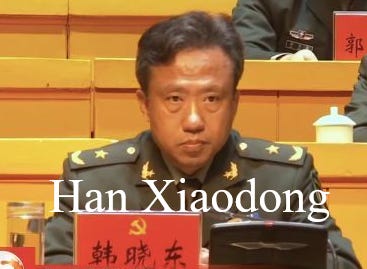
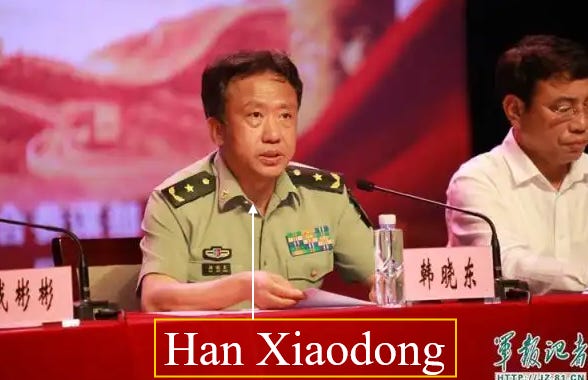
PLA Major General Han Xiaodong’s Mandate in Provincial Coercion and Military-Civil Fusion

 An analysis of Major General Han Xiaodong (韩晓东)—who served as Political Commissar of the Hebei Provincial Military District when elected as an active-duty military delegate to the 13th National People’s Congress (NPC), before his appointment as Assistant to the Chief of the Joint Staff Department of the Central Military Commission (CMC)—exposes the administrative mechanics of how the CCP integrates provincial military command, high-tech civilian co-optation, and parliamentary immunity.

Han Xiaodong, Political Commissar of the PLA Hebei Provincial Military District中国人民解放军河北省军区政治委员韩晓东

As an active-duty officer and delegate whose constitutionally mandated duties included formally approving Xi Jinping’s reappointment as President of Communist China, voting to endorse Premier Li Keqiang’s Government Work Report, and passing the 2018 Central Public Budget, Han Xiaodong exemplifies the dual operational-legislative role of active-duty military personnel in state governance. Han Xiaodong is the former Director of the Youth Bureau of the PLA General Political Department and Political Department Director of a major operational base.

Han’s commentary following CMC Chair Xi Jinping’s address to the PLA and Armed Police delegation at the 13th NPC (March 2018) demonstrates how senior political officers align regional mobilization structures with the CMC’s overarching mandate to eliminate operational complacency (“peace disease”) and build an integrated national strategic capacity.

                  CCP CENTRAL MILITARY COMMISSION (CMC)
            (Absolute Command & Joint Staff Operational Control)
                                   |
         +-------------------------+-------------------------+
         |                                                   |
         v                                                   v
[1. Legislative Power Alignment]             [2. Provincial & Staff Command]
Han Xiaodong: Delegate, 13th NPC             Han Xiaodong: Major General
- Endorsing Xi's MCF directives              - Political Commissioner, Hebei Provincial
- Reviewing & approving SPC/SPP                Military District (2017–2018)
  work reports                               - Assistant to the Chief of Staff, Joint
                                               Staff Department, CMC (July 2018)
         |                                                   |
         +-------------------------+-------------------------+
                                   |
                                   v
            [3. Subordinated Judiciary & Absolute Protection]
            - Complete protection from civilian legal scrutiny
            - Exemption of provincial mobilization & Joint Staff operations 
              from civilian court oversight

Career Elevation: From Provincial Mobilization to the CMC Joint Staff

Born in December 1965, Han Xiaodong rose through the political officer hierarchy of the armed forces:

  • Political Leadership Tiers: Served as Director of the Youth Bureau in the Organization Department of the former PLA General Political Department and Political Department Director at a key operational base.

  • Provincial Military Command: Appointed Political Commissioner of the Hebei Provincial Military District in August 2017, overseeing regional militia mobilization, civil-military coordination, and recruitment pipelines surrounding the capital region.

  • CMC Joint Staff Elevation: By July 2018, shortly after his service at the 13th NPC session, Han was elevated to Assistant to the Chief of the Joint Staff Department of the CCP Central Military Commission (CMC), transitioning directly from provincial mobilization to top-tier strategic and operational planning.

Operationalizing Military-Civil Fusion (MCF) and Eradicating “Peace Disease”

During the March 12, 2018 plenary meeting of the PLA and Armed Police delegation, Xi Jinping emphasized that realistic, combat-oriented training must be intensified to eradicate “peace disease” (和平病) and ensure forces train strictly according to operational warfare requirements.Responding directly to the directives issued by Xi Jinping, Chairman of the CCP Central Military Commission (CMC), PLA Major General Han Xiaodong framed Military-Civil Fusion (MCF) not as a collaborative economic policy, but as an absolute mechanism for subordinating all civilian state capacity to military command:

  1. The Tripartite Imperative: “Why to Fuse, What to Fuse, How to Fuse” (为什么融、融什么、怎么融)

    • “Why to Fuse” (Systemic Resource Extraction): Han identified MCF as the sole pathway to realize the CMC’s force expansion goals (强军目标). The underlying logic dictates that civilian economic growth has no independent purpose; its value exists exclusively to provide material support and technological extraction for military power.

    • “What to Fuse” (Total Requisition of Civilian Assets): Han mentioned building an “integrated national strategic system and capability” (一体化国家战略体系和能力). This demands the total absorption of civilian industry, technology, infrastructure, and human capital into the PLA’s operational matrix—stripping the boundary between the private/civilian sector and the military apparatus.

    • “How to Fuse” (Coercive Integration under “Embedding Military Power in the Civilian Populace” - 寓军于民): Han mandated that both military and civilian organs strictly execute the CMC Chairman’s orders. “Embedding military power within the civilian populace” means forcing local municipal governments, public institutions, and civilian enterprises to construct dual-use infrastructure and supply networks that can be instantly requisitioned for PLA needs.

  2. The “Enriching the State and Strengthening the Military” Paradox (富国强军) Han’s explicit call to achieve the “unity of embedding military power within the civilian populace and enriching the state while strengthening the military” exposes the regime’s predatory economic logic: “enriching the state” (富国) is the accumulation stage required to fund “strengthening the military” (强军). Economic activity is systematically subordinated to regional coercion and regime survival.

  3. Regional Execution and Provincial Mobilization Mandates As Political Commissioner of the PLA Hebei Provincial Military District, Han’s interpretation serves as an administrative directive to regional government officials. By declaring that local authorities must “earnestly implement Chairman Xi’s important instructions,” Han established that provincial administrative budgets, transport networks, and urban planning must prioritize CMC readiness demands over civilian social welfare or municipal development.

The official state media report from the Beijing Daily on January 22, 2020—documenting the Capital Military-Civilian Forum held on January 21, 2020—provides definitive institutional evidence that PLA Major General Han Xiaodong (韩晓东) was actively serving as Assistant to the Chief of the Joint Staff Department of the CCP Central Military Commission (CMC) during the key onset period of the COVID-19 outbreak in late 2019 and early 2020.

The position where the Chairman of the CCP Central Military Commission (CMC) directs military delegates to the National People’s Congress (NPC)—who then formally participate in enacting state legislation and reviewing the work reports of the SUPREME COURT (SPC) and SUPREME PROCURATORATE (SPP)—underscores the underlying mechanics of institutional authority:

               CHAIRMAN OF THE CENTRAL MILITARY COMMISSION (CMC)
                       (Xi Jinping - CMC Chairman & NPC Delegate)
                                         |
                  +----------------------+----------------------+
                  |                                             |
                  v                                             v
     [Military Command & Guidance]                  [Legislative Delegation]
  Directs armed forces & regional commanders     PLA & Armed Police NPC Delegation
  (e.g., Wang Hai, Jiang Jianxin, Han Xiaodong)   (Military commanders acting as legislators)
                  |                                             |
                  +----------------------+----------------------+
                                         |
                                         v
                         [NPC State Framework]
       - Passes national legislation & Military-Civil Fusion (MCF) mandates
       - Reviews & approves annual work reports of SPC and SPP
                                         |
                                         v
                    [Subordinated Judicial Apparatus]
       - SUPREME COURT (SPC) & SUPREME PROCURATORATE (SPP)
       - Structurally incapable of reviewing military operations,
         provincial mobilization, or CMC directives

Key Structural Dynamics

1. Dual Role of the CMC Chairman within the Legislature

Xi Jinping serves as Chairman of the Central Military Commission (CMC) while simultaneously sitting as a delegate to the National People’s Congress. During the annual plenary sessions of the PLA and Armed Police delegation, the CMC Chairman issues operational imperatives—such as intensifying combat preparedness or advancing Military-Civil Fusion (MCF)—directly to senior military commanders who themselves hold seats as legislative delegates.

2. Military Commanders as National Lawmakers

Senior commanders across theater fleets, research institutes, and military districts (such as Vice Admiral Wang Hai, Professor Jiang Jianxin, and Major General Han Xiaodong) exercise dual functions:

  • Operational Command: Executing CMC directives within combat units, trauma research centers, and joint staff operations.

  • Legislative Authority: Sitting in the NPC to deliberate national laws, approve state budgets, and review work reports submitted by state organs.

3. Formal Subordination of State Judicial Organs

Under Articles 62 and 67 of the PRC Constitution, state judicial and prosecutorial bodies—the SUPREME COURT (SPC) and the SUPREME PROCURATORATE (SPP)—are created by, report to, and are constitutionally subordinated to the NPC.

Because the military delegation operates under the unified command of the Central Military Commission (CMC) within the NPC framework:

  • The armed forces directly participate in reviewing and approving the performance reports of the SUPREME COURT (SPC) and SUPREME PROCURATORATE (SPP).

  • State judicial organs possess no constitutional mandate, statutory authority, or jurisdiction to audit, challenge, or legally review military command decisions, defense R&D programs, or regional mobilization directives issued by the Central Military Commission (CMC).