The official narrative of the Chinese Communist Party (CCP) frames the Tibet Autonomous Region (TAR) as a self-governing ethno-regional entity under the “System of Regional Ethnic Autonomy.” However, structural roster audits of both the 14th National Congress (NPC) and the 12th TAR Congress reveal a complete subversion of this framework.
On January 16, 2023, the 1st Session of the 12th TAR People’s Congress selected 24 “delegates” to represent Tibet at the National Congress in Beijing. A deeper forensic analysis of the underlying regional body—the 12th TAR Congress—exposes the totalitarian core: 49 active-duty military personnel operating directly under the command of the Central Military Commission (CMC) of Chinese Communist Party hold voting seats within this local civilian legislature.
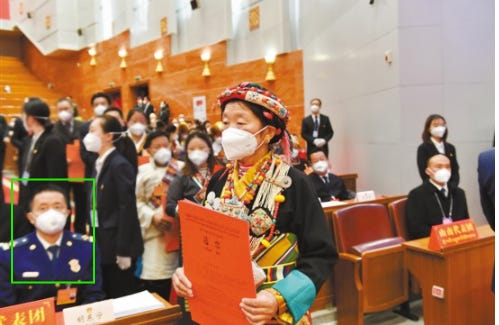
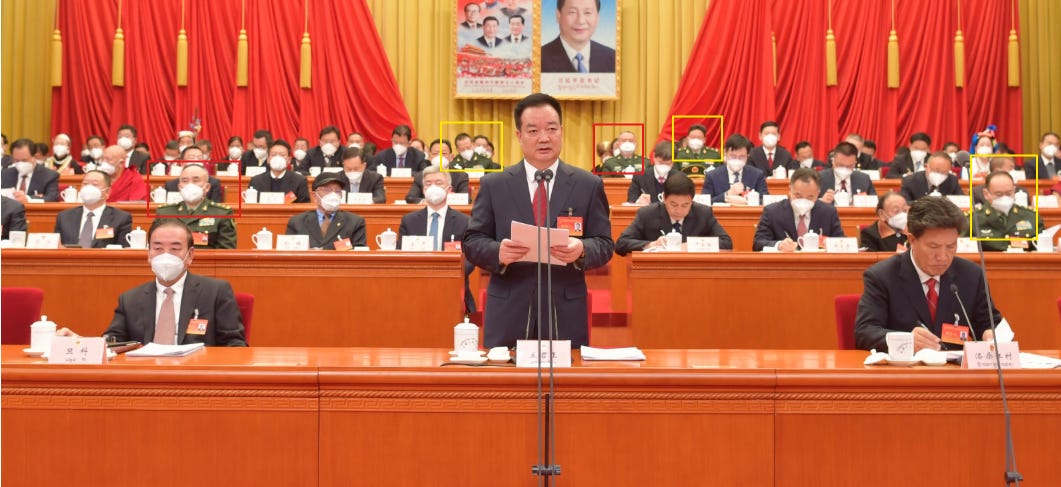
The Legislative Hijack: Three Core Control Vectors
The presence of 49 active-duty commanders, commissars, and garrison officers within a regional legislature invalidates any claim of local self-governance. It establishes a direct mechanism for active military officers to dictate civilian policy through three key administrative levers:
1. Structural Hijacking of the Fiscal Budget
Active-duty military delegates do not merely observe proceedings; they hold direct voting rights to approve or reject the TAR’s annual financial budgets.
The Reality: This mechanism allows active-duty PLA and Communist Armed Police (CAP) commanders to manipulate regional civil budget allocations, ensuring that municipal infrastructure, highway construction, and telecom grids are engineered primarily for military logistics, border mobilization, and troop maneuverability under the guise of local economic development.
2. Coercive Oversight of Civil Administration and Judiciary
Under the PRC constitution, regional congresses approve the appointment and work reports of local administrative heads, the Higher Court, and the Procuratorate.
The Reality: By forcing regional civil administrators, judges, and chief prosecutors to submit their operational work reports for approval to a assembly containing 49 active-duty military officers, the CMC creates a continuous coercive loop. The judiciary and civil government are structurally subordinated to the operational needs of the military occupation.
3. The NPC Delegation as a Military Firewall
The 24 delegates selected on January 16, 2023, to represent Tibet at the National level in Beijing do not represent the local Tibetan population.
The Reality: Selected through a process dominated by Party functionaries and military officers, these delegates serve as an international and domestic diplomatic firewall. Their function is to rubber-stamp federal defense policies and project a false image of ethnic endorsement for Beijing’s military consolidation along the militarized Himalayan border.
4. Direct Institutional Penetration into the Presidium (Core Agenda Control)
Cross-referencing the 105-member Presidium of the 1st Session of the 12th TAR Congress against the 49-member PLA delegation reveals an exact overlap of 7 active-duty military officers integrated directly into the legislature’s supreme decision-making body.
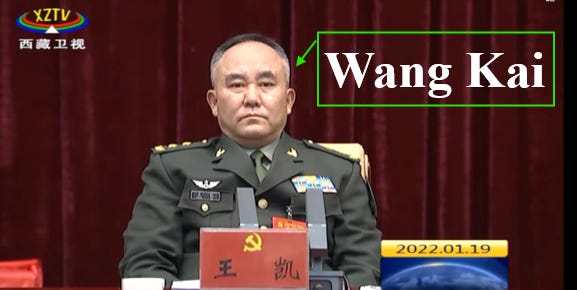
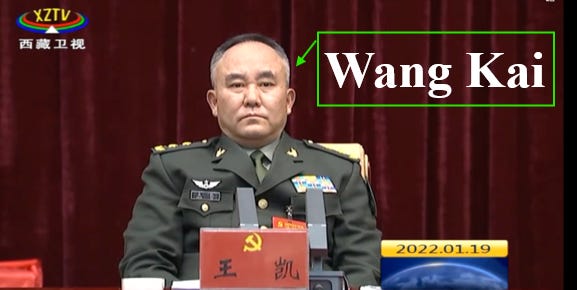
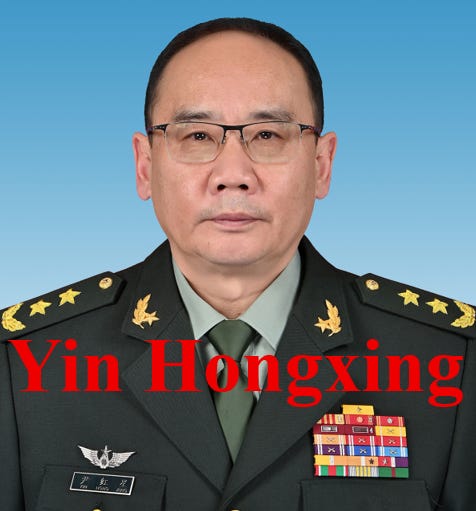
The Reality: These 7 military presidium members include the top operational and political commanders of the region—Lieutenant General Wang Kai (Commander of the Tibet Military District) and Major General Yin Hongxing (Political Commissar of the Tibet Military District), alongside senior officers Feng Guifu, Liu Zehong, Yang Meng, Fan Yun, and Zhao Zhigang. Because the Presidium controls the legislative agenda, determines voting procedures, and manages candidate nominations for civil offices, the direct seating of active-duty generals guarantees that the CMC maintains absolute, top-level steering over every resolution before it reaches the floor.
Wang Kai, Commander of the PLA Tibet Military District中国人民解放军西藏军区司令员王凯 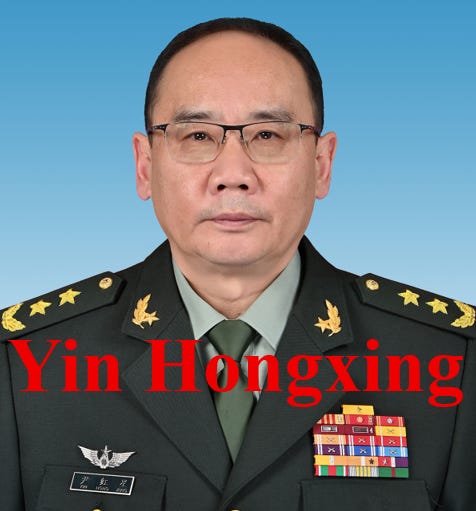
Yin Hongxing, Political Commissar of PLA Tibet Military District中国人民解放军西藏军区政治委员尹红星
Conclusion
The term “Tibet Autonomous Region” is an administrative misnomer designed for external political consumption. When 49 active-duty officers under the direct command of the CMC hold constitutional voting power—and when their top theater commanders personally sit on the 105-member Presidium that controls the legislative agenda—local autonomy is rendered completely non-existent.
The regional legislature functions not as a representative civilian assembly, but as a political instrument of the Central Military Commission—ensuring that all civil, financial, and judicial assets in Tibet are permanently aligned with total-war readiness and internal pacification.
Profile: Lieutenant General Wang Kai (王凯)
Current Role: Commander of the Tibet Military District
Birth Year/Origin: Born in 1963; Meishan, Sichuan Province
Branch & Service: People’s Liberation Army (PLA) Ground Force (PLAGF)
Career Trajectory & Tactical Background
Lieutenant General Wang Kai is a career infantry commander with extensive experience in high-altitude, mountainous, and expeditionary warfare. His rise through the PLA hierarchy aligns with key operational nodes in Western China:
Chief of Staff, 14th Group Army: Served as top operational planner for one of China’s primary border defense formations in the Southern Theater Command.
Commander, 13th Group Army (Late 2013): Promoted to lead the elite 13th Group Army (headquartered at Eling, Chongqing), a Category A fully mechanized formation historically designated as the PLA’s premier mountain and jungle combat unit (”Tigers of the Mountains”).
Deputy Commander, Western Theater Command Army (2017): Transitioned into theater-level operational leadership at Lanzhou, supervising ground forces across Sichuan, Tibet, Chongqing, Gansu, Ningxia, Qinghai, and Xinjiang.
Commander, Tibet Military District: Appointed to command the frontline garrisons along the disputed Sino-Indian border and oversee military-civil alignment within the TAR in 2021.
Institutional Heritage of the Former 13th Group Army
The 13th Group Army holds a unique pedigree within the PLA structure. Formed in 1985 through the consolidation of the 13th and 50th Armies, it stands out as the only group army to maintain continuous combat deployments from the founding of the PRC into the 21st century. Its lineage includes participation in the Korean War, Sino-Indian Border War, Sino-Vietnamese War, as well as UN peacekeeping operations in Cambodia, Haiti, and Africa. Notably, the 13th Group Army has served as a launchpad for top military leaders, including Zhang Youxia (Vice Chairman of the Central Military Commission), Zhao Zongqi (former Western Theater Command Commander), and Xu Yong (former Tibet Military District Commander).
The Wenchuan Earthquake Response: Disaster Operations as Propaganda & Pacification
Wang Kai’s public profile heavily centers on his role during the May 12, 2008 Wenchuan Earthquake, where he served as Commander of an armored regiment/Red Army division within the Chengdu Military Region. Official state media credited his unit with rapid mobilization (reaching the epicenter in 3.5 hours) and the rescue of hundreds of survivors in Beichuan County.
The “Saluting Baby” (郎铮) Narrative
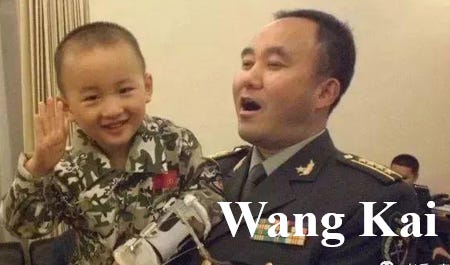
Wang Kai was featured prominently in state propaganda following the rescue of Lang Zheng, the 3-year-old survivor known as the “Saluting Baby.” On June 30, 2008, state broadcaster CCTV arranged a televised reunion between Wang Kai and Lang Zheng during a prime-time gala. The event was broadcast nationwide to project a soft, humanized image of the military apparatus.
Independent analysts, dissidents, and prominent public figures have frequently scrutinized the PLA’s narrative surrounding the Wenchuan disaster relief effort, identifying several critical vulnerabilities:
Staged Human-Interest Media Operations: Observers have pointed out that incidents like the “Saluting Baby” photo-op were heavily curated by state media to transform a catastrophic structural failure—including the collapse of poorly built “tofu-dreg” schools—into a patriotic celebration of military heroism.
Disaster Response as Military Pacification: Rather than purely humanitarian assistance, the rapid deployment of 1,500 armed troops under Wang Kai served an essential internal security purpose: locking down access to disaster zones, preventing foreign media coverage, and suppressing protests by bereaved parents demanding investigations into corrupted construction standards.
Disruptive Chain of Command: Critical assessments highlight that early disaster relief efforts were hampered by political maneuvering and centralized command bottlenecks, where high-profile troop movements were prioritized for television cameras over efficient civilian-led Search and Rescue (SAR) logistics.
Profile: Lieutenant General Yin Hongxing (尹红星)
Current Role: Party Committee Secretary & Political Commissar, PLA Tibet Military District
Rank: Lieutenant General (中将) (Promoted early 2022)
Branch: PLA Ground Force (PLAGF)
Key Career Milestones & Operational Background
Yin Hongxing is a senior political commissar within the People’s Liberation Army, specializing in political warfare, party discipline, and troop indoctrination across multiple military commands:
Political Commissar, 71352 Unit (Former Jinan Military Region): Served as top political officer of the renowned “Tiger Division” (猛虎师) based in Anyang, Henan. This unit is historically regarded as one of the PLA’s elite assault formations, with combat lineages tracing back to the Autumn Harvest Uprising, Pingxingguan, and the Korean War.
Deputy Secretary, Discipline Inspection Commission, Southern Theater Command Army: Managed internal party compliance, ideological rectitude, and anti-corruption oversight within the Southern Theater Command.
Political Commissar, 71st Group Army (August 2018): Promoted to lead the political apparatus of the 71st Group Army (Eastern Theater Command), succeeding Xu Deqing.
Political Commissar, Tibet Military District (January 2022): Formally identified as the Secretary of the Party Committee and Political Commissar of the Tibet Military District during its 10th Party Committee 7th Plenary Session in Lhasa, serving alongside Commander Wang Kai.

The recent catastrophic landslide at the Gyirong (Keyrung) border crossing between Tibet and Nepal has once again pulled back the curtain on the Chinese Communist Party’s (CCP) crisis response protocol: stability maintenance first, political propaganda second, and human lives last.
While Nepal deployed heavy machinery, helicopters, and field personnel who worked around the clock in real mud and exhaustion, the CCP transformed a deadly humanitarian crisis into a staged propaganda commercial designed to glorify supreme leadership.
1. Stability Maintenance Rules: Information Blackout
Before any effective rescue operation began, the regime’s censorship machine was deployed at full force.
Erasing Evidence: Security camera feeds, real-time videos of the flood sweeping through the Gyirong port, and spontaneous eyewitness uploads were swiftly deleted across mainland platforms.
Monopolized Narrative: All authentic civilian imagery was replaced with state-sanctioned, heavily filtered videos and photo essays highlighting "the heroic rescue under the Party's direct guidance."
2. Fabricated Data and Mathematical Absurdities
The official statistics released by state media expose a complete disregard for public intelligence.
   [Upstream: CCP-Controlled Tibet]           [Downstream: Nepal]
    Reported Deaths: 7                        Reported Deaths: 626+
    Reported Missing: 554                      Reported Missing: 2,426+
    Atmosphere: "Emotions are stable"          Atmosphere: Ongoing Tragedy
Arbitrary Discrepancies: On August 28, official reports claimed 558 missing. By the following day, the missing count mysteriously dropped to 554, while reported deaths increased by 2, and successful rescues remained unchanged. The basic arithmetic fails to add up.
Vanishing Personnel: Media reports initially boasted that 1,200 first responders and 681 firefighters were operating on the front lines, supported by "621 heavy machines and 6,612 specialized gear units." Yet subsequent state press releases listed only 505 local cadres and personnel on site.
3. Propaganda Over Professionalism: The Staged "Rescue"
Visual evidence published by state mouthpieces like Tibet Daily and CCTV News reveals a stark contrast between professional emergency response and orchestrated political theater.
+-------------------------------------------------------------------------+
|                    REALITY vs. STATE MEDIA NARRATIVE                    |
+------------------------------------+------------------------------------+
| Genuine Rescue Standards           | CCP Propaganda Footage             |
+------------------------------------+------------------------------------+
| • Heavy machinery & excavators     | • Handful of personnel walking on  |
| • Search & rescue canines          |   hardened, solid debris           |
| • Infrared/thermal imaging gear    | • Bare hands and clean white gloves|
| • Noise silence protocols to hear  | • Shouting in unison for cameras   |
|   trapped survivors                | • Rehearsed 3-step walking routines|
+------------------------------------+------------------------------------+
Clean Gloves, Zero Equipment: Photographs show isolated personnel posing on top of hardened debris wearing spotless uniforms and stark white gloves, without basic shovels or heavy equipment in sight.
Camera-Driven Operations: State video feeds show groups of 3 to 5 responders marching three steps, shouting "Is anyone there?" into concrete slabs, and immediately marching forward for the next camera angle—making silence protocols impossible and render sub-surface detection useless.

4. Nepal's Genuine Effort vs. Beijing's Staged Suppers
The contrast along the Sino-Nepalese border could not be sharper.
Nepal: Operated with heavy excavators and transport helicopters despite limited resources, recovering hundreds of victims under harsh, muddy conditions without pristine photo-ops.
CCP State Media: Published photos of "delivering dinners to displaced residents" on spotless, undamaged city streets kilometers away from the blocked disaster zone, exposing the imagery as staged meals for visiting reporters rather than relief for victims.

Summary
From the Wenchuan earthquake to the Gyirong landslide, the regime's disaster management blueprint remains unchanged: rescue operations do not begin when lives are in danger; they begin when state cameras and cadres arrive on set. The tragedy at Gyirong is not merely a natural disaster, but a man-made political theater built on censorship and human suffering.


No comments:
Post a Comment