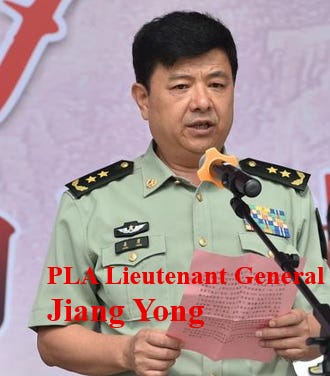
The totalitarian mechanism of the Chinese Communist Party (CCP) relies on a structural paradox: maintaining the outward shell of a constitutional state while systematically ensuring that power flows unchecked through party and military channels. At the heart of this deception is the National Soviet Assembly (National People’s Congress), framed as the “highest organ of state power.” In reality, the presence of military brass—such as Lieutenant General Jiang Yong, Political Commissar of the PLA Beijing Garrison—proves that the national legislature functions as an instrument for party-army supremacy, weaponizing state law to enforce political censorship and extinguish civil liberties.
                   +-------------------------------------------------+
                   |   Central Military Commission of the CCP (CMC)  |
                   +-------------------------------------------------+
                                           |
                   +-----------------------+-----------------------+
                   |                                               |
                   v                                               v
+------------------------------------+           +------------------------------------+
| Political Commissar Jiang Yong     |           | PLA Beijing Garrison               |
| (Beijing Garrison & 13th NPC)      |           | (Internal Security & Party Center) |
+------------------------------------+           +------------------------------------+
                   |                                               |
                   v                                               v
+-------------------------------------------------------------------------------------+
|                     National Soviet Assembly (13th NPC Delegation)                  |
|          Passes Criminal Law Amendments to Weaponize State Penal Apparatus          |
+-------------------------------------------------------------------------------------+
                                           |
                   +-----------------------+-----------------------+
                   |                                               |
                   v                                               v
+------------------------------------+           +------------------------------------+
| Criminalization of Free Speech     |           | Co-optation of State Courts        |
| (Targeting "Military Rumors")      |           | & Police Infrastructure            |
+------------------------------------+           +------------------------------------+
The Career of a Party Commissar: Guarding the Regime’s Core
Jiang Yong’s rapid rise through the senior political ranks of the Chinese People’s Liberation Army (PLA) illustrates the regime’s reliance on political commissars to maintain ideological discipline and operational security at the seat of power. Born in 1956 in Liaoning, Jiang graduated from the PLA National Defense University before rising through the political officer track of the former Nanjing Military Command.
+------------------------------------------------------------------------------------------------------------------------+
|                                  JIANG YONG: MILITARY & LEGISLATIVE CAREER PROFILE                                     |
+------------------------------------------------------------------------------------------------------------------------+
| PERIOD           | MILITARY ASSIGNMENT / RANK                | COMMAND / POLITICAL JURISDICTION                        |
+------------------+-------------------------------------------+---------------------------------------------------------+
| 2008 – 2014      | Political Commissar, 31st Group Army, PLA | Directed political surveillance and party discipline in |
|                  | Nanjing Military Command                  | primary amphibious strike force targeting Taiwan.       |
+------------------+-------------------------------------------+---------------------------------------------------------+
| 2013 – 2018      | Delegate, 12th National Soviet Assembly   | Represented PLA delegation; promoted internal party     |
|                  | (Major General)                           | control within military operations.                     |
+------------------+-------------------------------------------+---------------------------------------------------------+
| 2014             | Director, Political Department, Jinan     | Executed political vetting and internal surveillance    |
|                  | Military Command                          | across regional operational units.                      |
+------------------+-------------------------------------------+---------------------------------------------------------+
| 2015 – 2019      | Political Commissar, PLA Beijing Garrison | Governed internal security, garrison discipline, and    |
|                  | (Promoted to Lt. General, 2018)           | capital defense at the center of party power.           |
+------------------+-------------------------------------------+---------------------------------------------------------+
| 2018 – 2023      | Delegate, 13th National Soviet Assembly   | Lead sponsor of Criminal Law amendments criminalizing   |
|                  | (PLA & PAP Delegation)                    | online speech and "military-related rumors."            |
+------------------+-------------------------------------------+---------------------------------------------------------+
Jiang served as Political Commissar of the 31st Group Army in Fujian—a frontline force tasked with operations against Taiwan—working alongside then-Commander Wang Ning. In July 2014, Jiang was transferred across military commands to serve as Director of the Political Department of the Jinan Military Command.
By January 2015, in his second cross-command transfer within a single year, Major General Jiang Yong was appointed Political Commissar of the PLA Beijing Garrison. The Beijing Garrison occupies an institutional position within the PLA: it is responsible for the defense of the capital, the security of top party leaders, and the immediate deployment of internal security forces in the event of political instability in Beijing. Standing as Political Commissar of this capital guard unit, Jiang held immense political weight while simultaneously serving as a delegate to both the 12th and 13th National Soviet Assemblies.
The Structural Erasure of Separation of Powers
The co-occurrence of Jiang Yong holding command authority over capital garrison forces while serving as a senior lawmaker exposes the complete absence of constitutional checks and balances in Communist China:
No Separation of Powers: Unlike democratic constitutions structured around horizontal division between legislative, executive, and judicial branches, the CCP regime explicitly rejects separation of powers. The party controls the state executive, the judiciary, and the military through a single, unified command architecture.
The “Party Commands the Gun” (党指挥枪): The PLA is not a national defense force accountable to a civilian parliament; it is the armed wing of the Communist Party. Military delegates in the legislature answer exclusively to the Central Military Commission of the CCP, not to civilian voters.
Absence of Judicial Independence and Jury Systems: Chinese state courts (People’s Courts) and procuratorates (People’s Procuratorates) operate under the direct oversight of Party Political-Legal Committees (政法委). There is no independent judiciary, no trial by jury, and no constitutional tribunal to invalidate party mandates.
Rejection of Federalism: China operates as a centralized unitary state where provincial military commands and garrisons double as local party standing committee members (”戎装常委”), forcing local civilian authorities to execute military readiness mandates.
Weaponizing the Penal Code: Censorship and the Great Firewall
The legislative output of Political Commissar Jiang Yong demonstrates how military officers utilize the national legislature to expand the penal state and crush online civil discourse. During the 1st Session of the 13th National Soviet Assembly in March 2018, Jiang led a high-profile legislative motion demanding sweeping amendments to the Criminal Law of the People’s Republic of China.
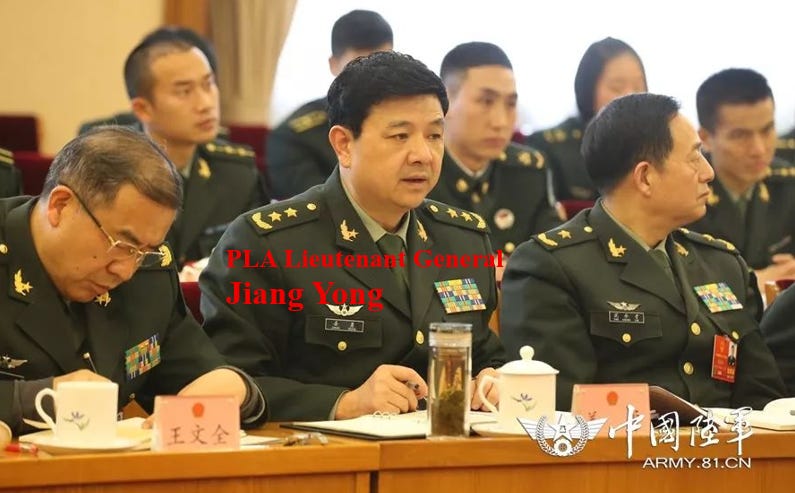
Jiang explicitly targeted “military-related online rumors” (涉军网络谣言) and online commentators as Key Opinion Leaders(KOLs) (”网络大V”), arguing that public questioning of military conduct, historical narratives, or garrison activities posed a “grave threat to national security and social order.”
+------------------------------------------------------------------------------------------------------------------------+
|                                JIANG YONG'S PROPOSED CRIMINAL LAW AMENDMENTS (2018)                                    |
+------------------------------------------------------------------------------------------------------------------------+
| PROPOSED STATUTORY CHANGE                    | OPERATIONAL IMPACT ON CITIZENS & DIGITAL SPEECH                         |
+----------------------------------------------+-------------------------------------------------------------------------+
| Amend Article 291-2: "Fabricating and        | Broadens criminal liability for online posting; converts digital        |
| Deliberately Disseminating False Information"| commentary into state-level offenses carrying heavy prison sentences.   |
+----------------------------------------------+-------------------------------------------------------------------------+
| Add to Chapter VII (Crimes Against National  | Establishes a dedicated criminal offense specifically for criticizing  |
| Defense Interests): "Fabricating False Info" | or reporting on military operations, personnel, or logistics.           |
+----------------------------------------------+-------------------------------------------------------------------------+
| Mandate Public Security Assistance in        | Forces public security (police) state apparatus to actively investigate |
| Defamation / Insult Cases                    | online critics, stripping citizens of civil defense rights.             |
+----------------------------------------------+-------------------------------------------------------------------------+

Jiang’s legislative proposals were designed to complement the regime’s digital control system—the Great Firewall—by criminalizing the content that slips through automated technical filters:
Criminalizing Public Criticism of the Armed Forces: By amending Article 291-2 and inserting new offenses under “Crimes Harming National Defense Interests,” Jiang sought to ensure that any independent investigative journalism or social media criticism regarding military corruption, garrison conduct, or defense spending carries severe criminal sentences.
Co-opting Civilian Police for Military Protection: Jiang’s proposal explicitly mandated that when military entities or figures claim defamation, civilian courts must direct Public Security organs (police) to step in and investigate the poster, transforming civil disputes into criminal prosecutions driven by state intelligence units.
Institutionalizing the Great Firewall: Technical censorship via the Great Firewall blocks external information, while penal amendments drafted by military commissars like Jiang Yong terrorize domestic internet users into self-censorship.
The career and legislative actions of Lieutenant General Jiang Yong show how the Chinese Communist Party uses unelected military leaders to bridge the gap between military enforcement and legislative control. By holding key positions in both the Beijing Garrison and the National Soviet Assembly, military commissars ensure that state law, public security forces, and judicial organs are weaponized to safeguard party-army supremacy and suppress free expression.
中共中央军委领导的第十二届、第十三届现役军人全国人大代表姜勇出生于1956年,辽宁盖县人,毕业于国防大学,研究生学历,2008年2月任第31集团军政委,2014年7月22日已经由中国人民解放军南京军区第31集团军政委调任济南军区政治部主任,2015年1月8日已经担任中国人民解放军北京卫戍区政治委员。
十三届全国人大一次会议上,姜勇领衔提出《关于修改完善刑法有关规定的议案》侵犯言论自由。
【议案概要】涉军网络谣言层出不穷,已经成为危害国家安全、扰乱社会秩序、损害军队形象、离间军民关系的又一重大现实威胁,造成了恶劣的政治影响和社会影响。建议修改完善刑法有关内容,进一步健全罪名体系,畅通诉讼渠道,加大惩戒力度,对法律用语的具体含义作出明确规定,对刑法第二百九十一条之第二款修改为“编造和故意传播虚假信息罪”,让法律的指向性更清晰;在刑法第七章“危害国防利益罪”中增加“编造虚假信息损害国防利益罪”,并加大惩戒力度,形成震慑效果;修改刑法侮辱诽谤罪有关规定,网络谣言受害者提供证据有困难的,人民法院应当要求公安机关提供协助,而不能简单地以治安事件处置,以充分保证网络谣言受害者的诉讼权利。
【代表心声】一些网络大V借助涉军事件,肆意歪曲解读,损毁军队形象,造成了恶劣的政治影响和社会影响。但由于我国目前还没有关于网络谣言治理的专门法规,这些造谣者至今仍未受到刑事处罚,导致部分网民仍然相信谣言是真实的,认为官方在“冷处理”。我们应尽快完善刑法有关规定,加大惩戒力度,形成威慑效果,让造谣者为自己的行为付出代价。


No comments:
Post a Comment