
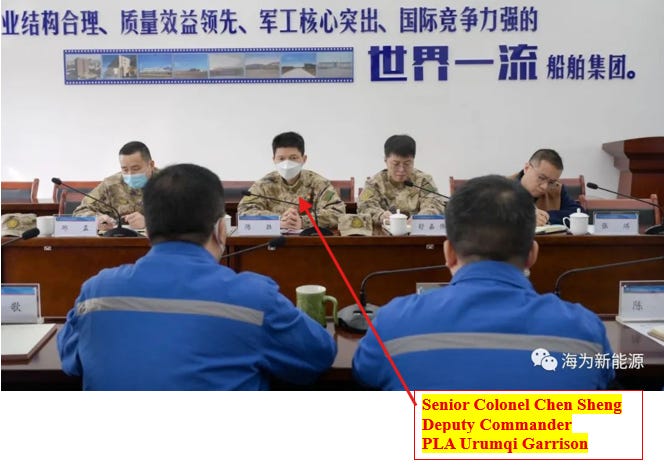
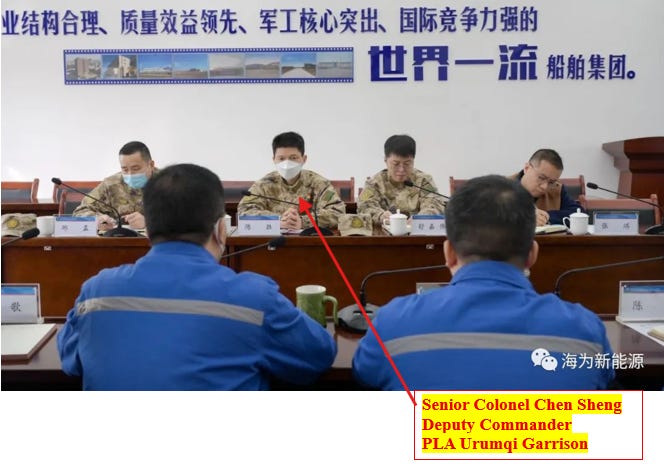
The verified profiling of Senior Colonel Chen Sheng (陈胜)—Deputy Commander of the PLA Urumqi Garrison (乌鲁木齐警备区大校副司令员) and a sitting delegate of the Xinjiang Regional Soviet (新疆维吾尔自治区人大代表)—unmasks the institutional interface between municipal military commands, high-level provincial legislation, and the state-owned military-industrial complex.
Official press releases from CSSC Haiwei (Xinjiang) New Energy Co., Ltd. (中船海为(新疆)新能源有限公司)—a subsidiary under the China State Shipbuilding Corporation(CSIC/CSSC 713th Research Institute)—confirm Senior Colonel Chen’s direct execution of military-civilian joint collaboration (军地协作) targeting renewable energy and logistics support for the Xinjiang Military Region.
I. Institutional Blueprint: The Provincial Lawmaker in a Municipal Garrison Command
Unlike lower-level municipal representatives whose influence is strictly localized, Senior Colonel Chen Sheng operates with dual-tier strategic leverage:
  [Urumqi Garrison Command (乌鲁木齐警备区)]
  · Senior Colonel Chen Sheng (Deputy Commander)
  · Operational Focus: Urban Military Mobilization, Local Military-Civilian Liaison
                        │
                        ▼ (Dual Strategic Leverage)
  [Xinjiang Autonomous Region Soviet Assembly (Provincial Level)]
  · Senior Colonel Chen Sheng (Provincial Lawmaker)
  · Systemic Function: Converting Regional Military Logistics & Energy Needs into Policy
                        │
                        ▼ (Military-Industrial Target)
  [State-Owned Military-Industrial Grid (e.g., CSSC / 713th Research Institute)]
  · Products: Wind-Solar-Diesel-Storage Power Platforms, Mobile Military Quartermaster Gear
The Garrison Command Intersect: As Deputy Commander of the Urumqi Garrison, Senior Colonel Chen directly oversees local militia mobilization, military infrastructure integration, and urban military-civilian alignment within Xinjiang’s political capital.
The Provincial Legislative Lever: His position as a provincial-level lawmaker (自治区人大代表) enables him to shape regional military mobilization budgets, legal statutes on military-civilian fusion (军民融合), and provincial supply procurement frameworks, far surpassing municipal administrative boundaries.
II. Strategic Function: Engineering Renewable Energy and Logistic Grids for Frontier Operations
Official records of his inspection at CSSC Haiwei reveal the precise operational mandate enforced through his provincial legislative role:
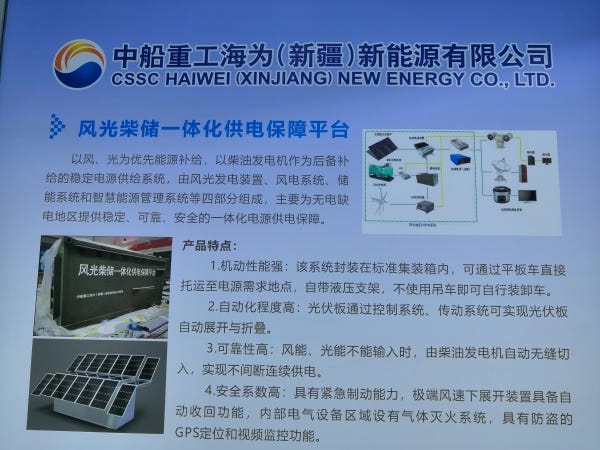
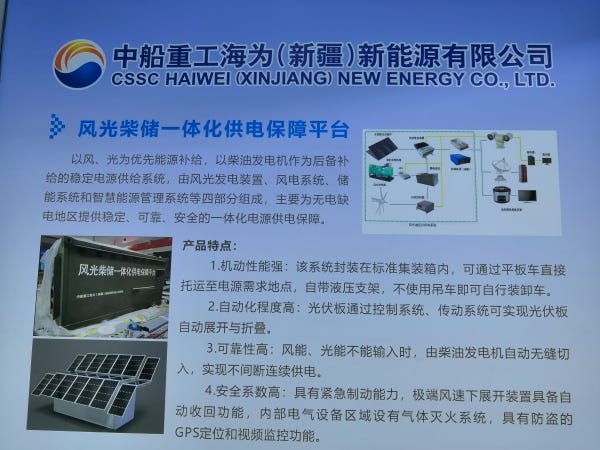
Siphoning Military-Industrial R&D for Regional Garrison Support: CSSC Haiwei’s specialized portfolio—including wind-solar-diesel-storage integrated power supply platforms (风光柴储一体化供电保障平台), mobile quartermaster gear (军需保障装备), and intelligent electromechanical systems—targets off-grid, high-altitude energy supply. Senior Colonel Chen’s directive for the company to “actively participate in military construction and provide support services for the Xinjiang Military Region” highlights a systematic drive to leverage state-owned enterprise (SOE) engineering for PLA border posts
.
Provincial-Level Policy Alignment for Military Logistics: Seated in the Xinjiang Regional Soviet, Senior Colonel Chen is positioned to align broad provincial development funds, industrial park subsidies, and new-energy infrastructure grants directly with military procurement needs. By framing military off-grid power requirements as civilian “new-energy development,” high-altitude combat support infrastructure can be quietly subsidized under regional green-energy budgets.
Institutionalizing Military Supply Chains in the Capital: Urumqi serves as the primary logistical and industrial hub for the entire Xinjiang Military Region. Senior Colonel Chen’s dual role ensures that state shipbuilding and military conglomerates operating within Urumqi are legally and fiscally integrated into the military command’s long-term mobilization and war preparation pipelines.
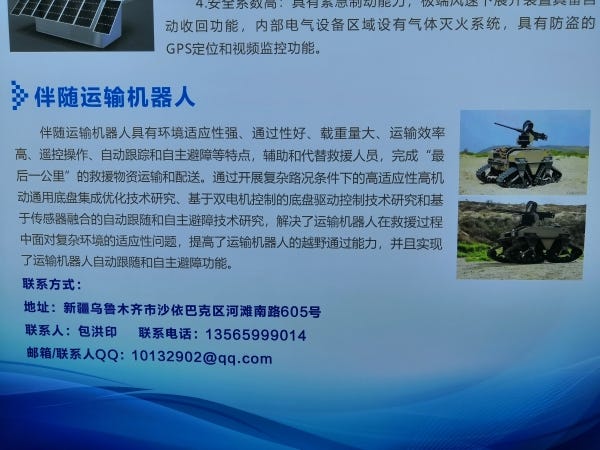
The operations of China State Shipbuilding Corporation (CSSC) and its 713th Research Institute in Xinjiang directly interface with naval warfare systems and illicit technology transfers to the Iranian Navy. The 713th Research Institute is a core military-industrial enterprise specializing in naval gunfire, shipborne missile launchers, and naval automation. The "wind-solar-diesel-storage integrated power platform" tested by CSSC Haiwei in Urumqi represents ruggedized, off-grid naval propulsion and island-military power architecture. This microgrid system is engineered to sustain isolated coastal missile batteries, naval radar outposts, and swarm-boat operational bases in austere environments—technologies directly sought by the Islamic Republic of Iran Navy (IRIN) for asymmetric Persian Gulf choke-point warfare. By embedding military-industrial research and manufacturing deep within Xinjiang, CSSC establishes a secondary, land-locked supply node that bypasses maritime interdiction, enabling the stealth export of naval-grade power and electromechanical hardware to Iranian-backed maritime networks. Specific information on example product of CSSC Haiwei (Xinjiang) New Energy Co., Ltd.:
Overview (2022)
CSSC Haiwei (Xinjiang) New Energy Co., Ltd. is a new-energy platform enterprise established in April 2010 in Xinjiang with 100% capital investment from the 713th Research Institute of China State Shipbuilding Corporation (CSSC). It is directly subordinated to CSSC. CSSC Haiwei (Xinjiang) aggressively develops military-civilian fusion (MCF) operations, deepens R&D, and expands markets for smart equipment products, including new-energy operation and maintenance (O&M) services, military quartermaster logistics support equipment, clean energy hardware, IoT smart streetlights, energy storage, automated vertical warehousing, wind/photovoltaic power generation support equipment, and special-purpose military/industrial vehicles. The company has filed three invention patents—namely “A Drone Aircraft with Intelligent Fuselage Balance Adjustment,” “A Method for Measuring Wind Turbine Tower Tilt,” and “A Method for Remote-Controlled Anemometer Tower Data Acquisition”—alongside seven utility model patents.
One Strategic Objective
Focusing on CSSC’s overarching strategy—“building a world-class shipbuilding group with a rational industrial structure, leading quality/efficiency, prominent core ordnance focus, and strong international competitiveness”—the company centers its core business on new-energy project investment, construction, production operations, and EPC general contracting. It aggressively drives MCF industries, concentrating on new-energy equipment, power station O&M services, and military quartermaster logistics support hardware, positioning CSSC Haiwei as the primary platform for the promotion and operational application of MCF products for the 713th Research Institute and CSSC across Xinjiang.
Three Core Business Sectors
Power Production: Benchmarking against premier new-energy enterprises inside and outside Xinjiang; executing full-lifecycle power plant management to elevate operational standards; cultivating core technical capabilities in power plant operation and overhaul; and leveraging management output as a profit growth driver.
Engineering Construction: Strengthening power engineering construction capabilities to reduce costs and boost efficiency while building high-tier engineering projects; expanding engineering construction operations into new civil/military domains, including building construction, municipal works, roadways, and bridges.
Military-Civilian Fusion (MCF): Adhering to the principles of “limited, relevant, and diversified” expansion, the company seizes growth opportunities in the new-energy sector to aggressively expand MCF industries. Operations center on equipment domains such as power station O&M services, integrated surveillance/monitoring systems, energy storage, heating, charging piles, smart streetlights, and integrated wind-solar-diesel-storage power and heating supply equipment.
Strategic & Military-Industrial Analysis: Deep Integration of Naval Ordnance R&D in Xinjiang
The official profile of CSSC Haiwei (Xinjiang) New Energy Co., Ltd. reveals the direct deployment of China’s core naval weapons R&D architecture into the Eurasian hinterland. As a 100% state-owned subsidiary of the 713th Research Institute of China State Shipbuilding Corporation (CSSC)—the nation’s premier military-industrial facility specializing in naval missile launching systems, naval gunfire, and shipborne automation—CSSC Haiwei functions as a key terrestrial platform for off-grid power testing, forward logistics, and dual-use technological expansion.
 [713th Research Institute (CSSC) / Core Naval Ordnance R&D]
                                │
                                ▼ (100% Capital Investment)
 [CSSC Haiwei (Xinjiang) New Energy Co., Ltd. (Urumqi Platform)]
                                │
   ┌────────────────────────────┼────────────────────────────┐
   ▼                            ▼                            ▼
【1. Off-Grid Tactical Power】 【2. Terrestrial Microgrid Testing】 【3. ISR & Environmental Sensor Network】
· Wind-Solar-Diesel-Storage   · Testing Naval & Island Power · Balance-Controlled Drones
· Isolated Post Heating       · Austere Climate Iteration    · Anemometer Tactical Data Networks
Key Military & Strategic Dimensions
1. Terrestrial Testing Ground for Naval Microgrids & Asymmetric Power Export
While framed as “clean energy,” the development of integrated wind-solar-diesel-storage power systems directly serves the operational needs of off-grid military bases, high-altitude radar stations, and isolated missile positions along the Western border (e.g., Karakoram and Central Asian frontiers).
Naval Technology Transfer: The microgrid architectures engineered by the 713th Research Institute mirror the distributed power and auxiliary energy systems designed for naval warships and fortified island outposts. Testing these ruggedized units under extreme desert and high-altitude conditions accelerates technology iteration.
Export to Asymmetric Partners: These compact, stealthy, and off-grid power units provide the exact energy architecture required by coastal missile batteries, naval radar sites, and swarm-boat operational nodes used by asymmetric naval forces, including the Islamic Republic of Iran Navy (IRIN).
2. Drones and Meteorological Sensor Networks for Tactical Targeting
The company’s patent filings expose direct applications in battlefield intelligence, surveillance, reconnaissance (ISR), and artillery/ballistic calibration:
Balancing Control for Drones (Patent): The patent for an “Intelligent Fuselage Balance Adjustment Drone” targets flight stabilization under extreme wind shear and high-altitude conditions—critical for precise aerial reconnaissance, thermal imaging, and target designation.
Remote Meteorological Data Acquisition (Patent): Methods for remote anemometer data collection and tower tilt measurement provide real-time atmospheric data. In a combat scenario, this network converts into a battlefield meteorological sensing grid essential for ballistic calculations, missile guidance, and drone launch operations.
3. Pre-Engineered War Mobilization and Logistics Infrastructure
The company’s expansion into civil engineering—specifically roads, bridges, municipal works, and automated warehousing—aligns directly with the PLA’s military mobilization requirements:
Military-Grade Transport Planning: Construction of regional roadways and bridge networks by military-industrial state-owned enterprises (SOEs) ensures that load capacities and clearance standards are pre-engineered for heavy armor, missile transporters, and mobile launch vehicles.
Automated Logistics & Special Vehicles: Automated vertical warehousing and specialized vehicle production directly interface with the Xinjiang Military Region Logistics Department, enabling rapid ammunition handling and precision military supply chain management during contingencies.
4. Tactical Surveillance Mesh via Smart Municipal Hardware
The repeated emphasis on IoT smart streetlights and integrated monitoring systems serves an intelligence role. Embedded along strategic border transport corridors and military transit routes, these smart lighting grids function as edge-computing nodes equipped with optical sensors, license plate recognition, and signal monitoring—forming a low-level surveillance net for regional security and military grid management.
Conclusion
CSSC Haiwei (Xinjiang) is not a standard civilian green-energy firm. It operates as a frontline military-industrial platform for the 713th Research Institute, embedding naval-grade automation, energy, and sensor technologies directly into the Xinjiang Military Region’s war preparation and logistical infrastructure.
2022年时的情况:中船重工海为(新疆)新能源有限公司是中国船舶集团有限公司第七一三研究所于2010年4月在新疆全额出资成立的新能源平台公司,隶属于中国船舶集团有限公司。中船重工海为(新疆)新能源有限公司大力发展军民融合业务,深入研发、开拓新能源运维服务 、军需后勤保障装备、清洁能源装备、物联网智慧路灯、储能、立体仓储、风电/光伏发电配套装备、特种车辆等智能装备产品市场,申报发明专利3项,分别为《一种智能调节机身平衡的无人机飞行器》《一种测量风电机组塔筒倾斜度方法》《一种远程控制测风塔数据采集装置的方法》,申报实用新型专利7项。
一个目标:围绕集团公司“构建产业结构合理、质量效益领先、军工核心突出、国际竞争力强的世界一流船舶集团”的战略目标,以新能源项目投资建设、生产运营、工程总承包等业务为主,大力发展军民融合产业,紧紧围绕新能源装备,电场运维服务和军需后勤保障装备领域,把海为新能公司作为七一三所及中国船舶集团公司在新疆军民融合产品推广应用的平台。
三大业务:
1、电力生产:对标疆内外优秀新能源企业,做好电场全寿命周期管理,提升运营水平;打造电场运营、检修核心技术能力,将管理输出作为效益增长点。
2、工程建设:加强电力工程施工能力建设,降本增效,打造精品工程;延伸工程建设业务,拓展建筑施工、市政工程、道路、桥梁等新领域。
3、军民融合:按照有限、相关、多元的原则,紧抓新能源行业的发展机遇,大力发展军民融合产业,围绕电场运维服务、综合监控、储能、供暖、充电桩、智慧路灯、风光柴储一体化供电供暖装备等业务的装备领域。
军事意义与军工深层逻辑分析(Strategic & Military Analysis)
这份资料完全暴露了中国船舶集团(CSSC)旗下核心军工研究所——第七一三研究所(专门从事海军舰载导弹发射系统、舰炮及海装自动化研制的国家级核心军工单位)——将新疆作为其陆基极端环境测试、前线战术能源保障以及亚欧陆路军工辐射基地的真实战略图景。
 [中船731所CSSC 713th Research Institute (海军舰载武器/导弹发射系统核心所)]
                                │
                                ▼ (100% 控股出资)
 [中船海为(新疆)新能源有限公司 (乌鲁木齐陆基军工/MCF平台)]
                                │
   ┌────────────────────────────┼────────────────────────────┐
   ▼                            ▼                            ▼
【1. 远洋/边境离网战术能源】  【2. 高原/荒漠军用微电网测试】 【3. 战时无人机与智联网监控】
· 风光柴储一体化装备        · 713所海军舰载/岛礁电力      · 智能平衡无人机专利
· 军需后勤离网供暖          · 陆基高压极端环境隐蔽迭代    · 测风塔数据远程采集
1. 核心军工所(713所)的“隐蔽陆基试验场”与技术外溢
七一三所的主业是海军舰载重型武器。其在新疆设立全资子公司,表面上从事“新能源”,实质上是将海军舰艇分布式动力系统、孤岛/岛礁独立阵地电力架构放在新疆的高原、荒漠与极寒极端环境下进行陆基测试。
风光柴储一体化供电供暖装备:这是标准的军用孤立阵地/防空导弹阵地/雷达站离网能源系统。柴油机配合储能与新能源,能确保军事阵地在主电网被摧毁或无电网覆盖的高海拔边境(如喀喇昆仑、中印/中亚边境)维持不间断的作战雷达与火控系统运转。
海军微电网技术的转移:此类微电网与柴储技术同样可无缝移植至伊朗海军(IRIN)等中东波斯湾/红海沿岸的快艇基地、岸导阵地与隐蔽雷达站,为其非对称封锁战术提供强韧的离网电力。
2. 无人机与数据采集专利的战术监控意图
公司申报的三项发明专利直接暴露了其军用侦察与战场环境感知属性:
《一种智能调节机身平衡的无人机飞行器》:在新疆强风、高海拔环境下,无人机的平稳性直接决定了遥感侦察、热成像与目标指示的精度。七一三所开发此类专利,直指高原复杂气流下的军用侦察与边境巡逻无人机。
《一种远程控制测风塔数据采集装置的方法》与塔筒倾斜度测量:表面上用于风电场,实则可直接转化为弹道计算、气象侦察以及军用无人机发射前的战场风速/气象数据实时采集网络。
3. 战场基础设施与“战时动员”前置布局
三大业务中的“工程建设”明确提出要扩展“道路、桥梁、市政工程”。
军用交通干线铺设:作为军工央企下属单位,其承建的公路与桥梁在设计载重、通行标准上必然预设了重型履带车辆、装甲车及导弹发射车的通行需求。
立体仓储与特种车辆:自动化立体仓储是战时弹药、军需物资快速调拨与精准后勤(Just-In-Time Logistics)的核心硬件;特种车辆研发则直接对接新疆军区保障部的战术运输需求。
4. “智慧路灯”与城市/边境军用感知网
资料中反复出现的“物联网智慧路灯”和“综合监控”,在边境城镇与关键军用交通干线上并非普通的照明设施,而是整合了光电摄像头、车牌识别、微型基站及信号监听设备的战术监控节点,是新疆军区与军工企业联合构建的底层边缘计算与监控网。
结论
中船海为(新疆)绝非一家普通的“民用新能源公司”,而是七一三所挂着“新能源”外衣、嵌入新疆边防与战备体系的军工前沿阵地。


No comments:
Post a Comment