


Major General Guan Yanmi embodies the direct pipeline between regional military repression, central hardware expansion, and legislative monopolization under the CCP Central Military Commission. Guan’s career trajectory—spanning from commanding the armed security apparatus in occupied Xinjiang to directing the newly elevated Corps-grade Armed Police Equipment Department—exposes how the regime systematically elevates field enforcers to central logistical posts to accelerate military procurement and secure totalitarian rule.
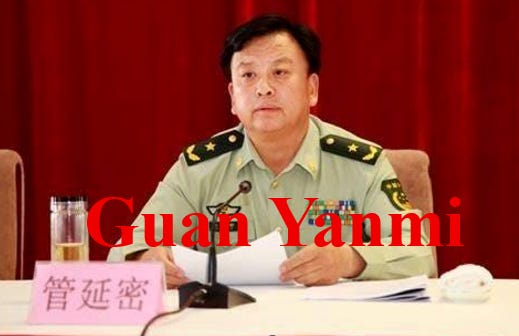
Born in January 1960 in Jiaonan, Shandong, Guan built his career through operational leadership roles in the internal security apparatus. He previously served as Chief of Staff of the Shandong Provincial Armed Police Force and Chief of Staff of the Xinjiang Provincial Armed Police Force. In July 2016, he was promoted to Commander of the Xinjiang Provincial Armed Police Force, attaining the Corps-grade (正军职) rank. During his tenure in Xinjiang, Guan directed local suppression operations, mass surveillance enforcement, and counter-terror pretexts used to justify totalitarian control over the region.
       CCP CENTRAL MILITARY COMMISSION (CMC) / ARMED POLICE COMMAND
                                    |
         +--------------------------+--------------------------+
         |                                                     |
         v                                                     v
[1. Internal Suppression Field]                     [2. Capital Hardware Expansion]
Guan Yanmi: Commander,                              Guan Yanmi: Director,
Xinjiang Provincial Armed Police (2016-2017)        Armed Police Equipment Department (Oct 2017)
- Overseeing regional military control              - Elevating equipment R&D to Corps-grade
- Executing internal security operations            - Integrating Military-Civil Fusion (MCF)
         |                                                     |
         +--------------------------+--------------------------+
                                    |
                                    v
                     [3. Legislative Monopolization]
                     Delegate, 13th NPC (March 2018)
                     - Rubber-stamping CMC operational mandates
                     - Coercing civilian economy to fund military logistics
The October 2017 Expansion: Elevating the Equipment Department
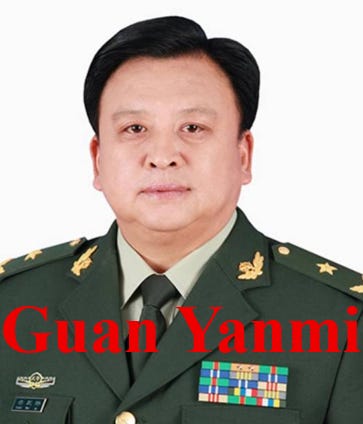
In October 2017, at age 57, Guan was transferred to Beijing to serve as Director of the newly established Corps-grade Equipment Department of the Armed Police. Prior to the military structural overhaul, equipment management operated merely as a secondary subunit under the Headquarters staff. Elevating the Equipment Department to a dedicated Corps-grade entity directly reflects the regime’s strategy to expand specialized military hardware, anti-riot equipment, counter-terrorism technologies, and mobilization logistics.
By 2015, the Armed Police had already established a specialized equipment architecture covering combat duty, counter-terrorism, social stability maintenance, anti-riot operations, and emergency rescue. Under Guan’s direction, the Equipment Department was tasked with accelerating dual-use technology integration through Military-Civil Fusion (MCF) to guarantee absolute readiness for regime survival and domestic control
.
Parliamentary Discourse at the 13th NPC (2018)
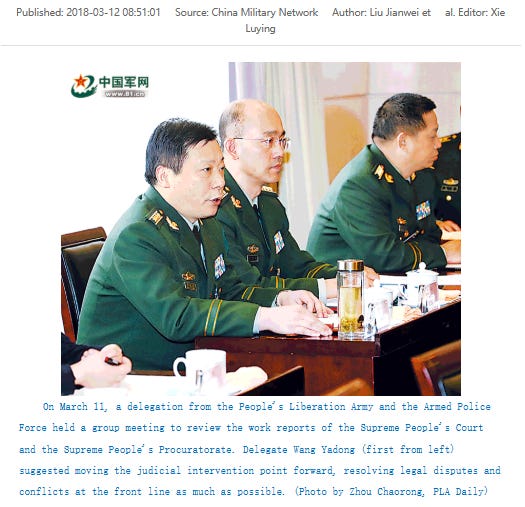
In March 2018, Guan appeared in Beijing as an active-duty delegate representing the Armed Police at the 13th National People’s Congress (NPC). During the plenary session of the military and armed police delegation on March 12, 2018—attended directly by CCP General Secretary Xi Jinping—Guan delivered a speech framing civilian economic output as a mandatory support mechanism for armed power expansion.
Key takeaways from Guan’s parliamentary discourse include:
Explicit Role as Regime Enforcers: Guan explicitly stated that the Armed Police serves as a primary tool for “safeguarding political security, particularly regime security and institutional security.” This statement confirms that the primary function of the Armed Police is not public defense, but protecting the CCP dictatorship from internal challenges.
Economic Coercion via Military-Civil Fusion (MCF): Emphasizing that “a strong military requires a wealthy nation for support,” Guan demanded that municipal governments, local Party committees, and civilian industries allocate concrete resources to military logistics, combat readiness, troop housing, and veteran benefits under the Military-Civil Fusion (MCF) doctrine.
Institutional Interlocking Control: Serving simultaneously as a Corps-grade equipment chief and a sitting NPC delegate, Guan illustrates how active military commanders use legislative platforms to enforce military priorities over civilian governance without judicial or democratic oversight.
Major General Guan Yanmi’s dual appointment as Director of the Armed Police Equipment Department and delegate to the 13th National People's Congress (NPC) provided the critical institutional transmission belt to translate Xinjiang’s draconian control protocols into nationwide police-state architecture. Leveraging his field command in occupied Xinjiang—where he oversaw real-time electronic device searches, face-recognition cameras, and grid-based surveillance—Guan utilized his legislative position to embed these repression techniques into the regime's "Smart Rock" (智慧磐石) engineering project under the guise of Military-Civil Fusion (MCF) and technology-driven security. By scaling post-information terminals, automated facial recognition, and mobile forensic extraction tools through central equipment procurement, Guan helped standardize the hardware and legal pretexts necessary to roll out Xinjiang-style totalitarian controls across major eastern metropolitan hubs, enabling municipal police in cities like Shanghai to routinely inspect citizens' mobile phones and enforce absolute political compliance.
Structural Analysis: The Interlocking Machinery of Impunity
Guan Yanmi’s dual role as an operational equipment chief and an NPC delegate highlights the core mechanics of the regime’s power structure:
From Field Repression to Central Logistics: Guan’s promotion from Xinjiang commander to central equipment director underscores how the regime rewards field commanders who demonstrate uncompromising effectiveness in executing internal security operations.
Subordination of the Judiciary: Because the Armed Police operates under the direct command of the CCP Central Military Commission (CMC), and its senior commanders sit within the NPC—which directly appoints and supervises the SUPREME COURT (SPC) and SUPREME PROCURATORATE (SPP)—the Armed Police operates with absolute immunity from civilian legal accountability.
Economic Subservience to the Military Apparatus: Guan’s speech reinforces the regime’s doctrine that civilian economic development exists primarily to fuel the military-industrial complex and sustain the armed forces required to maintain totalitarian rule.
No comments:
Post a Comment