


The case of Major General Tan Min (谭民) provides an unusually clear documentary window into the relationship between the Chinese People’s Liberation Army (PLA), the Chinese Communist Party (CCP), and the National People’s Congress (NPC).
During the first session of the 13th National People’s Congress in March 2018, Tan Min was publicly identified as both a deputy to the National People’s Congress and Deputy Chief of Staff of the PLA Central Theater Command. At the same time, his recorded interventions as an NPC deputy concerned the operational capabilities and command responsibilities of the very military theater in which he held a senior command position.
His case is therefore more revealing than the simple observation that “military officers sit in the NPC.” The official record shows a serving senior PLA commander participating in the NPC while simultaneously speaking from within the PLA command structure about military operational policy, and explicitly describing that command structure as operating under the leadership of the CCP Central Committee and the Central Military Commission (CMC).
The institutional question is straightforward:
What does it mean for a serving senior military commander, whose own command authority is embedded in the CCP leadership system, simultaneously to exercise a representative role in the national legislature?
1. Who was Tan Min?
In March 2018, official and state-affiliated Chinese media repeatedly identified Tan Min as:
中部战区副参谋长、人大代表
that is, Deputy Chief of Staff of the Central Theater Command and an NPC deputy.
This was not a former military officer who had subsequently entered civilian politics. He was a serving PLA officer occupying a senior operational position.
The Central Theater Command was one of the PLA’s five theater commands established during the military reforms initiated under Xi Jinping. Its function was not simply administrative. It was designed as a joint operational command organization.
Tan himself explained its role in a March 2018 interview.
He described the theater command as a:
联合作战指挥机构
—a joint operational command organization—
whose principal responsibility was:
主战
literally, primary responsibility for warfighting.
He summarized the theater’s responsibilities through four concepts:
主战主责 — primary responsibility for warfighting;
联战联训 — joint operations and joint training;
胜战胜算 — preparing systematically to achieve victory;
统战统保 — unified operational command and unified support.
Thus, Tan’s military position was directly connected to the PLA’s operational command system.
2. The same officer was an NPC deputy
The significance of Tan’s NPC status becomes clearer when the chronology is examined.
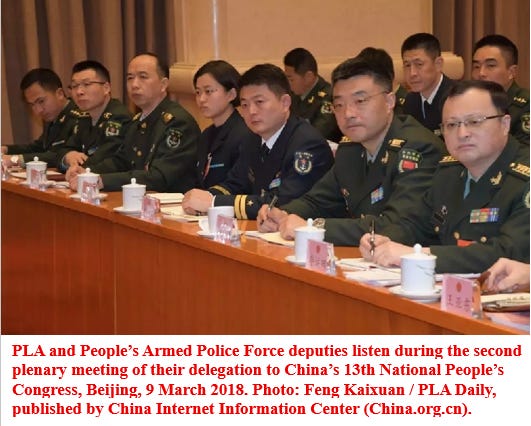
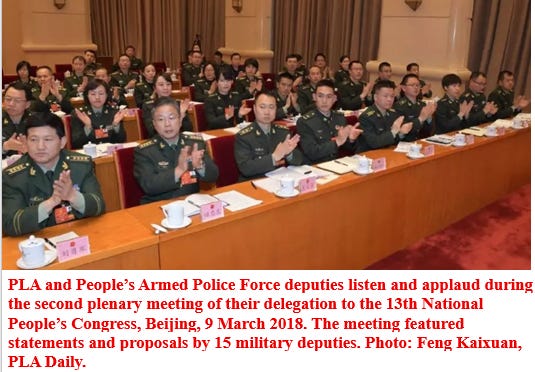
On 9 March 2018, the PLA and People’s Armed Police Force delegation to the 13th NPC held its second plenary meeting.
The official report identified:
中部战区副参谋长谭民代表
— NPC deputy Tan Min, Deputy Chief of Staff of the Central Theater Command.
Fifteen military deputies reportedly made suggestions concerning the strengthening of the armed forces and military training. Tan’s particular intervention concerned:
加快提升战区联合作战指挥能力
— accelerating the improvement of the theater’s joint operational command capability.
This is significant.
Tan was not merely a military officer who happened to possess an NPC seat. His documented NPC activity included advocating improvements to the operational command capabilities of the military theater in which he was himself a senior commander.
The NPC therefore provided a setting in which a serving theater-command officer participated as a national legislative representative while addressing the institutional requirements of his own military organization
3. Tan’s own description of the Theater Command is even more revealing
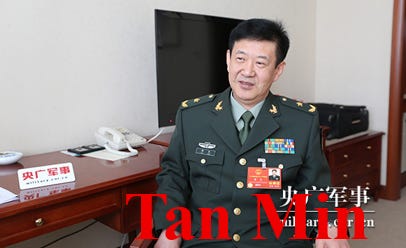
A March 2018 interview published by “央广军事” CNR Military provides an unusually direct statement concerning the institutional position of the Theater Command.
Discussing the new theater-command system, Tan stated:
“战区作为本辖区内唯一的最高指挥机构,在党中央、中央军委的领导下,根据相应的权责,统一指挥作战。”
In English:
“As the sole highest command authority within its area of responsibility, the theater command, under the leadership of the CCP Central Committee and the Central Military Commission, exercises unified command over military operations in accordance with its assigned authorities and responsibilities.”
This sentence deserves particular attention.
Tan did not describe the Theater Command as an autonomous military institution. He explicitly located its command authority within a political hierarchy:
CCP Central Committee → Central Military Commission → Theater Command
The significance is heightened by the fact that Tan was himself a senior officer within that command hierarchy.
The same officer who served as an NPC deputy therefore publicly described the military command organization in which he served as operating under the leadership of the CCP Central Committee and the CMC.
4. His NPC role and his military command role cannot simply be treated as unrelated
One could argue that Tan had two separate capacities: military officer and NPC deputy.
Formally, that is true.
But the documentary record shows that these two capacities overlapped in practice.
On 9 March, he participated in the PLA/PAP NPC delegation and addressed the improvement of theater-level joint operational command.
In the same month, he explained that the Theater Command was the highest command authority in its area and operated under the leadership of the CCP Central Committee and CMC.
Then, on 18 March, another official report recorded Tan speaking as an NPC deputy about Xi Jinping’s military-strengthening doctrine and the political requirements imposed on military personnel.
The resulting picture is not merely:
military officer + legislator
It is:
serving PLA commander + NPC deputy + participant in a military delegation + advocate of PLA operational policy + publicly declared adherent to the CCP military leadership structure.
That combination is the institutional fact that deserves examination.
5. Tan’s statement after Xi Jinping’s election is particularly important
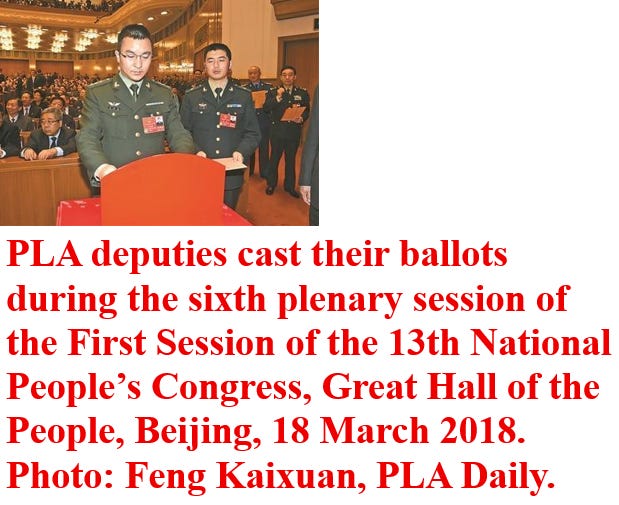
On 17 March 2018, the 13th NPC elected Xi Jinping as President of the PRC and Chairman of the Central Military Commission.
The following day, military and People’s Armed Police deputies were reported as expressing their determination to:
safeguard the authority and centralized, unified leadership of the CCP Central Committee with Xi Jinping at its core;
follow Xi Jinping Thought on Socialism with Chinese Characteristics for a New Era;
establish Xi Jinping’s military-strengthening thought as the guiding principle for national defense and military construction;
advance the CCP’s objectives for strengthening the military.
Tan Min was specifically quoted discussing how military personnel should understand and implement Xi Jinping’s military-strengthening thought.
He said that military personnel should:
“紧紧跟上党中央、中央军委和习主席决策部署”
— closely follow the decisions and deployments of the CCP Central Committee, the Central Military Commission and Xi Jinping.
This is important evidence because it comes from the same person who was simultaneously serving as an NPC deputy.
His public description of military political responsibility was therefore framed around alignment with the CCP Central Committee, the CMC and Xi Jinping.
The source does not portray Tan’s military political orientation as being derived from an independent legislative mandate.
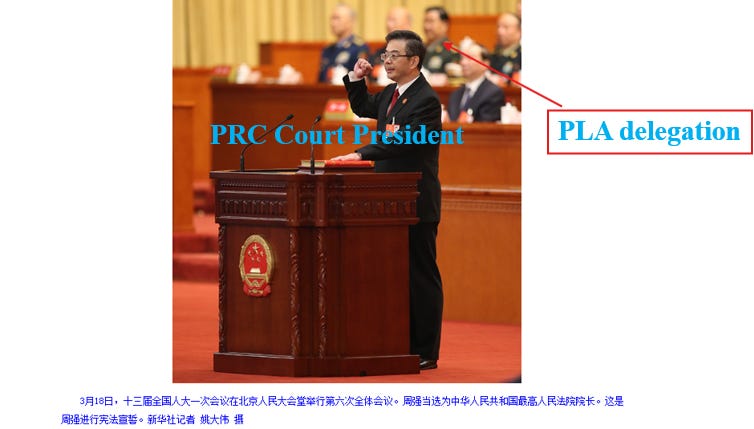
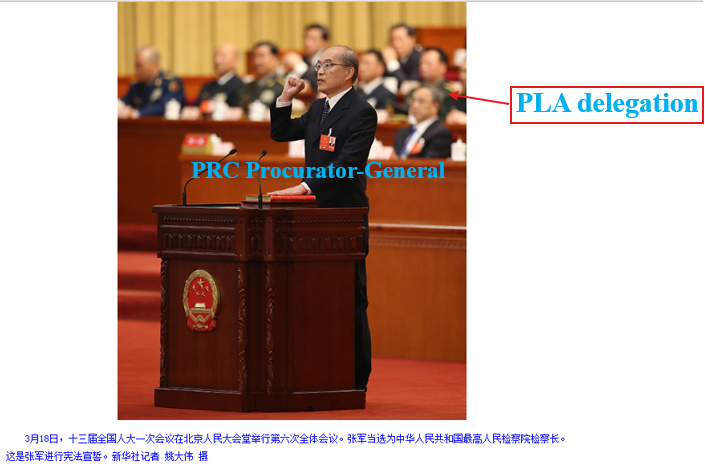
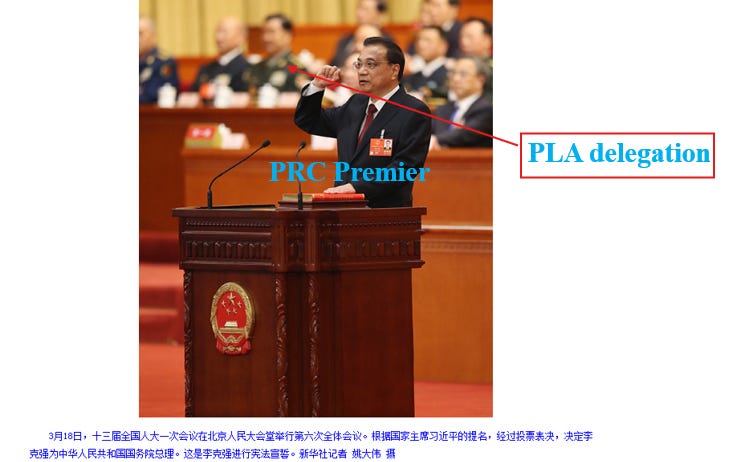
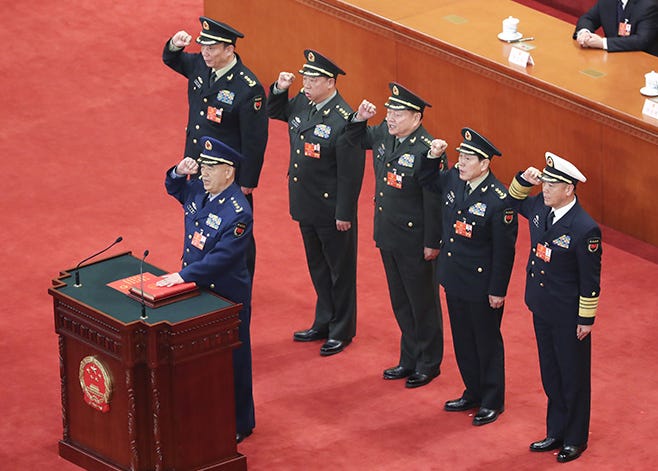
6. The distinction between the NPC and the PLA command structure
This raises a fundamental institutional question.
The NPC is formally the national legislature of the PRC. Its deputies are described as representatives participating in the exercise of state power.
Yet Tan’s documented case shows a serving senior PLA commander participating in the NPC through the PLA and People’s Armed Police delegation, while simultaneously occupying a command position within a military organization that he explicitly described as operating under the leadership of the CCP Central Committee and CMC.
This does not require the claim that Tan personally violated any rule.
The more consequential observation concerns institutional structure.
The question is whether the military deputies should be understood merely as individual citizens who happen to be members of the armed forces, or whether their representation reflects the institutional organization of the PLA itself.
Tan’s case strongly supports the latter interpretation.
His official identification consistently linked him to his military command position. His NPC participation occurred within the PLA/PAP delegation. His policy intervention concerned theater-level military command. And his public political statement emphasized obedience to the CCP Central Committee, CMC and Xi Jinping.
The evidence therefore points toward institutional representation by a politically organized military establishment, rather than a conventional model in which military personnel appear in the legislature simply as ordinary individual constituents.
7. “Who does the military representative represent?”
This is the central question raised by Tan Min’s case.
In a conventional representative legislature, a representative may simultaneously have a profession, organizational affiliation and personal political views. But the representative’s legislative position is ordinarily understood through a political constituency.
Tan’s case presents a different institutional configuration.
He was a senior PLA commander.
He belonged to the PLA/PAP NPC delegation.
His legislative intervention addressed the operational requirements of the Theater Command.
And his own description of military authority placed that command structure under the CCP Central Committee and CMC.
That makes it reasonable to ask:
When Tan Min acted as an NPC deputy, was the relevant institutional constituency simply the general population, or was his representation also structured through the PLA’s own organizational and command system?
The documentary evidence does not require an answer based on speculation. It provides the institutional facts from which the question arises.
8. The 2019 record confirms the continuity of his military position
The documentary record does not end with the 2018 NPC session.
On 24 September 2019, Xinhua identified Tan Min as:
阅兵联合指挥部办公室常务副主任、中国人民解放军中部战区副参谋长
— Executive Deputy Director of the Office of the Joint Parade Command and Deputy Chief of Staff of the PLA Central Theater Command.
The occasion was a national press briefing concerning the military parade for the 70th anniversary of the PRC.
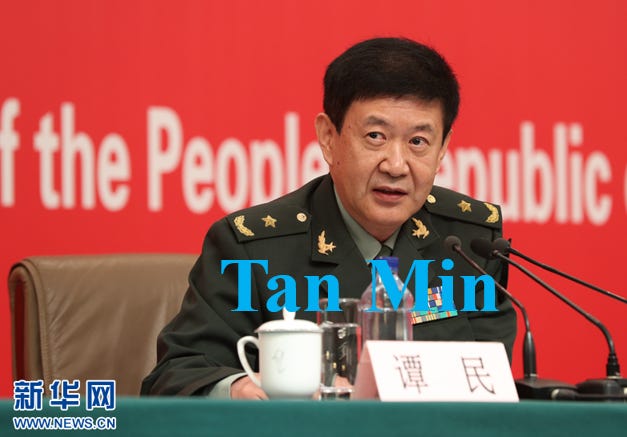
This provides an independent chronological confirmation that Tan continued to hold a senior Central Theater Command position after the 13th NPC session.
It also demonstrates the national-level significance of his military role: he was involved in the command structure responsible for the military parade marking the PRC’s 70th anniversary.
Thus, the 2018 NPC evidence cannot be dismissed as a temporary or purely ceremonial military affiliation.
9. A four-document documentary chain
Tan Min’s case can therefore be reconstructed through four contemporaneous documents:
9 March 2018
PLA/PAP delegation, 13th NPC
Tan Min is identified as both Central Theater Command Deputy Chief of Staff and an NPC deputy, and speaks about improving the Theater Command’s joint operational command capabilities.
12 March 2018
“央广军事” interview
Tan explains that the Theater Command is the highest command authority within its area and explicitly states that it operates under the leadership of the CCP Central Committee and CMC.
18 March 2018
13th NPC session
Tan, identified as an NPC deputy, discusses Xi Jinping’s military-strengthening doctrine and states that military personnel should closely follow the decisions and deployments of the CCP Central Committee, CMC and Xi Jinping.
24 September 2019
Xinhua
Tan is again identified as Deputy Chief of Staff of the Central Theater Command, while simultaneously serving as Executive Deputy Director of the Office of the Joint Parade Command.
Taken together, these documents establish a continuous institutional picture rather than a single isolated statement.
10. Why Tan Min matters beyond Tan Min
Tan Min should not be treated merely as an individual biography.
His importance lies in what his career demonstrates about the institutional relationship among three structures:
the PLA
↓
the CCP leadership system
↓
the National People’s Congress
His case shows a serving senior PLA commander entering the NPC as part of the military delegation while continuing to operate within a military command structure explicitly described as being under CCP Central Committee and CMC leadership.
The evidence also shows that his NPC activity included advocacy concerning the operational capabilities of that military command structure itself.
This is precisely the type of evidence that should be examined when assessing the character of military representation in the NPC.
More Than a “Military Deputy”
Tan Min’s case deserves attention because the available record shows considerably more than the fact that a PLA officer possessed an NPC seat.
He was:
a serving senior PLA commander;
an NPC deputy in the 13th NPC;
a participant in the PLA/PAP delegation;
an advocate for strengthening theater-level joint operational command;
an officer who publicly described the Theater Command as operating under the leadership of the CCP Central Committee and CMC;
and a military representative who publicly called for alignment with the decisions of the CCP Central Committee, CMC and Xi Jinping.
The central issue is therefore institutional rather than personal.
Tan Min’s documented career provides a concrete example in which military command authority, CCP political leadership and national legislative representation converge in the same individual.
That convergence deserves to be examined directly when evaluating claims that the NPC functions as an independent representative legislature, particularly where PLA and People’s Armed Police deputies are concerned.
In Tan Min’s own words, the Theater Command operated under the leadership of the CCP Central Committee and Central Military Commission.
Yet Tan Min simultaneously occupied a seat in the institution presented as the highest organ of state power.
That institutional overlap—not the personality of Tan Min—is the real subject of this case study.
The Wuhan Nexus: Central Theater Command, JLSF Institutional Zeal, and the 2019 Escalation
Newly correlated open-source intelligence (OSINT) connects the 2019 COVID-19 timeline directly to the operational hierarchy of the PLA Central Theater Command and the Wuhan-based PLA Joint Logistics Support Force (JLSF).
The Command Imperative of Major General Tan Min:
Major General Tan Min—deputy in the 13th NPC, Deputy Chief of Staff of the Central Theater Command (covering Wuhan and Hubei), and Executive Deputy Director of the 2019 Military Parade Joint Command Office—explicitly affirmed in 2018 that under the Central Military Commission, the theater command operates as the “sole supreme commanding body inside its jurisdiction, exercising unified command over all operations.” Any high-risk bio-warfare exercise, logistics coordination, or pathogen handling in Wuhan fell directly under Central Theater Command authority.
JLSF Headquarters and the 70th Anniversary Parade Escalation:
On October 1, 2019, the newly formed JLSF made its historical debut at the 70th Anniversary Parade in Beijing, an event managed directly by Tan Min’s parade office. Just two weeks later, the 7th Military World Games opened in Wuhan—the primary headquarters and logistical hub for the JLSF. Propelled by the political momentum of the Beijing parade and rooted in institutional narratives tracing back to the Korean War (where the U.S. was designated as the primary existential enemy), the JLSF had both the ideological mandate and operational imperative to target foreign military delegations.
Convergence with Intelligence Disclosures:
This institutional alignment provides critical context for investigative disclosures by OSINT analysts like Dr. Lawrence Sellin regarding alleged statements by PLA personnel (”Let the white pigs have some”). Driven by Korean War historical enmity, the JLSF’s Wuhan headquarters provided the ideal operational platform where bio-warfare exercises, dual-use gain-of-function research, and Anti-U.S. combat readiness converged under the unified command of the Central Theater Command.
The Chain of Command: Central Military Commission (CMC) Direct Oversight
The nuance of General Tan Min’s statement—emphasizing that all unified operations occur strictly “under the leadership of the CCP Central Committee and the Central Military Commission (CMC)”—is critical to mapping responsibility for the 2019 Wuhan activities.
Institutional Separation Under Post-2015 Military Reforms:
Under China’s post-2015 defense structural reforms, neither the PLA Joint Logistics Support Force (JLSF, headquartered in Wuhan) nor the Academy of Military Medical Sciences (AMMS) report to the Central Theater Command. Both are direct subordinates of the Central Military Commission (CMC).
The Imperative of High-Level CMC Authorization:
Because theater commands possess no authorization to independently command or direct CMC-direct units like AMMS or JLSF, any joint biodefense exercise, viral sampling program, or operational deployment surrounding the October 2019 Military World Games in Wuhan could only be mandated and coordinated directly by the highest authority: the Central Military Commission.
Closing the Accountability Loop:
This institutional reality eliminates the possibility of rogue actions by regional theater commanders. The convergence of JLSF logistics, AMMS biodefense personnel, and Central Theater Command elements in late 2019 required a top-down operational vector authorized directly by the supreme command in Beijing.
No comments:
Post a Comment