


What Everyone’s Reading
-
Based on its own charter, leadership endorsements, and political positioning, CMAA (全联并购公会) is not an independent market institution. It i...
-
Jun Guo Product Safety Manager at Amway (China) R&D Center once worked at PLA Academy of Military Medical Sciences(AMMS) prior to joi...
-
Law Offices of Yu & Associates, led by Xiaohui Yu, operates in Washington D.C. with a focus on international business, immigration, and ...
-
Duan & Duan Law Firm (段和段律师事务所), headquartered in Shanghai with offices across China, has established itself as one of the most politica...
-
S.Res. 444 (Sen. Scott, of FL): A resolution condemning the dictator of the People's Republic of China, Xi Jinping, for deceit, undermin...
-
01 内塔尼亚胡支持川普停火两周决定:前提是伊朗立即开放海峡并停止一切攻击,黎巴嫩不在停火范围内 https:// ludepress.com/news/newshighl ights/56346/ 02 川普宣布美国将协助疏导霍尔木兹海峡航运,并“守”在那里确保一切顺利...
-
序言:那粒被诅咒的种子 要真正理解为什么这片土地至今仍被沉重的铁笼所禁锢,必须追溯到一百年前那个致命的起点。历史的悲剧从来不是凭空出现的,它在第一粒种子种下时,就已经写好了所有的灾难密码。 1924年,黄埔军校在莫斯科的资金和枪支援助下建立。这粒种子不仅带回了绝对服从的冷酷纪律,...
-
Michael J. Zhang (张军) is a U.S.-based attorney and a member of the Overseas Lawyers Group of the Legal Advisory Committee under the All-C...
-
在当代国际政治的聚光灯下,我们正有幸目睹一场人类历史上最荒诞、最硬核,也最具黑色幽默色彩的“跨国双向奔赴”。 这边厢,最高权力殿堂里正襟危坐,高调宣示着“打铁还需自身硬” 、 “反腐败斗争绝对无上限、无死角、无禁区”。那铿锵有力的表态,仿佛要把每一个贪腐分子都送进历史的绞肉机。 ...
13 September 2026
12 September 2026
How PLA Western Theater Command Chief of Staff Rong Guiqing used his seat in the National People’s Congress to demand fiscal, statutory, and dual-use mobilization powers

Command Power Meets Legislative Authority
PLA Lieutenant General Rong Guiqing (戎贵卿) embodies the seamless integration of operational warfighting command and state legislative authority. A decorated veteran officer who advanced through four military regions to become Deputy Commander and Chief of Staff of the PLA Western Theater Command—the vast operational jurisdiction covering Sichuan, Tibet, and Xinjiang—Rong simultaneously held a seat as a deputy in both the 12th and 13th National People’s Congresses (NPC).
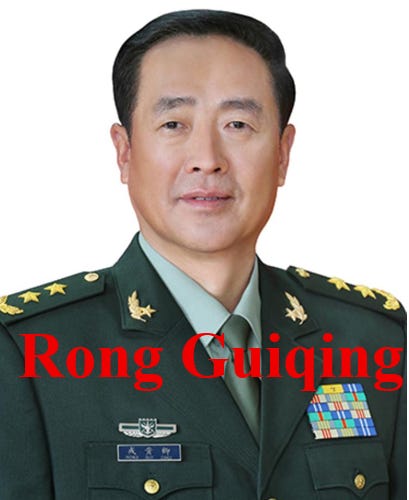
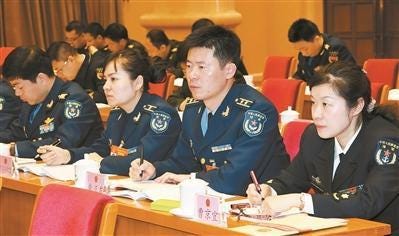
In modern constitutional democracies, active-duty military commanders are strictly barred from holding legislative seats to preserve civilian supremacy over the armed forces. Under China’s party-state architecture, however, active-duty flag officers sit directly inside the highest organ of state power, actively shaping the laws, budgets, and mobilization structures under which they operate.
       WESTERN THEATER COMMAND                      NATIONAL PEOPLE'S CONGRESS
 (Operational Combat Command over                    (Highest Organ of State Power)
   Sichuan, Tibet, & Xinjiang)
               │                                                │
               └───────────────────────┬────────────────────────┘
                                       │
                         LIEUTENANT GENERAL RONG GUIQING
                     (Deputy Commander & Chief of Staff / NPC Deputy)
                                       │
                       ┌───────────────┴───────────────┐
                       ▼                               ▼
            LEGISLATING MOBILIZATION         EXPANDING DUAL-USE MCF
          Demanded clearer command authority   Advocated for deep military-civil
          & direct fiscal funding channels     fusion in defense transportation
Direct Access to Top Leadership: Advocating MCF and Joint Operations
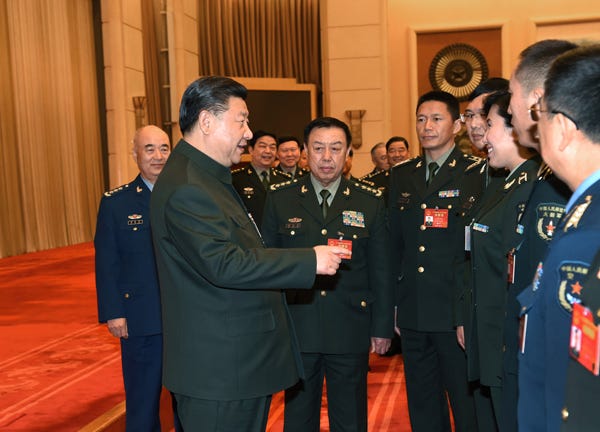
During the plenary meeting of the PLA delegation at the 5th Session of the 12th NPC on March 12, 2017, PLA General Rong Guiqing was selected as one of only nine military representatives to directly deliver policy recommendations to Xi Jinping (Chairman of the Central Military Commission).
Presenting alongside key defense-tech figures, Rong and his fellow representatives delivered targeted proposals spanning key operational priorities:
Promoting Innovation in Weapons and Equipment
Enhancing Innovative Capabilities for New Combat Forces
Advancing Joint Campaign Training
Safeguarding China’s Overseas Interests
Deepening Military-Civil Fusion (MCF) in National Defense Transportation Infrastructure
This high-level access highlights how theater-level operational commanders like Rong directly influence top-level party decisions, using parliamentary plenaries to lobby for the deeper integration of civilian transport networks and technology into frontline military mobilization.
Demand for Expansion: The Four “Inadequacies”
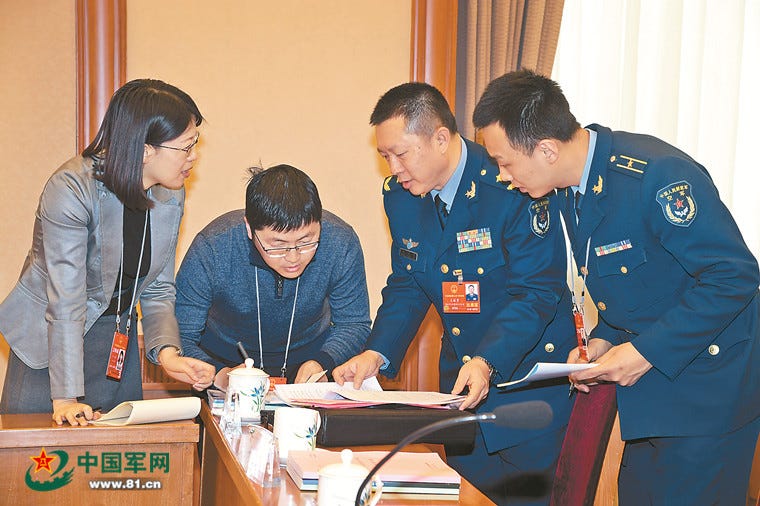
During the first parliamentary session of the 13th NPC in 2018, PLA General Rong leveraged his legislative platform to publicly identify critical bottlenecks in China’s national defense mobilization system, directly advocating for statutory and fiscal expansion to support frontline combat readiness.
Rong cited four structural “inadequacies” and one “lag” in existing civilian-military structures:
Inadequate Institutional Mechanisms: Demanding tighter coordination between civilian provincial governments and military commands.
Inadequate Statutory Frameworks: Calling for overhauled national defense mobilization laws that grant explicit military command authority over civilian assets during crises.
Inadequate Command Authority: Demanding clear, unencumbered operational power to mobilize local resources.
Inadequate Funding Channels: Calling for direct, unobstructed streams of public revenue from civilian treasuries into theater-level militarty infrastructure.
Lagging Command Information Systems: Advocating for dual-use tech integration to upgrade military command-and-control networks.
Rather than submitting to civilian legislative oversight or budget limitations, PLA General Rong used his constitutional position as a lawmaker to demand that the state apparatus subordinate local economies, public infrastructure, and fiscal policy directly to the requirements of war preparation.
The Operational Mandate: The “Five Characteristics” and “Four Priorities”
In March 2019, General Rong explicitly outlined the strategic reality of his command, characterizing the operational posture of the PLA Western Theater Command through five features: elevated political imperatives (”高”), concerning external security environments (”忧”), escalating risks and challenges (”多”), heavy operational warfighting mandates (”重”), and immense accountability for execution (”大”).
To address these challenges, Rong insisted that the theater command must prioritize four concrete imperatives:
Upholding Political Allegiance (强化旗帜引领)
Fortifying Party Political Construction (加强党的政治建设)
Concentrating All Efforts on Combat Readiness (聚力练兵备战)
Elevating Joint Operational Command Capabilities (提升联合作战指挥能力)
The Constitutional Paradox
The career of Lieutenant General Rong Guiqing underscores the core structural reality of the Beijing regime:
Absence of Civilian Oversight: Senior commanders do not answer to a civilian legislature; they sit inside the legislature as an organized voting bloc led by CCP Central Military Commission, voting on state budgets, judicial reports, and executive appointments.
Erasure of Res Publica: In classical constitutional theory, res publica dictates that public treasuries, civil infrastructure, and legislative bodies belong strictly to the citizenry. Under Articles 4, 21, and 22 of the National Defense Law, however, the very concept of a "public domain" is legally erased. Public funds, civilian transport networks, and tax policies are statutory instruments bound to serve party supremacy and war readiness above all else. By forcing civilian taxpayers to underwrite unmonitored military energy stockpiles and dual-use infrastructure under the guise of "public development," the Beijing regime effectively liquidates the public character of the state, replacing civilian governance with a permanent mobilization system..
By uniting operational command over Western China with legislative voting power in Beijing, Lieutenant General Rong Guiqing serves as a definitive case study in how China’s party-army system converts public governance into a instrument for total state mobilization of Chinese Communist Party totalitarian.
Information Blockades as Military Shielding: Censorship, Total Mobilization, and Covert Operations
In the strategic architecture of the Chinese Communist Party (CCP), the Great Firewall and aggressive state censorship are not merely tools for domestic regime survival; they function as active-duty military shielding for total state mobilization and illicit CBRN (Chemical, Biological, Radiological, and Nuclear) developments. To bypass United Nations Security Council (UNSC) scrutiny and international monitoring under the Biological Weapons Convention (BWC), Beijing relies on a pervasive digital iron curtain to enforce strict operational security (OPSEC) over its dual-use infrastructure.
This systematic information blackout serves three primary strategic functions:
Covert Mobilization and OSINT Interception: Real-time suppression of localized financial transfers, hospital anomalies, and transport logistics prevents foreign intelligence and open-source intelligence (OSINT) analysts from detecting early indicators of military mobilization and emergency requisitioning.
Shielding High-Risk Military Testing: Deep information blackouts in Xinjiang and key military-research hubs provide absolute cover for high-risk biodefense exercises, dual-use gain-of-function research, and non-transparent nuclear site expansions, insulating the regime’s civil-military fusion (MCF) entities from international inspection.
Tactical Delay and Asymmetric Advantage: As demonstrated by the intentional suppression and delayed release of early genomic sequencing data during the initial COVID-19 outbreak, information blockades create critical time windows. This tactical delay allows the party-state to purge raw laboratory records, shape global narratives, and consolidate strategic medical supplies before international health or security bodies can intervene.
By severing internal data streams from global oversight, the regime’s censorship apparatus operates as an essential force multiplier—enabling covert military readiness, concealing CBRN liabilities, and liquidating international transparency mechanisms under the cover of a managed digital environment.
11 September 2026
From Major General Leng Zhiyi’s Legislative Dual-Hatting to the National Defense Law: Deconstructing the Structural Incompatibility of the Beijing Regime with the Founding Mandates of the UN Charter.

The Constitutional Mirage: A Republic Without Public Control
The foundational preamble of the United Nations Charter explicitly establishes that the post-WWII international order was built to “save succeeding generations from the scourge of war” by dismantling authoritarian militarism and subjecting national defense structures to civilian, public governance (res publica).
Yet, inside the United Nations Security Council, a permanent veto power is wielded by a regime whose state architecture directly violates the basic definitions of a republic. Under the name “People’s Republic of China,” the state apparatus operates not as a neutral public framework, but as an institutional vessel for absolute party leadership—a contradiction clearly demonstrated through the legal framework and legislative roles assigned to active-duty military commanders.
       UN CHARTER FOUNDATIONAL PRINCIPLES
   [Public Neutral Governance & Civilian Oversight]
                      │
                      ▼
   ┌──────────────────────────────────────────┐
   │         CONSTITUTIONAL CONTRADICTION     │
   │  Is a state governed by a Party-Army     │
   │  legally a "People's Republic"?          │
   └──────────────────────────────────────────┘
                      │
        ┌─────────────┴─────────────┐
        ▼                           ▼
ARTICLE 59 CONSTITUTION     NATIONAL DEFENSE LAW
Active-Duty Military Bloc   Party Supremacy & MCF
in the Legislature          Directives (Arts 4, 21, 22)
Exhibit A: Major General Leng Zhiyi and the Dual-Hatting of Military Enforcement
The structural integration of military power into civilian legislative bodies is not theoretical; it is operationalized by high-ranking active-duty officers across local and national political assemblies.
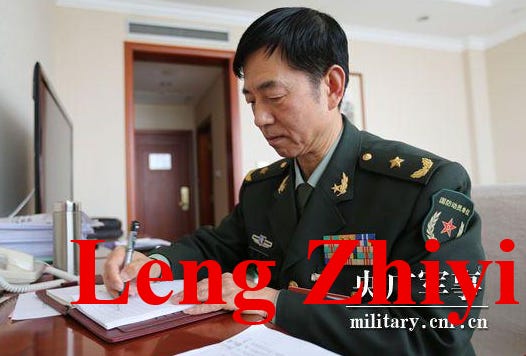
A prime case is Major General Leng Zhiyi (冷志义). His career demonstrates the seamless overlap between provincial military command, internal party-military discipline, and state legislative functions:
Provincial Military Command & National Delegation: In March 2018, serving as Political Commissar of the PLA Sichuan Provincial Military District, Leng sat as a deputy in the 13th National People’s Congress (NPC). In Sichuan, Leng was part of a local assembly that included 28 active-duty officers—ranging from provincial military district leaders to command staff from the 77th Group Army, strategic support units, and military aerospace divisions—who directly shaped the election of the 148-member provincial delegation to the national legislature.
Political Discipline & Combat Readiness: By March 2019, Leng transitioned to serve as a Senior Inspector (正军职巡视专员) of the Central Military Commission (CMC) Inspection Group. Addressing the military delegation at the NPC, Leng explicitly advocated for using party inspection and disciplinary mechanisms to enforce combat readiness, demanding “joint military-civilian inspection and enforcement in sectors with high Military-Civil Fusion (MCF) integration.”
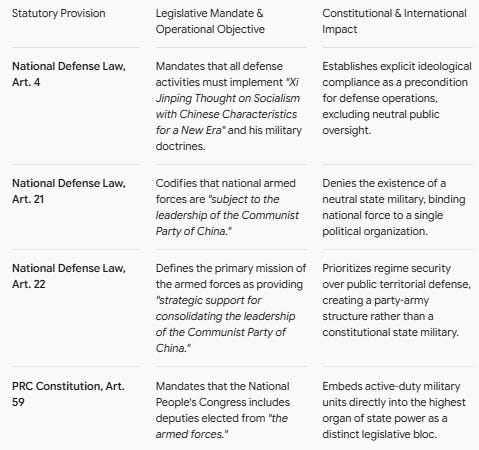
The Statutory Paradox: Articles 4, 21, and 22 of the National Defense Law
The presence of officers like Leng Zhiyi inside the legislature is not an anomaly—it is codified by statutory mandates that subordinate public governance to political imperatives.
Judicial Immunity and the Invalidation of Civilian Oversight
To maintain this party-army loop, the legal architecture explicitly insulates military operations from civilian judicial review.
Under Articles 128 and 134 of the PRC Constitution, the SUPREME COURT (SPC) functions as the supreme judicial organ, while the SUPREME PROCURATORATE (SPP) serves as the supreme legal supervision body. However, under Articles 133 and 138, both organs are explicitly answerable to and supervised by the National People’s Congress.
Because active-duty officers sit as a permanent, organized bloc within the NPC under Central Military Commission authority, the highest judicial authorities lack any jurisdiction or constitutional standing to review, challenge, or invalidate military decisions, defense mobilization mandates, or Military-Civil Fusion (MCF) operations.
┌─────────────────────────────────────────────────────────┐
│              NATIONAL PEOPLE'S CONGRESS                 │
│  Includes Active-Duty Military Deputies (Article 59)    │
└────────────────────────────┬────────────────────────────┘
                             │ Supervial / Responsible To
              ┌──────────────┴──────────────┐
              ▼                             ▼
   SUPREME COURT (SPC)           SUPREME PROCURATORATE (SPP)
     (Article 128)                  (Article 134)
              │                             │
              └──────────────┬──────────────┘
                             ▼
     NO JURISDICTION OVER MILITARY / MCF MANDATES
The Institutional Loophole: Legislative Dual-Hatting and the Complete Erasure of Civilian Oversight
Unassailable Timeline and Personal Identity: The institutional record establishes a direct, unassailable identity across both provincial and national legislative assemblies. Major General Leng Zhiyi (冷志义)—serving as Political Commissar of the PLA Sichuan Provincial Military District in 2018 and transitioning to Senior Inspector of the Central Military Commission (CMC) Inspection Group by 2019—exercised concurrent voting power within the 13th Sichuan Provincial People’s Congress and the 13th National People’s Congress (NPC). This is not a matter of shared nomenclature; it is a documented, continuous tenure of an active-duty flag officer exercising dual-level legislative authority.
Provincial-Level Legislative Control and Fiscal Allocation: At the provincial level, Leng sat as one of 28 active-duty military deputies in the Sichuan Provincial People’s Congress. In this capacity, Leng did not merely represent defense interests; he wielded direct constitutional authority to:
Approve Provincial Executive and Judicial Leadership: Vote on the appointment and work reports of the Governor of Sichuan Province, the President of the Sichuan High People’s Court, and the Chief Procurator of the Sichuan People’s Procuratorate.
Direct Public Fiscal Appropriations: Review and approve the Sichuan provincial annual budget, ensuring the redirection of local public revenues toward Military-Civil Fusion (MCF) infrastructure, military recruitment mandates, and provincial military district operations.
Determine National Legislative Delegation: Cast votes to elect the 148 deputies representing Sichuan Province in the National People’s Congress, embedding active-duty military influence directly into the selection of the national legislative body.
National-Level Ratification and the Inversion of Civilian Control: Upon entering the National People’s Congress, Leng’s legislative role expanded from provincial budget approval to the highest level of state ratification. As an active-duty officer operating under Central Military Commission discipline, Leng voted to:
Ratify State Leadership and Constitutional Amendments: Formally approve the presidency of the PRC, the chairmanship of the State Central Military Commission, the Premier of the State Council, and the members of the Standing Committee of the NPC.
Authorize National Public Budgets: Review and pass the central government’s national budget, channeling public funds directly into defense mobilization, strategic force expansion, and state-directed Military-Civil Fusion initiatives.
Endorse Judicial Work Reports While Maintaining Absolute Immunity: Review and pass the annual work reports of the SUPREME COURT (SPC) and the SUPREME PROCURATORATE (SPP).
The Constitutional Paradox of Self-Authorization: This dual-hatting structure creates a fatal conflict of interest that dismantles the core principles of res publica:
                  PARTY-ARMY COMMAND STRUCTURE
             (Central Military Commission / Active Duty)
                                 │
                                 ▼
                    MAJOR GENERAL LENG ZHIYI
                                 │
        ┌────────────────────────┴────────────────────────┐
        ▼                                                 ▼
SICHUAN PROVINCIAL CONGRESS                       NATIONAL PEOPLE'S CONGRESS
  • Votes on Provincial Budget                      • Votes on National Budget
  • Approves High Court & Procuratorate              • Approves SPC & SPP Reports
  • Elects 148 NPC Deputies                         • Elects PRC President & Premier
        │                                                 │
        └────────────────────────┬────────────────────────┘
                                 │
                                 ▼
                     THE CONSTITUTIONAL LOOP
           Military votes to approve civilian courts,
          while civilian courts possess ZERO jurisdiction
                     over military commands.
Unassailable Timeline and Personal Identity: The institutional record establishes a direct, unassailable identity across both provincial and national legislative assemblies. Major General Leng Zhiyi (冷志义)—serving as Political Commissar of the PLA Sichuan Provincial Military District in 2018 and transitioning to Senior Inspector of the Central Military Commission (CMC) Inspection Group by 2019—exercised concurrent voting power within the 13th Sichuan Provincial People’s Congress and the 13th National People’s Congress (NPC). This is not a matter of shared nomenclature; it is a documented, continuous tenure of an active-duty flag officer exercising dual-level legislative authority.
Provincial-Level Legislative Control and Fiscal Allocation: At the provincial level, Leng sat as one of 28 active-duty military deputies in the Sichuan Provincial People’s Congress. In this capacity, Leng did not merely represent defense interests; he wielded direct constitutional authority to:
Approve Provincial Executive and Judicial Leadership: Vote on the appointment and work reports of the Governor of Sichuan Province, the President of the Sichuan High People’s Court, and the Chief Procurator of the Sichuan People’s Procuratorate.
Direct Public Fiscal Appropriations: Review and approve the Sichuan provincial annual budget, ensuring the redirection of local public revenues toward Military-Civil Fusion (MCF) infrastructure, military recruitment mandates, and provincial military district operations.
Determine National Legislative Delegation: Cast votes to elect the 148 deputies representing Sichuan Province in the National People’s Congress, embedding active-duty military influence directly into the selection of the national legislative body.
National-Level Ratification and the Inversion of Civilian Control: Upon entering the National People’s Congress, Leng’s legislative role expanded from provincial budget approval to the highest level of state ratification. As an active-duty officer operating under Central Military Commission discipline, Leng voted to:
Ratify State Leadership and Constitutional Amendments: Formally approve the presidency of the PRC, the chairmanship of the State Central Military Commission, the Premier of the State Council, and the members of the Standing Committee of the NPC.
Authorize National Public Budgets: Review and pass the central government’s national budget, channeling public funds directly into defense mobilization, strategic force expansion, and state-directed Military-Civil Fusion initiatives.
Endorse Judicial Work Reports While Maintaining Absolute Immunity: Review and pass the annual work reports of the SUPREME COURT (SPC) and the SUPREME PROCURATORATE (SPP).
The Constitutional Paradox of Self-Authorization: This dual-hatting structure creates a fatal conflict of interest that dismantles the core principles of res publica:
PARTY-ARMY COMMAND STRUCTURE
(Central Military Commission / Active Duty)
│
▼
MAJOR GENERAL LENG ZHIYI
│
┌────────────────────────┴────────────────────────┐
▼ ▼
SICHUAN PROVINCIAL CONGRESS NATIONAL PEOPLE'S CONGRESS
• Votes on Provincial Budget • Votes on National Budget
• Approves High Court & Procuratorate • Approves SPC & SPP Reports
• Elects 148 NPC Deputies • Elects PRC President & Premier
│ │
└────────────────────────┬────────────────────────┘
│
▼
THE CONSTITUTIONAL LOOP
Military votes to approve civilian courts,
while civilian courts possess ZERO jurisdiction
over military commands.
Under Articles 128, 133, 134, and 138 of the PRC Constitution, the SUPREME COURT (SPC) and SUPREME PROCURATORATE (SPP) are subordinate to and supervised by the National People’s Congress. When an active-duty military commander votes to approve the leadership and budgets of these supreme judicial bodies, an inverted power dynamic occurs: the military sits in judgment of the judiciary, while the judiciary is constitutionally barred from exercising any jurisdiction, legal review, or oversight over the military.
Rather than civilian legislators exercising democratic oversight over the armed forces, active-duty officers like Leng Zhiyi hold dual-level voting power over civilian governments, public treasuries, and judicial organs—insulating military operations from legal accountability while claiming the international legitimacy of a public republic.
The Institutional Irony at the United Nations
The founding mandate of the UN Security Council relies on the assumption that permanent members operate as sovereign, public state entities subject to international law and constitutional accountability.
When a regime operates an unchecked Military-Civil Fusion (MCF) strategy, embeds military commanders like Leng Zhiyi into its legislative bodies, and statutorily dedicates its military to defending party rule rather than neutral public security:
It contradicts the literal meaning of a “Republic”: A state where the military belongs to a party rather than the public fails the fundamental test of res publica.
It undermines UN Security Council Neutrality: Granting a permanent veto to a regime that systematically fuses civilian research, local administration, and military mobilization creates an unconstrained party-state bloc inside the global security structure.
As long as state power remains structurally fused with party-army directives, the claim that this system represents a true “People’s Republic” under the spirit of the UN Charter remains one of the most profound institutional paradoxes in modern international law.
Subscribe to:
Posts (Atom)