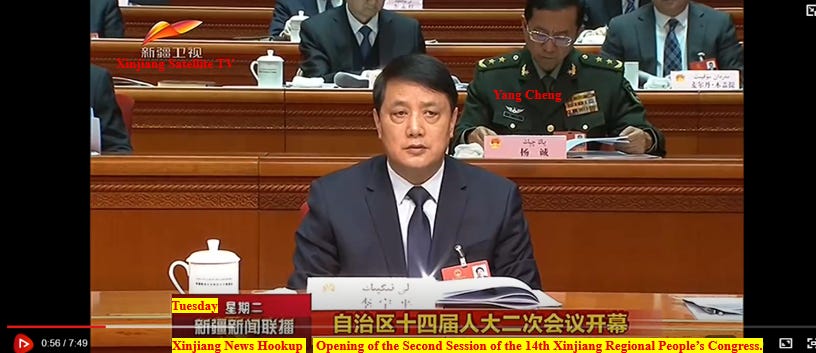
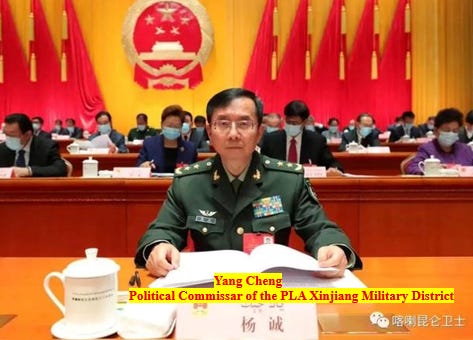
The institutional alignment between Lt. Gen. Liu Lin (柳林), Commander of the PLA Xinjiang Military Command, and Lt. Gen. Yang Cheng (杨诚), Political Commissar of the PLA Xinjiang Military Command, highlights the structural role of the military hierarchy in governing Xinjiang.
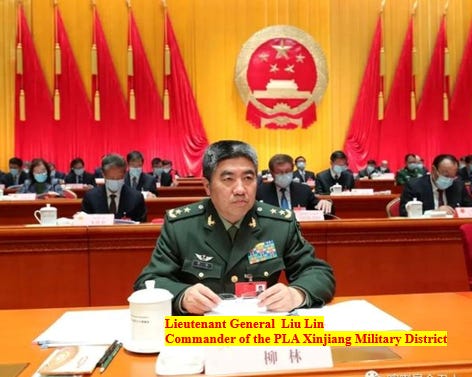
Their dual leadership combines tactical combat operations along the high-altitude western borderlands with political warfare, civil-military coordination, and internal security enforcement across the province.
  ┌────────────────────────────────────────────────────────────────────────┐
  │                   PLA XINJIANG MILITARY COMMAND                        │
  ├────────────────────────────────────────────────────────────────────────┤
  │ Commander: Lt. Gen. Liu Lin (柳林)                                     │
  │ · Former South Xinjiang Military District Commander                      │
  │ · Lead Sino-Indian Border Negotiator (Galwan Valley Crises)            │
  ├────────────────────────────────────────────────────────────────────────┤
  │ Political Commissar: Lt. Gen. Yang Cheng (杨诚)                        │
  │ · Former 73rd Group Army & CAP Deputy Political Commissar               │
  │ · Directs Military Party Oversight & Local Armed Forces Review          │
  └─────────────────────────────────┬──────────────────────────────────────┘
                                    │ (Direct Joint Command)
                                    ▼
  ┌────────────────────────────────────────────────────────────────────────┐
  │             XINJIANG PROVINCIAL ASSEMBLY & ARMED WORK GRID             │
  ├────────────────────────────────────────────────────────────────────────┤
  │ Function: Enforces Military Budget Priority, Defense Mobilization,    │
  │           and Local Civil-Military Fusion (MCF) Mandates               │
  └────────────────────────────────────────────────────────────────────────┘
Key Military Leaders of the Xinjiang Regional Garrison:
Lt. Gen. Liu Lin (柳林): Commander of the PLA Xinjiang Military Command. A seasoned operational commander who previously served as Commander of the South Xinjiang Military District and led Chinese military delegation talks during the 2020 Sino-Indian standoff at Galwan. He leverages extensive high-altitude combat experience to manage border militarization and force projection across the Tianshan and Karakoram frontiers.
Lt. Gen. Yang Cheng (杨诚): Political Commissar of the PLA Xinjiang Military Command. Having held senior political warfare roles across the former 21st Group Army, 73rd Group Army, and the Communist Armed Police (CAP), Yang conducts ideological enforcement and evaluates local party secretaries on their performance in managing local armed forces (党管武装).
Structural Functions inside Provincial Administration:
Enforcing Armed Mobilization over Local Civilian Bureaus: During regional military work conferences (议军会议), Lt. Gen. Yang Cheng explicitly evaluates municipal and regional party secretaries on their performance in defense mobilization, local militia training, and border infrastructure construction. This ensures that civilian municipal budgets across Xinjiang prioritize military logistics and garrison expansion over local social spending.
Coordinating Joint Security Capabilities: Alongside operational commanders from the Malan Nuclear Testing Base (Unit 63650), the CAP Xinjiang General Corps, and the Air Force Urumqi Base, Lt. Gen. Liu Lin and Lt. Gen. Yang Cheng maintain an integrated joint-command structure that embeds military priorities directly into regional administrative policies.
Institutionalizing Veteran & Housing Pipelines: By pressuring provincial education, human resources, and veterans affairs departments to guarantee civil service placement and housing for military families, the command structure secures civilian administrative resources to maintain troop morale along remote border outposts.
PLA Unit 63650—the Malan Nuclear Testing Base (马兰核武器基地) located near Lop Nur—functions as a strategic cornerstone within the military-industrial apparatus of Xinjiang Province.
While CCP media presents regional governance as standard provincial administration, the active integration of Unit 63650’s senior leadership into the Xinjiang Provincial Assembly (Xinjiang Provincial Soviet) and regional military work conferences (议军会议) demonstrates how strategic nuclear warfare assets directly shape local governance, land allocation, and security budgets.
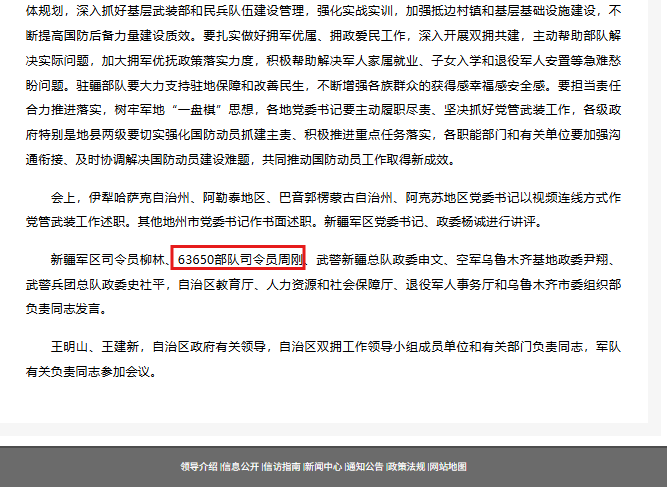
Commanded by senior officers (such as Commander Zhou Gang [周刚]), Unit 63650 operates under the direct oversight of the Strategic Support Force / Rocket Force ecosystem and the CCP Central Military Commission (CMC), while maintaining deep integration with provincial authorities:
  ┌────────────────────────────────────────────────────────────────────────┐
  │                 CCP CENTRAL MILITARY COMMISSION (CMC)                  │
  ├────────────────────────────────────────────────────────────────────────┤
  │ Direct Strategic Command over PLA Unit 63650 (Malan Nuclear Base)      │
  └─────────────────────────────────┬──────────────────────────────────────┘
                                    │ (Strategic Warfare Mandate)
                                    ▼
  ┌────────────────────────────────────────────────────────────────────────┐
  │                   PLA UNIT 63650 (LOP NUR / MALAN BASE)                │
  ├────────────────────────────────────────────────────────────────────────┤
  │ Command & Research Facility: Nuclear Testing Infrastructure, Missile   │
  │ Telemetry, High-Energy Physics, and Subcritical Testing Corridors       │
  └─────────────────────────────────┬──────────────────────────────────────┘
                                    │ (Institutional Integration)
                                    ▼
  ┌────────────────────────────────────────────────────────────────────────┐
  │     XINJIANG PROVINCIAL ASSEMBLY & REGIONAL MILITARY WORK GRID         │
  ├────────────────────────────────────────────────────────────────────────┤
  │ · Co-optation of Provincial Land, Airspace, and Water Resources        │
  │ · Securing Local Civilian Budget Allocations & Defense Infrastructure  │
  └────────────────────────────────────────────────────────────────────────┘
Core Strategic Functions of Unit 63650 in Xinjiang’s Regional Grid
Legislative Co-optation of Regional Land and Resources:
Resource Reservation: Unit 63650 commands vast restricted geographical zones across the Bayingolin Mongol Autonomous Prefecture and Lop Nur basin.
Assembly Voting Leverage: By placing the commander of Unit 63650 directly into regional military conferences alongside the PLA Xinjiang Military Command and Communist Armed Police (CAP) commissars, the military guarantees that provincial land-use policies, mining concessions, and regional water allocations defer entirely to nuclear infrastructure expansion without civilian oversight.
Dual-Use Airspace and Infrastructure Integration:
Airspace Superiority: The Malan base operates large-scale military airfields and missile tracking corridors that overlap with regional commercial flight paths across Southern Xinjiang.
Civil-Military Fusion (MCF) Supply Lines: Unit 63650 relies on Xinjiang’s civilian transportation grid—including regional high-speed rail lines and highway expansions—to transport heavy research materials, hazardous testing gear, and personnel, effectively transforming provincial infrastructure projects into strategic military supply channels.
Strategic Co-ordination with Western Theater Forces:
Integrated Defense Grid: Unit 63650 does not operate in a vacuum. Its command structure coordinates directly with Lt. Gen. Liu Lin (PLA Xinjiang Military Command) and PLAAF Urumqi Base air defense assets to maintain a hardened multi-layered security umbrella protecting China’s western strategic rear.
Internal Security Synergy: The military perimeter surrounding the Lop Nur testing grounds is secured in coordination with local CAP garrisons and XPCC (Northern/Southern) paramilitary units, ensuring absolute demographic surveillance and physical access restriction around nuclear facilities.
Conclusion
The active seat held by Unit 63650’s command in Xinjiang’s regional military assembly proves that the province is treated as a militarized garrison zone. By embedding strategic nuclear leadership into provincial governance, the CCP ensures that Xinjiang’s civilian resources, land, and budget remain fully subordinate to the requirements of the regime’s nuclear weapons infrastructure.
Ultimately, the pervasive, militarized "stability maintenance" grid across Xinjiang serves a critical dual function for the Chinese Communist Party. Beyond suppressing ethnic friction, this totalizing security architecture provides a impenetrable operational envelope for the CCP's strategic military-industrial complex. By imposing absolute physical isolation, pervasive surveillance, and restricted access under the imperative of counter-terrorism, the regime effectively insulates sensitive installations—most notably the nuclear warfare testing infrastructure of PLA Unit 63650 at Lop Nur—from international scrutiny, intelligence monitoring, and verification of international non-proliferation compliance. In the totalitarian calculus of the Central Military Commission, manufacturing and sustaining a perpetual state of local emergency directly serves to safeguard, conceal, and expand the hard nuclear and biological capabilities that underpin the regime's existential power.
In failing to look past the human rights reporting, Western strategic planners are falling into a dangerous blind spot—one that risks persisting until the Chinese Communist Party's nuclear warhead stockpile reaches tens of thousands. The totalizing "stability maintenance" grid across Xinjiang Province is not merely a localized counter-terrorism apparatus; it is a strategic cloak designed to insulate the CCP's core nuclear weapons infrastructure, centered around PLA Unit 63650, from international oversight, satellite intelligence, and treaty verification. By manufacturing a perpetual state of emergency, the Central Military Commission has secured an unmonitored sanctuary to accelerate nuclear testing and strategic warhead expansion. Unless Western powers recognize Xinjiang for what it truly is—a militarized garrison state shielding the CCP’s ultimate strategic capabilities—they will wake up to a nuclear parity shift that permanently alters global deterrence.
The financial and operational metrics from China National Uranium Co., Ltd. (CNUC) provide concrete corporate evidence that Western strategic warnings are far from alarmist. By examining the exponential growth in raw materials, inventory, and operational expenditures within CCP-controlled uranium entities operating in Xinjiang, the economic footprint directly matches the infrastructure scale required for rapid nuclear warhead breakout and sustained strategic expansion.
Key Financial & Operational Indicators (CNUC Reports)
Surging Strategic Inventory Holdings:
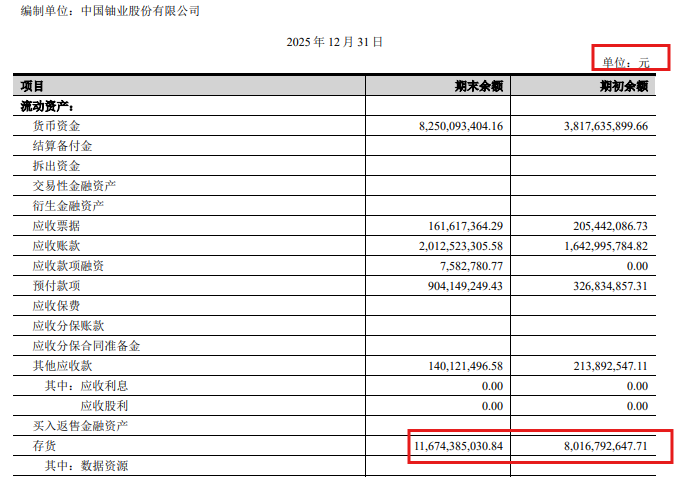
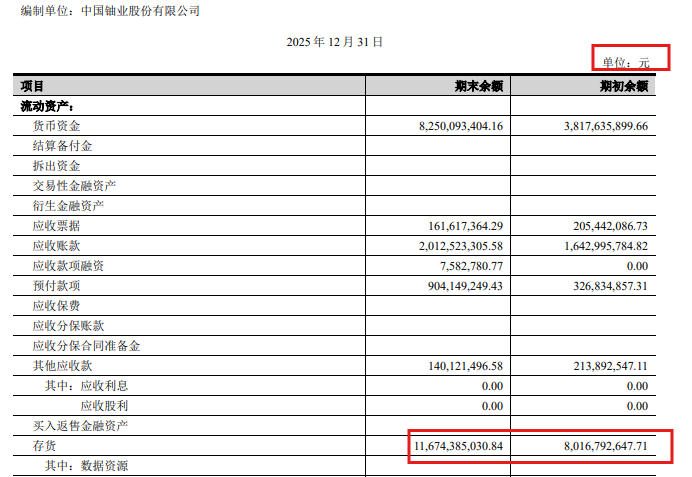
2025 Year-End Inventory: ¥11.67 Billion (RMB) (~$1.6+ Billion USD)
2024 Year-End Inventory: ¥8.02 Billion (RMB)
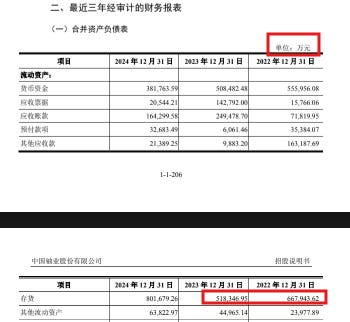
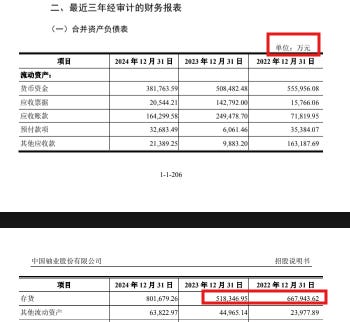
2023 Year-End Inventory: ¥5.18 Billion (RMB)
Analysis: Raw natural uranium holdings (yellowcake / $U_3O_8$) inside state coffers grew by 125% within two years. Accumulating over 11.6 billion RMB in raw nuclear inventory signals strategic stockpiling that far exceeds civil nuclear power generation baselines.
Escalating Operational Costs & Processing Capacity:
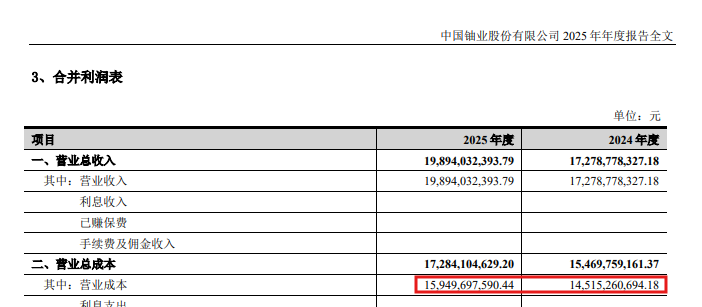
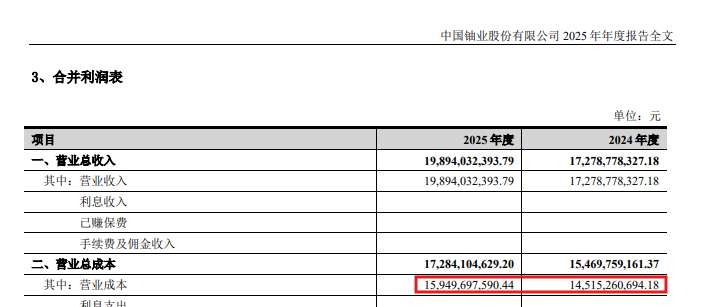
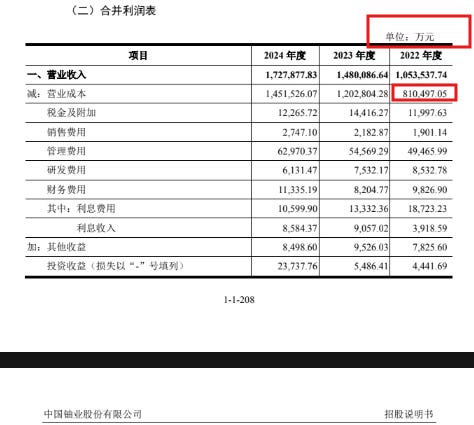
2025 Cost of Goods Sold: ¥15.95 Billion (RMB)
2024 Cost of Goods Sold: ¥14.52 Billion (RMB)
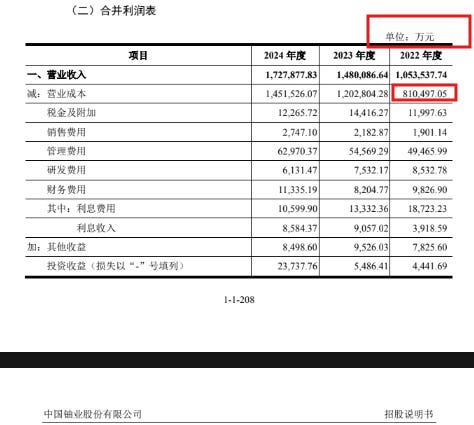
2022 Cost of Goods Sold: ¥8.10 Billion (RMB)
Analysis: Annual operating costs nearly doubled between 2022 and 2025, demonstrating massive industrial scaling up in the extraction, refining, and international trade of natural uranium ($U_3O_8$)
Explicit Dual-Use Mandate:
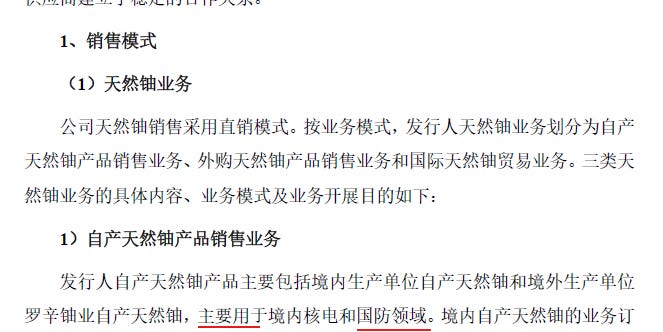
Official CNUC annual filings state directly that natural uranium products serve as the “critical material foundation for nuclear energy development, applied across civilian nuclear power and defense sectors (国防领域).”
The Xinjiang Extraction Hub: Anchored by CNNC Subsidiaries
CNUC’s official corporate structure confirms that Xinjiang Province operates as the primary domestic extraction, mining, and supply-chain hub feeding China’s nuclear defense apparatus:
Key Xinjiang Entities:
CNNC Tianshan Uranium Co., Ltd. (新疆中核天山铀业有限公司): Directs large-scale in-situ leach (ISL) natural uranium mining across Xinjiang’s northern and southern basins.
CNNC Xinjiang Mining Co., Ltd. (中核新疆矿业有限公司): Manages regional ore processing and refining facilities.
CNNC Xinjiang Supply Chain Co., Ltd. (中核新疆供应链有限公司): Coordinates heavy industrial logistics, chemical inputs, and secure transit across militarized administrative zones.
Strategic Takeaway for Western Defense Planners
The corporate disclosures of China National Uranium Co., Ltd. confirm that Xinjiang’s physical geography, raw natural resources, and CCP-backed mining enterprises are directly integrated into the CCP Central Military Commission’s strategic buildup.
When corporate inventory jumps to over 11.6 billion RMB alongside the expansion of high-altitude testing corridors under PLA Unit 63650 (Malan Base), Xinjiang’s heavy “stability maintenance” grid is shown to be a security wrapper designed to obscure the industrial-scale accumulation of nuclear warhead fissile materials from global scrutiny.
China’s Own IPO Confirms: “China National Uranium Co., Ltd.” Supplies Uranium for Nuclear Weapons
From Uranium Mines to Military Logistics: The Hidden Supply Chain


No comments:
Post a Comment