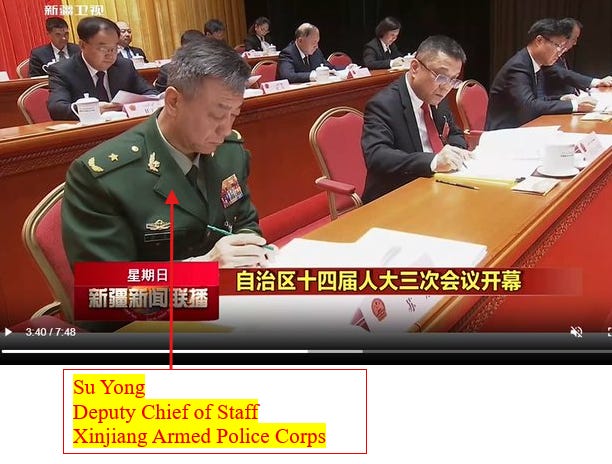
Official publications of Chinese Communist Party (CCP), the Party, identify Su Yong (苏勇) as a deputy to the Xinjiang Assembly—the regional legislature under the CCP’s political system—while serving as Deputy Chief of Staff of the Xinjiang Armed Police Corps.
An official 2018 year-end commendation published by the Xinjiang Armed Police Corps provides insight into Su Yong’s military role and the priorities of the force he helped command.
According to the official announcement, the Xinjiang Armed Police Corps spent 2018 implementing Xi Jinping Thought on Socialism with Chinese Characteristics for a New Era and Xi Jinping’s Thought on Strengthening the Military, while focusing on combat readiness, political leadership, and maintaining what it described as overall stability.
Among the individuals recognized by the Corps that year, Su Yong, then serving as Deputy Chief of Staff, was honored as an “Advanced Individual in Stability Maintenance Work” (维稳工作先进个人).
The same official list illustrates the organizational emphasis placed on “stability maintenance.” In addition to Su Yong, the Corps’ Operations and Duty Department, a mobile detachment, and other operational units were recognized as “Advanced Units in Stability Maintenance Work,” while several intelligence and special operations officers received related commendations.
The publication also highlights the Corps’ broader institutional priorities, including:
implementation of Xi Jinping’s military ideology;
combat training and counterterrorism capabilities;
intelligence and reconnaissance work;
Party political work and ideological education;
military modernization and equipment support; and
joint operational readiness.
The Xinjiang Armed Police Corps plays a central role in the CCP’s security apparatus in Xinjiang. Its responsibilities include internal security, counterterrorism operations, and what official Chinese documents describe as “stability maintenance” missions throughout the region, which are in fact suppressing of dissidents and peaceful protest.
Su Yong’s dual position—as a senior active-duty Armed Police commander and a deputy to the Xinjiang Assembly—illustrates another example of active-duty security officials simultaneously serving in China’s system of soviet. His case reflects the institutional overlap between the CCP’s security apparatus and the representative bodies established under its political system.
Official CCP documents show that Su Yong (苏勇), then Deputy Chief of Staff of the Xinjiang Armed Police Corps, was one of at least five active-duty military and paramilitary officers serving on the Presidium of the First Session of the 14th Xinjiang Assembly on January 13, 2023.
The other serving officers on the Presidium included Yang Cheng and Liu Lin, both PLA lieutenant generals, as well as Li Yifei and Xue Bin from the Xinjiang Production and Construction Corps (XPCC), a paramilitary organization under the Central Military Commission’s unified national defense system.
The Presidium directed the proceedings of the inaugural session, during which the Xinjiang Assembly adopted its Rules of Procedure, approved resolutions on the regional government’s work report, economic development plan, budget, the work reports of the standing committee, procuratorate, and courts, and elected or confirmed the leadership of the regional government, supervisory commission, courts, and procuratorate.
On January 18, 2023, the same session elected the 60 deputies representing Xinjiang to the 14th National Assembly ie Supreme Soviet (NPC). Those deputies subsequently participated in the March 2023 NPC session in Beijing, where Xi Jinping was re-elected as President of the People’s Republic of China and Chairman of the Central Military Commission.
Official records further show that the 14th Xinjiang Assembly itself included active-duty representatives from three organizations directly involved in China’s security apparatus: the People’s Liberation Army (PLA), the People’s Armed Police (PAP), and the Xinjiang Production and Construction Corps (XPCC). Consequently, the legislative decisions adopted during the inaugural session—including the election of Xinjiang’s NPC deputies—were voted on by a body that included serving military and paramilitary officers alongside civilian representatives.
Su Yong’s role therefore extended beyond serving as a senior Armed Police commander. As both a member of the Presidium and a deputy to the Xinjiang Assembly, he participated in the institutional process through which Xinjiang’s delegation to China’s national legislature was selected.


No comments:
Post a Comment