All men are created by LORD God, and are created equal by the LORD God in being endowed by the LORD God with unalienable Right of Life, Liberty and the Pursuit of Happiness equally.
Let's pray in the name of Jesus Christ for a decentralised China with no nukes, no military and no Leninist organisation. May LORD God's light shine on China. Welcome to follow CPAJim at X: https://x.com/CPAJim2021
The Dual-Hat Deception: How Military Technocrats Exploited Parliamentary Seats for Naval Warfare, Civil Entitlements, and Submarine Detection
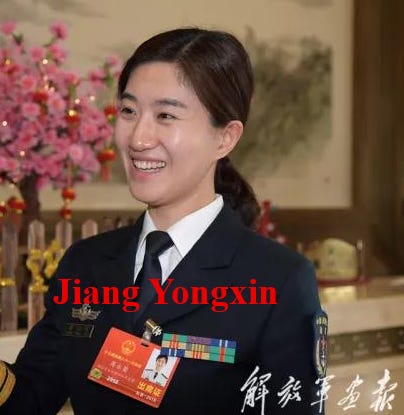
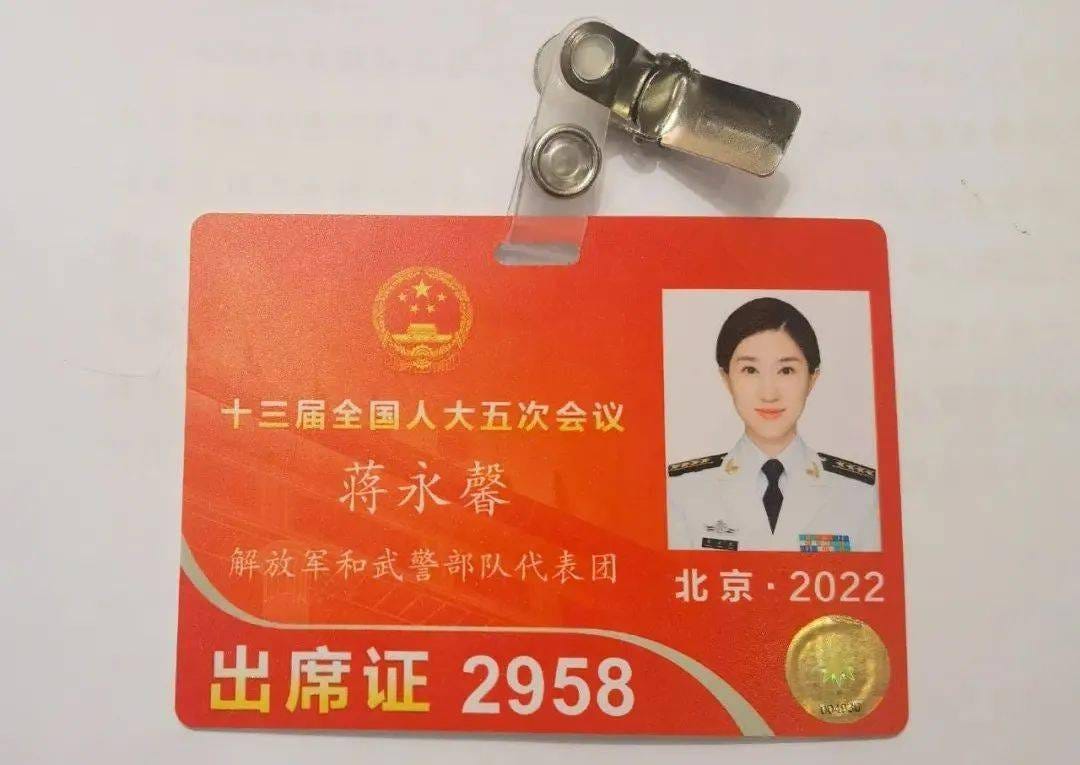
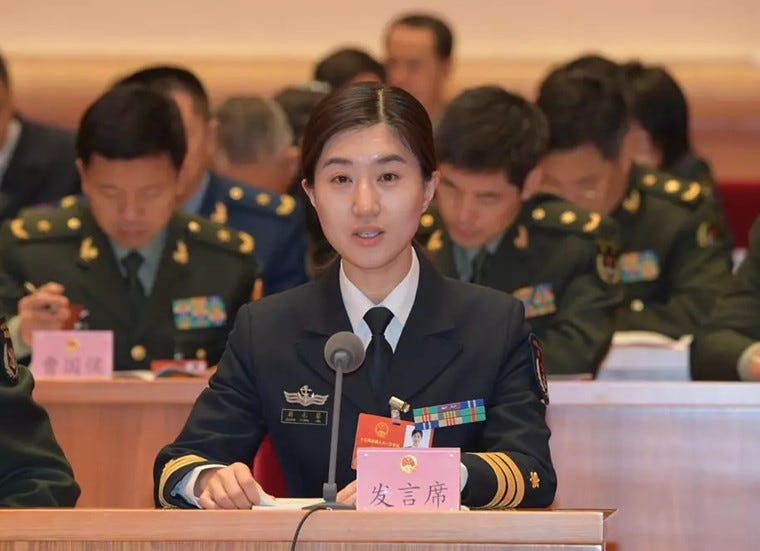
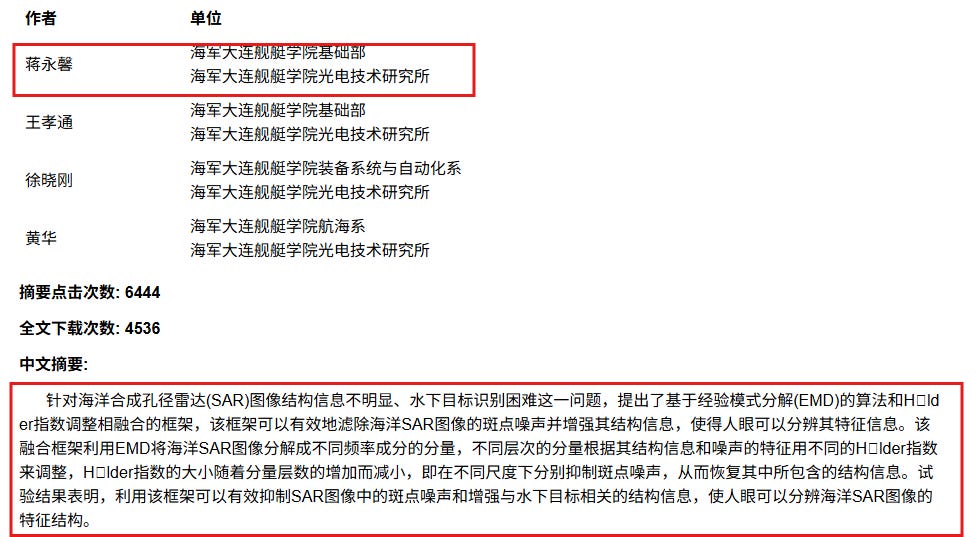
Jiang Yongxin, an Associate Professor at the PLA Naval Dalian Warship Academy and a member of its Optoelectronic Technology Research Institute of PLA Naval Dalian Warship Academy 中国人民解放军海军大连舰艇学院基础部、海军大连舰艇学院光电技术研究所副教授蒋永馨
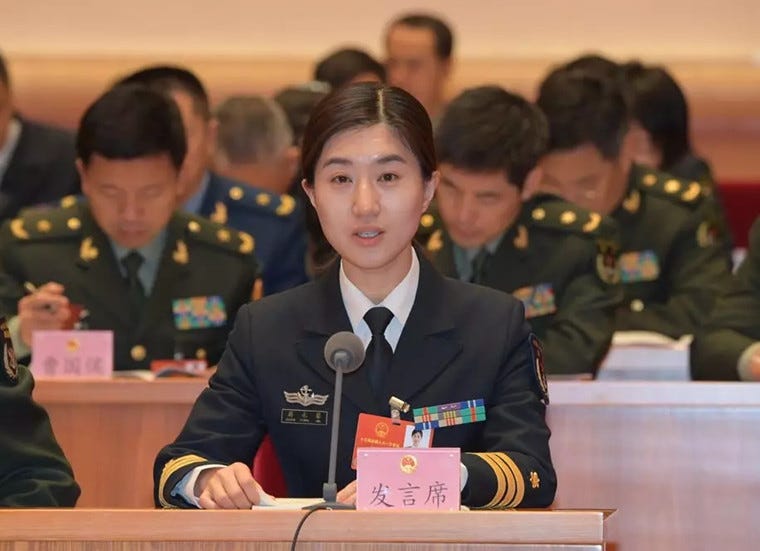
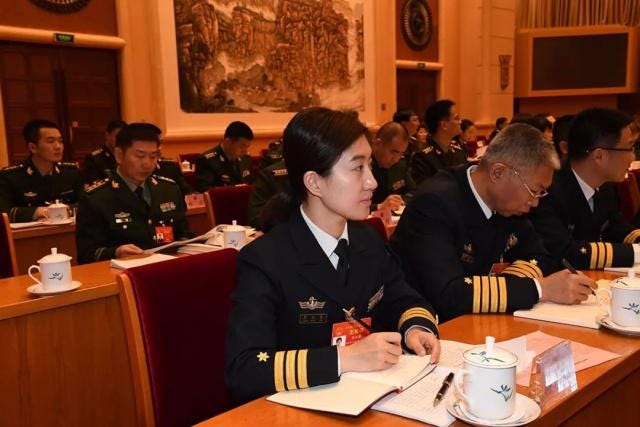
Associate Professor Jiang Yongxin(蒋永馨)—a delegate to the 13th National Soviet Assembly representing the armed forces and researcher at the PLA Naval Dalian Warship Academy’s Optoelectronic Technology Research Institute—exemplifies how the Chinese Communist Party (CCP) utilizes unelected military technocrats within its legislative framework. Sitting in an assembly insulated from civilian voters under separate military electoral statutes, Jiang leverages her dual role to lobby for civil resource reallocation to the armed forces while developing specialized optical and radar processing technologies for maritime warfare.
Legislative Priorities & Statutory Coercion
During assembly sessions, Jiang’s proposals centered on extracting legally binding civil privileges for active and retired military personnel. She advocated embedding military welfare guarantees into civilian law, establishing mandatory civil service quotas, and instituting strict legal protections under “hero and martyr” statutes to penalize civilian critique of military operations.
Naval Intelligence & Technical Application
Beyond her legislative profile, Jiang’s peer-reviewed research directly supports PLA Navy anti-submarine and surface-warfare capabilities. Her work on Ocean Synthetic Aperture Radar (SAR) image despeckling—utilizing Empirical Mode Decomposition (EMD) and Hölder exponent adjustments—specifically addresses the difficulty of identifying underwater structural features. In naval operations, processing SAR speckle noise enables the detection of subtle ocean-surface wake signatures, internal waves, and submerged hulls. Translating this research directly into cadet instruction under the PLA’s “teach for combat” mandate accelerates the deployment of high-resolution target-recognition capabilities across contested maritime domains in the Indo-Pacific.
The Chinese Communist Party routinely advertises its annual legislative session—the National Soviet Assembly of Communist China—as the ultimate venue for democratic governance. Yet, behind the official propaganda lies a stark structural truth: military officers who double as legislative delegates utilize their positions to demand legally binding civil resources for the armed forces while engineering combat technologies designed for high-intensity overseas conflict.
Consider Jiang Yongxin, a delegate to the 13th National Soviet Assembly and an associate professor at the Naval Dalian Warship Academy’s Optoelectronic Technology Research Institute. On paper, her political profile is marketed by state media as a “female rose of the military” advocating for veteran welfare and educational reform. In reality, Jiang’s career reveals a calculated combination of legislative leverage and advanced military research aimed directly at expanding maritime combat power and submarine target recognition.
During a plenary session of the armed forces and internal security delegation in March 2018, Jiang Yongxin focused her legislative proposals on extracting guaranteed civil privileges and state funding for military personnel:
Statutory Entitlements at Civil Expense: Jiang called for embedding military status and welfare protections directly into national civilian laws.
Legal Enforcement of Veteran Preferences: She advocated for the mandatory creation of a national “Veteran Priority Card” and legally binding civil service quotas.
Legislative Censorship and Ideological Protection: Jiang demanded specialized legislation to strictly define and defend “national heroes and martyrs,” creating statutory mechanisms to prosecute and silence any civilian criticism of past or present military operations.
Dual-Use Technical Realities: Synthetic Aperture Radar and Submarine Detection
State media routinely frames Jiang’s work around “astronomical navigation” and classroom pedagogy. However, her peer-reviewed technical research exposes her true role in accelerating China’s naval warfare capabilities.
In a published study co-authored with researchers from the Naval Dalian Warship Academy—titled “Despeckling of Synthetic Aperture Radar Images of the Ocean” (High Technology Letters, 2009)—Jiang and her team focused on a fundamental problem in modern naval intelligence: processing Ocean Synthetic Aperture Radar (SAR) imagery to detect subtle underwater features.
+-----------------------------------------------------------------------------------+
|               TECHNICAL FOCUS: SAR IMAGE DESPECKLING FOR SUB-SURFACE TARGETS      |
+-----------------------------------------------------------------------------------+
| Core Technical    | Eliminating speckle noise in Ocean Synthetic Aperture Radar   |
| Challenge         | (SAR) imagery caused by sea surface roughness.                |
+-------------------+---------------------------------------------------------------+
| Methodological    | Combining Empirical Mode Decomposition (EMD) with Hölder      |
| Innovation        | exponent adjustments across multiple frequency components.    |
+-------------------+---------------------------------------------------------------+
| Military / Naval  | Enhances human and automated visual identification of subtle  |
| Application       | structural features associated with underwater targets         |
|                   | (e.g., submarine wakes, internal waves, submerged hulls).     |
+-----------------------------------------------------------------------------------+
Synthetic Aperture Radar satellite imagery is critical for detecting submerged submarines and naval vessels by capturing ocean surface disturbances, internal wave signatures, and turbulent wakes. By developing noise-filtering algorithms to expose hidden structural features, Jiang’s research directly enhances the PLA Navy’s capability to track surface ships and detect submerged targets in contested waters across the Western Pacific and the South China Sea
The “Teach for Combat” Mandate: Integrating Technical Research into Maritime Warfare
During her term as a delegate, Jiang explicitly connected her academic work to the Central Military Commission’s push for “real-combat readiness.” In public statements and CCTV interviews during assembly sessions from 2019 to 2022, she declared:
“Teach What Is Fought in War”: Demanding that military academies restructure their curricula to align with real-time operational requirements, turning classrooms into testing grounds for modern maritime combat.
Rapid Technology Integration: Translating advanced technical projects—including over 20 military and National Natural Science Foundation research grants—directly into frontline naval training modules.
Focusing on “New-Type” Combat Forces: Aligning educational models with the rapid deployment of advanced naval platforms, ensuring that cadet officers are trained specifically to operate under complex, contested sea conditions.
The Closed-Loop Structural Paradox
The political ascension of technocratic military delegates like Jiang Yongxin highlights the systemic fraud of Communist China’s legislative system:
Exclusion of the Public: Under the Electoral Law for the National Soviet Assembly and Local Soviet Assemblies (2020 Revision), elections for the armed forces are conducted separately under internal military rules (Electoral Measures for the Chinese People’s Liberation Army). Civilian voters have no legal mechanism to vote for, question, or recall military delegates.
Self-Serving Resource Allocation: As an unelected military delegate, Jiang uses her legislative platform to demand that civilian budgets guarantee military perks and pensions, while ensuring that naval research remains completely insulated from civilian oversight.
A Facade for Military Expansion: State media leverages Jiang’s profile to project a soft image of “female military scholars,” masking the reality of an assembly delegate whose primary scientific output serves to enhance naval target recognition and prepare for high-intensity sea battles against democratic nations.
The Dual-Hat Deception: How Military Technocrats Exploited Parliamentary Seats for Naval Warfare, Civil Entitlements, and Submarine Detection by CPA Jim





No comments:
Post a Comment