


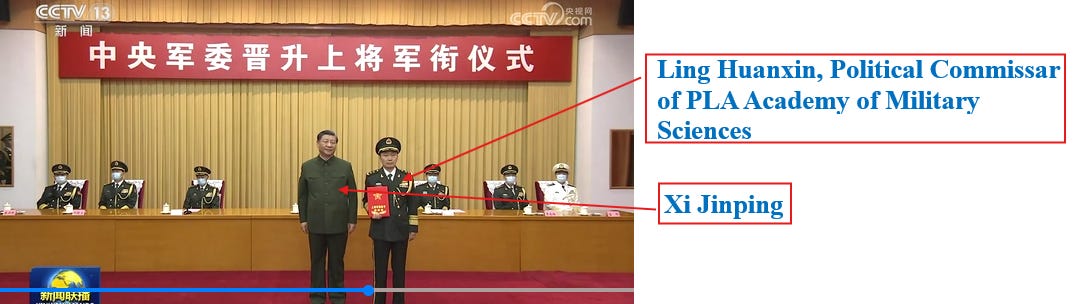
On June 28, 2023, CCP Central Military Commission (CMC) Chairman Xi Jinping elevated Ling Huanxin (凌焕新) to the rank of full General (上将) at the Bayi Building in Beijing, appointing him as Political Commissioner of the PLA Academy of Military Sciences (AMS).
This official ceremony—attended by CMC Vice Chairmen Zhang Youxia and He Weidong, alongside CMC members Li Shangfu, Liu Zhenli, Miao Hua, and Zhang Shengmin—marks a major elevation in the political enforcement apparatus governing the regime's military research sector. The Strategic Significance of AMS and the Academy of Military Medical Sciences (AMMS) As Political Commissioner of the PLA Academy of Military Sciences (AMS), General Ling Huanxin exercises top-tier political control over the military’s primary strategic warfare and technology research centers. Crucially, the AMS operational ecosystem includes the PLA Academy of Military Medical Sciences (AMMS)—the premier military medical research institution widely scrutinized by international intelligence communities for its biological warfare research, gain-of-function experiments, and direct ties to Wuhan Institute of Virology. Prior to his appointment at AMS, Ling served as a full corps-grade full-time commissioner of the CMC Commission for Discipline Inspection and later its Deputy Secretary. His career trajectory demonstrates the Central Military Commission's strategy: deploying seasoned political enforcement officers to oversee biological research, military technology, and internal ideological security. Institutional Immunities and Judicial Subordination Ling Huanxin’s career highlights the complete exemption of PLA military research from civilian oversight: Dual Role as Active-Duty Military NPC Delegate: Serving as an active-duty military NPC delegate, Ling participated in the unanimous 2018 parliamentary vote securing Xi Jinping's indefinite tenure, explicitly tying legislative mechanics to the absolute enforcement of the CMC Chairman Responsibility System.
An analysis of General Ling Huanxin (凌焕新)—Delegate to the 20th CCP National Congress, Delegate to the 13th National People’s Congress (NPC), Political Commissioner of the PLA Academy of Military Sciences, and former Deputy Secretary of the Discipline Inspection Commission of CCP Central Military Commission (CMC) —exposes the career path of a senior political officer elevated to enforce Party discipline, political compliance, and institutional loyalty across the armed forces.
                  CCP CENTRAL MILITARY COMMISSION (CMC)
                    (Absolute Command & Party Discipline)
                                   |
         +-------------------------+-------------------------+
         |                                                   |
         v                                                   v
[1. Internal Enforcement & Auditing]         [2. Military Science & R&D Control]
Ling Huanxin: Deputy Secretary, CMC          Ling Huanxin: General & Political Commissioner,
Commission for Discipline Inspection (2018–2023)  Academy of Military Sciences (2023–Present)
- Enforcing internal political purging        - Overseeing military research, biodefense R&D,
- Screening senior military personnel          and strategic warfare doctrines
         |                                                   |
         +-------------------------+-------------------------+
                                   |
                                   v
             [3. Legislative Immunity & Judicial Subordination]
             - Exercise of NPC delegate voting power under CMC direction
             - Total protection of CMC internal discipline & R&D from civilian courts
Career Elevation and Operational Background
Born in March 1962 in Jingjiang, Jiangsu Province, Ling Huanxin built his career entirely within the political officer and internal discipline systems of the armed forces:
General Political Department Tiers: Served as Deputy Director of the Organization Department within the former PLA General Political Department, overseeing cadres’ political vetting and institutional party alignment.
Northern Theater Command: Appointed Director of the Political Work Department of the PLA Northern Theater Command Army in January 2016 following the structural military reforms.
CMC Discipline Inspection Role: Promoted to Full Corps-Grade Special Commissioner of the Discipline Inspection Commission of CCP CMC in March 2017. Elevated to Deputy Secretary of Discipline Inspection Commission of CCP CMC in December 2018, placing him at the center of internal ideological purges, anti-graft enforcement, and political surveillance over senior flag officers.
Academy of Military Sciences Command: Appointed Political Commissioner of the PLA Academy of Military Sciences (Theater-Command Grade) in June 2023, assuming top political leadership over the regime’s premier military research, biological defense, and strategic doctrine establishment.
Rank Advancement: Promoted to Lieutenant General in December 2019, and elevated to full General on June 28, 2023.
Institutional Oversight and Control Mechanisms Over Military Research and Development
Ling Huanxin’s appointment as Political Commissioner of the PLA Academy of Military Sciences (AMS) in June 2023 reflects the Central Military Commission’s (CMC) structural mechanism for embedding party-military oversight directly into advanced defense R&D and strategic force planning:
Institutional Alignment of Advanced R&D: The Academy of Military Sciences serves as the premier hub for strategic doctrine, artificial intelligence applications, bio-weapon research, and Military-Civil Fusion (MCF) technology integration. As Political Commissioner, Ling’s core administrative function is to align scientific research projects, laboratory funding, and technology acquisition directly with CMC strategic priorities and PLA operational requirements.
Cadre Security, Vetting, and Information Isolation: Utilizing his background as Deputy Secretary of the CMC Commission for Discipline Inspection, Ling enforces institutional personnel security, counter-intelligence protocols, and strict secrecy classification across high-value military research units. This administrative oversight serves to prevent unauthorized disclosures, enforce strict compartmentalization of dual-use research programs, and maintain institutional compliance across all scientific departments.
Unanimous Parliamentary Ratification and Political Enforcement: General Ling Huanxin’s Role in Securing Unlimited Executive Power
An analysis of the March 17, 2018 plenary vote during the 1st Session of the 13th National People’s Congress (NPC)—where CCP Central Military Commission (CMC) Chairman Xi Jinping was unanimously re-elected as President of the PRC and Chairman of the State Central Military Commission—demonstrates how senior military political officers function within the parliamentary system.
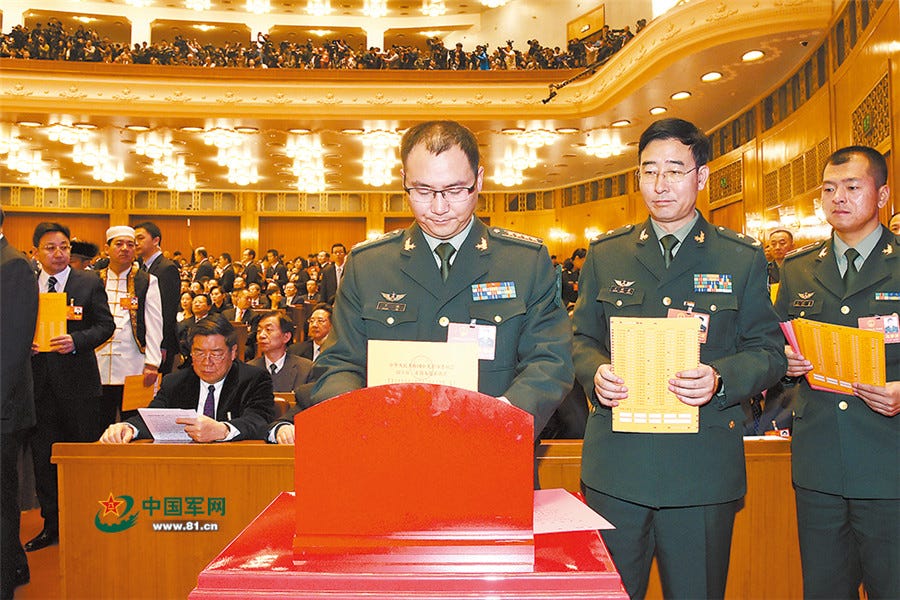
The official record confirms that General Ling Huanxin (凌焕新), serving as an active-duty PLA officer NPC delegate while holding the post of Full Corps-Grade Special Commissioner of CCP CMC’s Discipline Inspection Commission, cast his ballot to solidify Xi’s indefinite tenure, explicitly tying the legislative vote to the absolute enforcement of the CMC Chairman Responsibility System (军委主席负责制).
               CCP CENTRAL MILITARY COMMISSION (CMC)
              (Absolute Command & Internal Surveillance)
                               |
         +---------------------+---------------------+
         |                                           |
         v                                           v
[1. Legislative Ratification]                 [2. Internal Political Purging]
Ling Huanxin: Delegate, 13th NPC              Ling Huanxin: Commissioner & Deputy Secretary,
- Cast ballot for unanimous presidential       CMC Commission for Discipline Inspection
  re-election (March 17, 2018)                - Weaponizing internal discipline to enforce
- Publicly mandated absolute obedience         complete political submission
  to the CMC Chairman Responsibility System   - Eliminating internal opposition and residual
                                               factions ("purging Guo/Xu influences")
         |                                           |
         +---------------------+---------------------+
                               |
                               v
      [3. Subordinated Judicial Apparatus & Immunity]
      - Complete shielding of military personnel from civilian courts
      - Exemption of military discipline & purges from civilian legal oversight
Unanimous Voting and the Weaponization of the “CMC Chairman Responsibility System”
Following the unanimous 2,970-vote approval, Ling Huanxin publicly articulated the operational directive expected of the armed forces delegation. Ling declared that “maintaining the core and obeying command” fundamentally requires resolutely maintaining and implementing the CMC Chairman Responsibility System at all times and under all circumstances.
Ling’s public statements as a national legislator reveal the true function of military delegates:
Eliminating Legislative Independence: Rather than exercising independent legislative oversight or representing civilian constituencies, military delegates like Ling operate under strict military discipline, delivering 100% voting alignment to validate CMC decrees and constitutional modifications.
Linking Parliamentary Votes to Internal Purges: Ling explicitly connected the legislative endorsement to the requirement to “comprehensively and thoroughly purge the fluid poison of Guo Boxiong and Xu Caihou” . This logic weaponizes parliamentary proceedings as an extension of internal military purges, signaling that any deviation from absolute loyalty to the CMC Chairman will be treated as an infraction subject to disciplinary liquidation.
Institutionalizing Personal Loyalty: By declaring a “new political stance”, Ling established that obedience to the individual holding the CMC chairmanship overrides all statutory laws, state regulations, or administrative procedures.
An analysis of the voting procedure during the 6th Plenary Session of the 1st Session of the 13th National People’s Congress (March 18, 2018) exposes how active-duty military NPC delegates operate within the State hierarchy.
                      CCP CENTRAL MILITARY COMMISSION (CMC)
                         (Xi Jinping - CMC Chairman)
                                      |
         +----------------------------+----------------------------+
         |                                                         |
         v                                                         v
[1. Unanimous Confirmation of State CMC]          [2. Subordination of Judiciary]
Active-duty military NPC delegates vote           Active-duty military NPC delegates vote
to confirm Vice Chairmen & Members of             to elect Presidents/Procurators-General of:
State CMC per Xi Jinping's nominations            - SUPREME COURT (SPC) (Zhou Qiang)
- Xu Qiliang, Zhang Youxia (Vice Chairmen)        - SUPREME PROCURATORATE (SPP) (Zhang Jun)
- Wei Fenghe, Li Zuocheng, Miao Hua, Zhang Shengmin               |
         |                                                        v
         +--------------------------------------------------------+
                                      |
                                      v
            [3. Absolute Immunity from Civilian Judicial Jurisdiction]
            - SUPREME COURT (SPC) & SUPREME PROCURATORATE (SPP) remain
              constitutionally created by and subordinated to the NPC
            - Complete structural exemption of PLA operations, personnel,
              and CMC directives from civilian legal oversight
Institutional Analysis of the March 18, 2018 Plenary Votes
The official proceedings document that active-duty military NPC delegates in attendance cast ballots across six color-coded voting sheets to confirm state leadership candidates nominated directly by CCP Central Military Commission (CMC) Chairman Xi Jinping:
The PLA and Armed Police delegation voted to endorse Xi Jinping’s nomination of Li Keqiang as China’s state council prime minister.
Ratification of State Military Leadership: The PLA and Armed Police delegation voted to endorse Xi Jinping’s nominations for the State Central Military Commission, formally installing Xu Qiliang and Zhang Youxia as Vice Chairmen, alongside Wei Fenghe, Li Zuocheng, Miao Hua, and Zhang Shengmin as Commission Members. This voting block functions to convert CCP military command decisions into formal state designations.
Subordination of the National Judicial Apparatus: The military delegation participated directly in electing Zhou Qiang as President of the SUPREME COURT (SPC) and Zhang Jun as Procurator-General of the SUPREME PROCURATORATE (SPP).
Constitutional Suppression of Civilian Courts
Partly because the SUPREME COURT (SPC) and SUPREME PROCURATORATE (SPP) are constitutionally created by and subordinated to the NPC under Articles 62 and 67 of the PRC Constitution—which are made or decided by the CCP Central Military Commission (CMC) through the PLA delegation and through all non-PLA delegations (which are approved by PLA’s Provincial Congress delegates)—and the military delegation commands critical political weight within the NPC under CMC direction, all strategic missile R&D activities, internal military discipline enforcement, military medical research programs, and military personnel remain structurally exempt from civilian judicial oversight or legal challenge.
Consequently, internal political vetting, disciplinary detentions, and command purges overseen by officers like Ling Huanxin inside the CMC Commission for Discipline Inspection and the Academy of Military Sciences operate within a completely insulated legal ecosystem. Neither civilian courts under the SUPREME COURT (SPC) nor civilian prosecutors under the SUPREME PROCURATORATE (SPP) possess the constitutional jurisdiction or statutory standing to review, audit, or challenge military discipline enforced under the banner of the CMC Chairman Responsibility System.
No comments:
Post a Comment