Abstract
International Standards on Auditing—specifically ISA 315 (Identifying and Assessing the Risks of Material Misstatement)—and their domestic equivalents rely on the core assumption that auditors can objectively evaluate “the entity and its environment.” This paper argues that this foundational methodology fails when applied to corporate entities operating within mainland China. By treating environmental scanning, regulatory context, and internal control environments as neutral administrative variables, conventional audit models systematically overlook structural state penetration, military-legislative overlap, and emergency mobilization mechanics. Furthermore, domestic audit firms operating within China suffer from systemic independence impairment: embedded within the very socio-political apparatus they are tasked with evaluating, these firms operate under institutional coercion, ideological alignment, and statutory constraints that make impartial environment-level risk identification legally and practically impossible.
I. Introduction: The False Neutrality of ISA 315 and AU-C 315
Under standard international financial auditing frameworks, ISA 315 (and US PCAOB / AICPA equivalents) requires auditors to obtain a comprehensive understanding of the entity’s environment, including relevant industry, regulatory, and external factors, as well as the entity’s selection and application of accounting policies, objectives, strategies, and related business risks.
Conventional ISA 315 Audit Risk Model
[ Audit Risk = Inherent Risk × Control Risk × Detection Risk ]

    Inherent Risk (Assumed Isolated)   <--->   Control Risk (Corporate Governance)
                 │                                        │
                 └──────────────────┬─────────────────────┘
                                    ▼
                 Assumed Independent External Environment
             (Regulatory, Macroeconomic, Legal Frameworks)
In mature market economies, this framework presupposes a formal boundary between the corporate entity, civil regulatory bodies, and the national defense apparatus. When applied to enterprises operating in mainland China—whether state-owned enterprises (SOEs), private domestic firms, or foreign-invested enterprises (FIEs)—this epistemological model collapses.
The external environment in China is defined by a party-state-military continuum that directly penetrates corporate governance, local legislative bodies, and judicial enforcement. Conventional auditing standards lack the qualitative tools to evaluate these macro-environmental dynamics as inherent risk factors, treating them instead as passive background context.
II. Methodological Blind Spots in Evaluating “The Entity’s Environment”
The structural failure of standard audit risk models in China manifests across three critical dimensions of environmental and internal control assessment:
1. Misinterpretation of Internal Control Components (COSO Framework)
The COSO Internal Control—Integrated Framework, which underpins global auditing standards, emphasizes the “Control Environment” as the foundation of internal control. Under ISA 315, auditors evaluate management’s philosophy, organizational structure, and assignment of authority.
In China, corporate bylaws are legally mandated to incorporate Party committees directly into executive governance structure. Party committees hold explicit oversight over executive appointments, major capital allocation, and strategic operational direction. Standard audit practice treats Party governance either as a superficial compliance box or ignores it entirely during control risk scoring. In reality, this duality invalidates conventional assumptions regarding board independence, fiduciary duty, and management integrity, creating unquantified operational and asset-appropriation risks.
Actual Sub-National Control Matrix in Mainland China

+-------------------------------------------------------------------------+
|                  Party-State & Military Governance Structure            |
|   [ Central Military Commission / Theater Commands / MUCD Units ]        |
|                                     │                                   |
|                                     ▼                                   |
|   [ Local Legislative Presidiums / Emergency Secrecy Rules ]            |
+-------------------------------------------------------------------------+
                                      │
                                      ▼
+-------------------------------------------------------------------------+
|                    Enterprise Entity Level                              |
|   [ Party Committee Oversight ] <---> [ Executive Board / Management ]  |
|                                     │                                   |
|                                     ▼                                   |
|   [ Dual-Use Technology / Local Subsidies / Asset Allocations ]        |
+-------------------------------------------------------------------------+
2. Failure to Audit Sub-National Secrecy and Defense Mobilization Rules
Conventional audit methodologies restrict regulatory risk evaluations to industry-specific laws, tax regulations, and accounting standards. They systematically fail to evaluate sub-national statutory provisions—such as municipal legislative rules permitting closed-door (secret) legislative sessions, local national defense mobilization mandates, and cross-border data transfer restrictions.
Consequently, financial statements audited under standard frameworks fail to disclose material contingent liabilities, including:
Asset Expropriation & Dual-Use Conversion: The risk that enterprise technology, physical infrastructure, or cash reserves could be redirected under emergency mobilization directives passed behind closed doors.
Unenforceable Contractual Rights: The reality that judicial and administrative remedies available to foreign joint venture partners or global investors are subordinate to local party-state security priorities.
3. Misclassification of Related-Party Transactions and Government Subsidies
ISA 550 (Related Parties) directs auditors to identify transactions with entities under common control. In mainland China, sub-national municipal governments, municipal legislative presidiums (populated in part by military flag officers), and state-directed venture capital funds operate as an interconnected network.
Standard audits routinely classify municipal land grants, fiscal rebates, and research subsidies as standard arms-length government transactions. In practice, these capital flows represent state-directed industrial interventions that carry unstated regulatory, national security, and geopolitical exposure.
III. Structural Impairment of Auditor Independence for Domestic China-Based Audit Firms
The most severe breakdown in the audit chain occurs at the level of the auditing firm itself. Under standard international independence codes (e.g., the IESBA Code of Ethics), auditors must maintain independence in mind and appearance. For China's domestic accounting firms registered in mainland China (including the local joint-venture member firms of the global Big Four networks), independence in evaluating state-linked environment risk is structurally impossible.
+-------------------------------------------------------------------------+
|              Institutional Constraints on Domestic Audit Firms          |
+-------------------------------------------------------------------------+
|  [ Political & Legal Directives ]                                       |
|   ├── National Security Law & Anti-Espionage Law Compliance             |
|   ├── Prohibition of Cross-Border Workpaper Transmital                  |
|   └── Mandatory Party Cell Integration within Audit Firm Management      |
+-------------------------------------------------------------------------+
                                      │
                                      ▼
+-------------------------------------------------------------------------+
|                      Resulting Systemic Blind Spot                      |
|   Auditor treats state penetration, military involvement, and           |
|   statutory secrecy as "Normal Administrative Baseline"                 |
|                                     │                                   |
|                                     ▼                                   |
|   Financial Statements Issued with Clean / Unqualified Audit Opinions    |
+-------------------------------------------------------------------------+
1. Legal and Regulatory Coercion
Domestic audit firms operates under comprehensive state supervision governed by national security legislation, including the State Secrets Law, the Data Security Law, and the Anti-Espionage Law. Domestic auditors face criminal prosecution if they disclose or document operational details, state subsidies, or dual-use technological applications deemed sensitive by the government.
When an auditing firm is legally barred from documenting or reporting environmental risks that touch upon state security, military involvement, or local government liabilities, the audit process becomes an instrument of state compliance rather than an independent verification of financial truth.
2. Ideological Alignment and Institutional Capture
Domestic accounting firms are structurally embedded in the host political system. Key audit partners often hold concurrent appointments in local legislative assemblies, political consultative bodies, or state-run accounting associations.
This creates a severe self-interest and familiarity threat under international ethics codes:
Systemic Under-Reporting: Audit teams cannot independently critique environmental factors (e.g., military delegates in local legislative presidiums or statutory secrecy provisions) because doing so would challenge the legal and political legitimacy of the governance system in which the audit firm itself holds a stake.
Normalization of Structural Risk: Risks that an international investor would consider catastrophic—such as arbitrary regulatory intervention or uncompensated asset re-allocation—are treated by domestic auditors as a normal, unquantifiable baseline of doing business, leading to their complete omission from audit working papers and risk logs.
Strategic Assessment: KPMG’s Global Network Integration with Communist China and Chinese Communist military force
·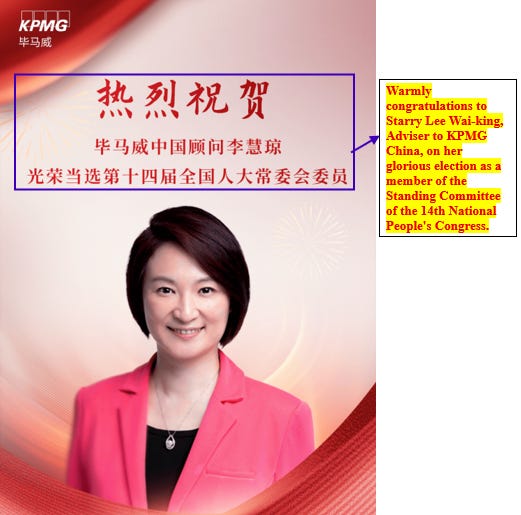
A granular analysis of KPMG’s official corporate operations, paired with structural evidence from Communist China’s legislative and military apparatus, reveals a systematic operational alignment between one of the world’s primary “Big Four” accounting networks and the strategic imperatives of the Chinese Communist Party (CCP).
IV. Implications for International Capital and Global Audit Regulators
The reliance of global capital markets, international regulatory bodies (such as the US PCAOB), and multinational corporations on standard audit reports issued out of mainland China presents systemic liabilities:
Systemic Mispricing of Capital Risk: Financial statements endorsed with unqualified (”clean”) audit opinions systematically misrepresent the risk profile of Chinese issuers and foreign subsidiaries, misleading international investors regarding asset security, governance integrity, and regulatory compliance.
Regulatory Counter-Compliance: Global firms relying on Chinese audit workpapers risk violating extraterritorial compliance frameworks—including export control regimes, anti-money laundering (AML) directives, and sanctions enforcement—because domestic auditors are legally constrained from disclosing underlying state and military linkages.
The Invalidation of the Audit Assertion Framework: Financial statement assertions regarding Existence, Rights and Obligations, and Completeness lose their foundational validity when the external legal and regulatory environment permits unilateral state intervention or retroactive secrecy.
V. Conclusion: Beyond the Illusion of Standardized Risk Assessment
The conventional accounting model for evaluating “the entity and its environment” under ISA 315 relies on assumptions of institutional independence, regulatory transparency, and auditor autonomy that do not exist in mainland China.
So long as international standards treat macro-environmental governance in China as a standard administrative background, and so long as audit opinions are rendered by domestic firms operating under state capture and strict statutory coercion, financial audits conducted in mainland China will remain fundamentally flawed. Evaluating enterprise risk in this environment requires abandoning legacy accounting models in favor of rigorous, multi-disciplinary frameworks that incorporate structural political economy, statutory secrecy analysis, and deep state-penetration metrics.


No comments:
Post a Comment