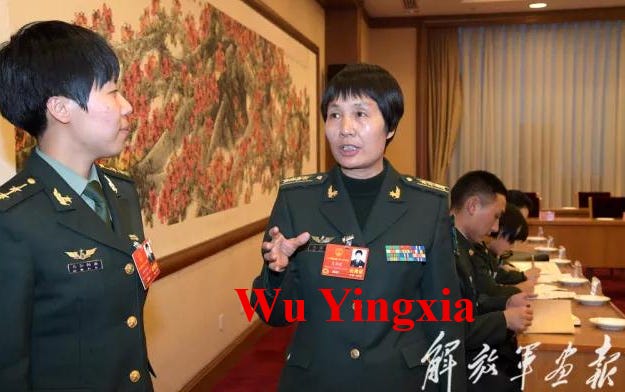
Academic research published by engineers at the PLA China Huayin Ordnance Test Center reveals how the Chinese Communist Party (CCP) armed forces refine mathematical models, simulation verification algorithms, and live-fire missile evaluation parameters.
Led by Senior Engineer Wu Yingxia—a delegate to the 13th National Soviet Assembly of Communist China—this research directly supports the precision verification of guided weaponry, missile testing, and live-fire hit accuracy without relying on costly multi-sample live missile launches.
Institutional Background and Soviet Assembly Delegate Representation
The primary entities, specialized key laboratories, and military personnel involved in this research include:
China Huayin Ordnance Test Center (中国华阴兵器试验中心): Operating under the cover designation PLA Unit 63870, this facility is the primary conventional weapons testing and evaluation base for the armed forces of the Chinese Communist Party, specializing in ground artillery, tank guns, missile systems, and precision-guided munitions.
Key Laboratory of Guided Weapons Test and Evaluation Simulation Technology: A specialized military defense laboratory embedded within the Huayin center, tasked with developing high-fidelity virtual simulation environments to evaluate guided missile trajectories, target acquisition systems, and warhead performance.
Wu Yingxia (吴颖霞): Senior Engineer at the Huayin center and elected delegate to the 13th National Soviet Assembly of Communist China representing the armed forces delegation. Her political status inside the national assembly underscores how technical military engineers are integrated directly into state legislative assemblies to champion defense research funding, military-civil fusion, and missile testing infrastructure.
Cooperating Defense Entities: Co-authors across these studies include researchers from Northwestern Polytechnical University (School of Astronautics) and the Xi’an Modern Control Technology Institute (China North Industries Group Corporation / NORINCO 203 Institute), a major missile design research unit.
Technical Focus: Enhancing Simulation Fidelity for Guided Weaponry
The research papers co-authored by Wu Yingxia and Ning Xiaolei focus on solving critical bottlenecks in simulation model validation during guided weapon testing and missile certification:
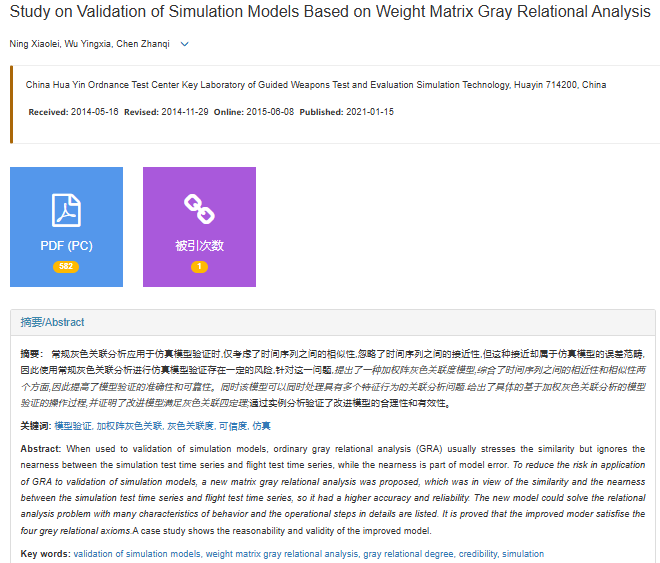
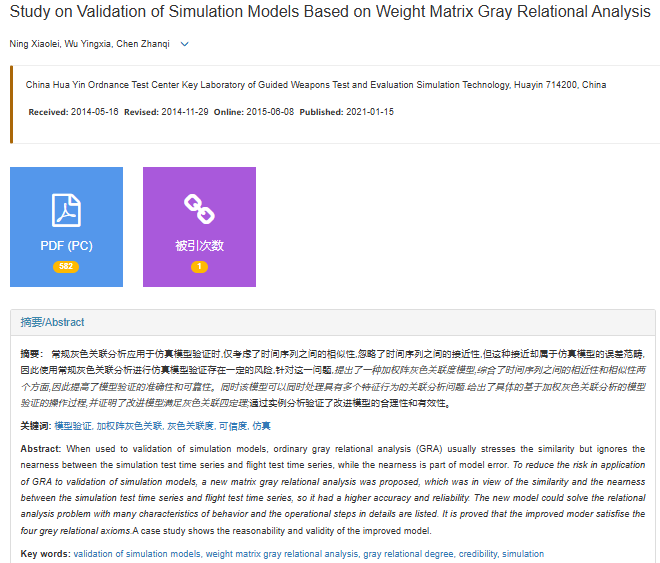
Weight Matrix Gray Relational Analysis (2015): Published in the Journal of Capital Normal University, this study addresses flaws in standard gray relational analysis used in simulation validation. Traditional models only evaluate similarity in time-series trends while ignoring absolute proximity—a critical gap that conceals trajectory errors in missile target-tracking simulations. The researchers formulated a weighted matrix gray relational model that integrates both proximity and trend similarity across multi-variable data, establishing higher precision in verifying missile flight software against real-world test parameters.
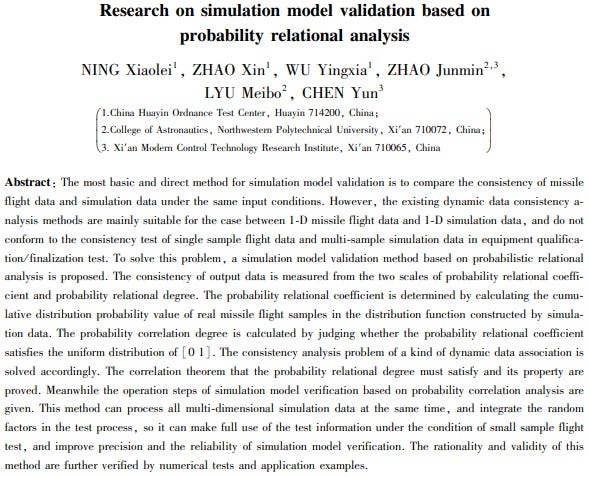
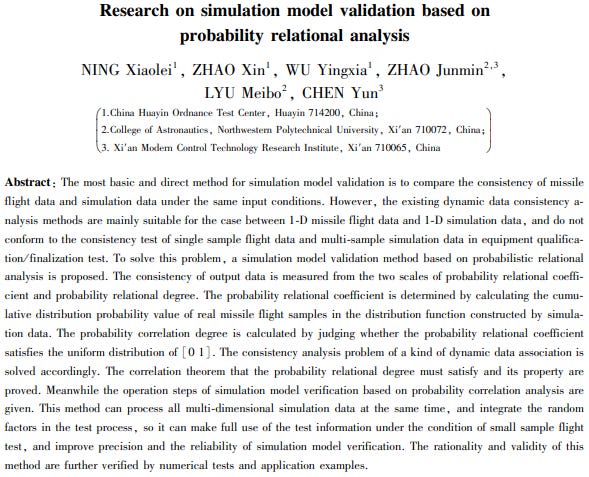
Probability Relational Analysis for Single Live-Fire Tests (2021): Published in military simulation journals alongside missile developers from NORINCO, this research tackles a persistent bottleneck in weapon certification: comparing a single live-fire missile launch sample against multi-sample computer simulations. The researchers introduced cumulative probability distribution metrics to calculate probability relational coefficients, enabling military engineers to validate complex simulation models under “small sample” live-fire conditions while integrating stochastic operational variables.
Strategic Implications for Missile Evaluation and Military Readiness
The integration of advanced mathematical verification models into guided weapon testing serves clear strategic objectives for the armed forces of the Chinese Communist Party:
Accelerated Missile Certification Cycles: By increasing the mathematical accuracy of simulation models, the Huayin test center reduces the total number of expensive live-fire missile launches required to certify new guided artillery and missile variants for operational deployment.
Seamless Military-Industrial Integration: Direct collaboration between PLA Unit 63870, academic aerospace programs (Northwestern Polytechnical University), and state missile institutes (NORINCO 203 Institute) ensures that simulation algorithms developed in military labs are applied directly to state missile production lines.
Legislative Advocacy for Military Science: The dual status of senior engineers as military researchers and delegates to the National Soviet Assembly of Communist China ensures that precision-guided munition testing, simulation infrastructure, and defense research budgets remain prioritized at the highest levels of party-state governance.


No comments:
Post a Comment